

























































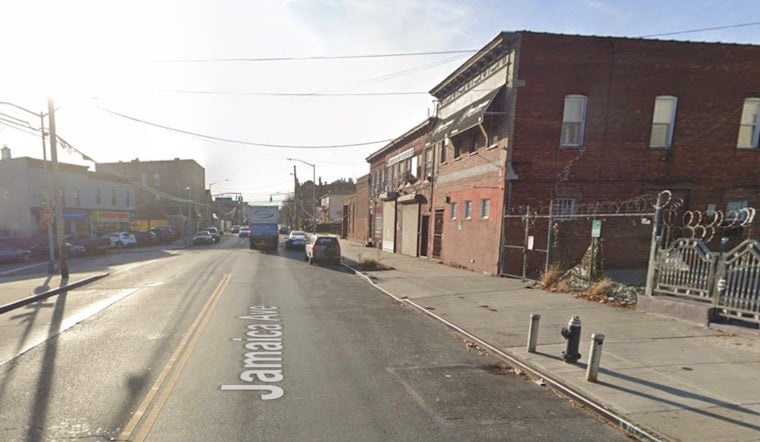
A century-old warehouse on Jamaica Avenue is getting a new life as the East Brooklyn Liberation Center, after the East New York Community Land Trust closed on a $2.3 million purchase of the 9,500-square-foot building this year. The two-story structure will house the land trust's main office, space for local organizations, businesses and worker co-ops, and an archive dedicated to preserving the history of East New York and East Brooklyn.
The deal, first detailed by Brooklyn Eagle reporter Kennedy Sessions, marks the first time a New York City community land trust has acquired a commercial property off the open market. The land trust put down $230,000 as an initial deposit, according to organizers, while Resource Generation helped raise around $250,000 toward the purchase. State Senator Julia Salazar committed $1 million to support the acquisition, and the New Economy Project co-underwrote a $650,000 acquisition loan alongside The Working World, according to Brownstoner.
The warehouse itself carries a long industrial résumé. Over its 95-year history it has had at least four owners and, per Brownstoner's reporting, previously housed a wagon painting business, a radio coil manufacturer, a shirt factory, an appliance machinery plant, and a door and cabinet workshop before the land trust took title.
A Grassroots Group With a Growing Portfolio
The East New York Community Land Trust is a five-year-old, membership-based grassroots group organizing for community ownership of housing, and this warehouse deal builds on earlier moves. In 2024 the trust bought a multifamily apartment building from a private landlord and began converting a rent-stabilized 21-unit building on Arlington Avenue in Cypress Hills into a democratically shared co-op.
Boris Santos, the land trust's president, said the nonprofit would hold the title to the Jamaica Avenue land and lease it to tenant shareholders — the same model the group has used to keep other properties permanently out of the speculative market. Debra Ack, the trust's special projects coordinator, has lived in East New York for nearly 30 years and said the new space means everything to her because it gives her a place to tell people about ownership.
Why East New York Is Ground Zero
The stakes behind the effort are steep. East New York has more than 196,000 residents whose population is 81% Black or Hispanic, according to the NYU Furman Center, and the neighborhood's population grew 33% over the past 25 years even as it experienced at least a 10% decline in Black residents since 2010. East New York and neighboring Cypress Hills rank among the neighborhoods facing the greatest danger of dislocation, per the city's displacement risk map.
Those pressures trace in part to the 2016 East New York rezoning, which spurred construction of 6,500 housing units and high-rise buildings along Atlantic Avenue. The broader picture is stark citywide too: 288,564 Black New Yorkers left the city between 2000 and 2024, according to census data cited in the reporting, part of a trend that has pushed Black homeownership in the city down nearly 15% between 2002 and 2023, to 32.7%, according to the NYU Furman Center. More than half of East New York renters — 55.3% — are rent-burdened, spending at least 30% of their income on housing against a median household income of $56,523, per the Brooklyn Eagle's reporting.
COPA Heads Toward a Council Vote
The warehouse purchase lands amid a renewed legislative push for the Community Opportunity to Purchase Act, which would give community land trusts and nonprofits first opportunity to buy distressed multifamily properties — buildings headed for foreclosure because of unpaid fines or excessive violations. The New York City Council passed COPA in 2025, but then-Mayor Eric Adams vetoed it in his final weeks in office; Council Member Sandy Nurse, the bill's sponsor, said supporters were one vote short of overriding that veto.
Nurse moved to revive the bill earlier this year, and the proposal is now on track to be calendared in September, she said. Under the current draft, property owners would have to notify the city's housing department of their intent to sell, interested nonprofits would get 20 days to submit a letter of interest and 70 days to submit an offer to buy, and the owner would be barred from selling to other buyers during that offer period. As Hoodline previously reported in its piece on the bill's revival battle, the Mamdani administration has backed the measure, and City Hall's Block By Block housing plan frames COPA as a key tool for protecting tenants in distressed buildings.
Per a city reporter analysis cited in the coverage, at least 46 properties with 1,152 apartments in East New York would currently qualify under the bill's criteria. Not everyone is on board: Kenny Burgos, CEO of the New York Apartment Association, has said the bill would not address rising operational and maintenance costs that landlords face, a concern echoed by property owner groups worried about mandated purchase windows cutting into free-market sales.
Part of a National and Historical Pattern
New York City now counts 20 community land trusts, part of a national movement of more than 200 such trusts across the United States. The model traces back to 1969, when the first community land trust was founded in Albany, Georgia, by civil rights activists Charles Sherrod, Shirley Sherrod, and Slater King, who secured 5,000 acres to shield Black sharecroppers from eviction after they took part in voter registration drives, according to Equity Trust.
Similar purchase-opportunity laws have already been implemented in San Francisco, San Diego, Chicago, Philadelphia and Washington, D.C. San Francisco's version, enacted in 2019, enabled the local land trust to save tenants in a similar acquisition, preserving 174 permanently affordable homes across 17 mixed-use and residential properties. New York City has funded community land trusts through its municipal budget since fiscal year 2020, and advocacy coalitions including the NYC Community Land Initiative are now pressing for $3 million in annual discretionary support to scale the model citywide, according to the New Economy Project.



