

























































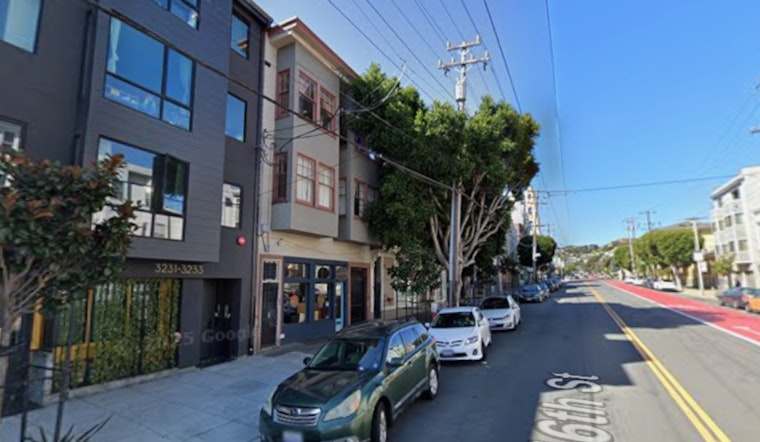
In a city where stability can feel as rare as a parking spot on 16th Street, tenants in one Mission District building just caught a break. Late last week, the San Francisco Community Land Trust closed on a mixed-use property on 16th Street, pulling it off the speculative market and locking in long-term affordability for the people who live there.
The three-story building, home to about a dozen residents that include artists and teachers, will now stay under community control instead of heading for a market-rate sale. For several tenants who have been there for decades, the deal brought a quick end to weeks of anxiety about losing their homes.
As reported by Mission Local, the San Francisco Community Land Trust paid $1.55 million for 3235 16th St., a five-unit building with a ground-floor commercial space occupied by Barnets Salon. According to that reporting, conversations between the nonprofit and the prior owner, Deborah V. Vanpatten, started over the summer after she signaled she was ready to sell. Tenants told the outlet they were relieved to learn that a community organization, not a private investor, would be stewarding their building.
In a press release via SFCLT, the land trust said the acquisition was made possible through city housing programs and the Community Opportunity to Purchase Act. Kyle Smeallie, the group’s policy and communications director, framed the purchase as “making sure they can stay rooted.” The organization noted that the 16th Street property is its 17th acquisition, bringing its portfolio to 174 permanently affordable homes, and described the deal as part of a broader preservation strategy that sits alongside the city’s efforts to build new housing.
How the deal was financed
According to the Mayor’s Office of Housing and Community Development, the purchase relied on city-backed loans, including support tied to the Small Sites Program and the Preservation and Seismic Safety (PASS) Program, as detailed by SF.gov and SF.gov. The transaction also leaned on the city’s Community Opportunity to Purchase Act (COPA), which requires owners of buildings with three or more residential units to notify qualified nonprofits and give them the first crack at buying.
The COPA framework, outlined by SF Planning, creates a short window for nonprofits to step in before a property hits the open market. Housing advocates argue that pairing that window with fast city financing is what lets groups like the land trust compete in a market where buildings often move at lightning speed.
What this means beyond one building
Preservation deals like this have taken on extra weight as cities try to keep up with state housing mandates. KQED reported that under AB 670, jurisdictions can now count preserved affordable units toward as much as 25 percent of their Regional Housing Needs Allocation goals. That means acquisitions are now a recognized tool, not just a feel-good side project, for meeting production and preservation targets.
Local leaders say the land-trust model is a relatively cost-effective way to keep long-term residents in place while the city simultaneously pushes new development. Instead of waiting for new buildings to open years down the line, these kinds of purchases lock in existing homes for the people already living in them.
Tenants respond
Tenants say the emotional shift was immediate. “It’s really a relief, the stability and the security,” said Alana Herron, who told Mission Local she has lived in the building for 24 years.
Other residents, including musicians, teachers and artists, told reporters they were prepared to accept modest, phased rent changes tied to nonprofit stewardship, instead of bracing for the steep rent hikes and uncertainty that often follow a private sale. For them, the trade-off is straightforward: predictable rents and community control beat a spin of the speculative-market roulette wheel.
Funding and capacity
The land trust’s ability to move quickly on deals like this has been boosted in a big way by philanthropy. The organization received a SFCLT $20 million gift from MacKenzie Scott, which the group said would support a $60 million capital campaign to grow its acquisition work. Combined with city loans, that kind of capital gives SFCLT and similar nonprofits the flexibility to respond quickly when a COPA notice goes out and a building suddenly hits the market.
For now, tenants at 16th Street are focusing more on daily life than on policy acronyms. SFCLT and city housing officials say next steps include stabilizing the building’s systems, planning modest repairs that preserve affordability, and supporting tenant governance. It is the less flashy, behind-the-scenes work that turns one lucky purchase into long-term neighborhood stability.





