

























































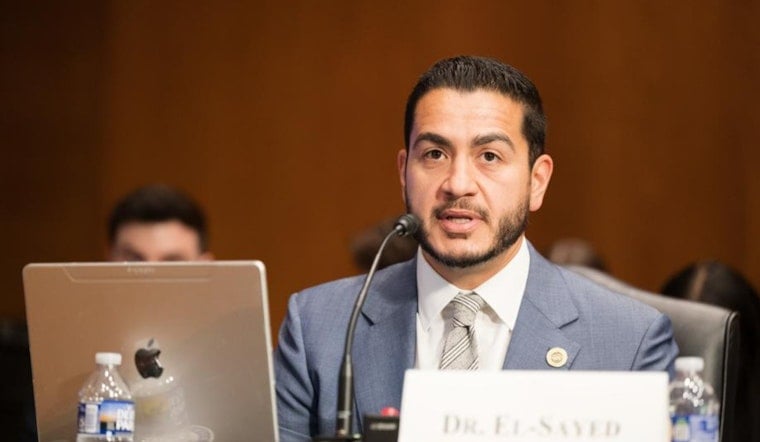
Michigan's Democratic Senate nominee Abdul El-Sayed turned a Fox News interview about transgender medical care into an unexpected question of his own this week, asking host Jesse Watters point-blank whether he is circumcised. Watters answered that he is, and the exchange quickly became a viral flashpoint in a Senate race that polling shows is essentially tied heading into the fall.
The confrontation began when Watters pressed El-Sayed on his support for gender-affirming surgery for people under 18, according to WOAI. Watters specifically asked whether a parent should be allowed to authorize genital surgery on a child. El-Sayed responded by asking Watters whether he himself is circumcised, and the Fox host answered that he is, then said that circumcision is a surgical procedure performed on a child.
Watters pushed back, saying circumcision is different from castration and gender-affirming surgery, and he called El-Sayed's comments “wacky” and “sick stuff.” He also described El-Sayed's circumcision question as personal. El-Sayed, for his part, accused Watters of selectively deciding when government should intervene in medical decisions and argued that the government should not dictate health care choices made by parents, patients, and doctors.
A Physician's Framing Meets Political Attack Lines
El-Sayed leaned on his medical background throughout the exchange, and that background is substantial. According to Ballotpedia, he earned his medical degree from Columbia University and a doctorate in public health as a Rhodes Scholar at Oxford, later serving as executive director of the Detroit Health Department from 2015 to 2017 and director of Wayne County's health department from 2023 to 2025. He is a physician and former public health official, though Hoodline has previously reported that his routine use of the title “physician” on the campaign trail drew scrutiny over his lack of an active clinical license in Michigan or New York.
The circumcision comparison El-Sayed drew on is grounded in real medical policy, even if the parallel is contested. The American Academy of Pediatrics has concluded in its official policy statement that while evidence shows health benefits of elective newborn male circumcision outweigh the risks, the procedure is non-essential, leaving parents to determine whether it is in their child's best interest. That framing underpinned El-Sayed's argument that circumcision, like the gender-affirming care Watters asked about, is an elective procedure performed on children with parental consent.
Watters, however, insisted the two procedures are not comparable, telling El-Sayed that circumcision is different from castration and gender-affirming surgery. El-Sayed countered that Watters failed to ask about issues Michigan voters actually care about, saying the interview focused on cultural flashpoints rather than costs and health care affecting residents. The broader interview also touched on immigration enforcement, taxing wealthy Americans, the war in Iran, and transgender athletes.
What the Data Shows About Pediatric Gender Surgery
Independent of the on-air sparring, empirical research complicates the premise behind Watters' original question. A study published in JAMA Network Open in June 2024 found that gender-affirming surgeries among transgender youth in the U.S. are extremely rare, with zero recorded genital surgeries on children age 12 and under in 2019 and a rate of just 2.1 per 100,000 among teens aged 15 to 17 — nearly all of which were chest procedures rather than genital surgery.
In Michigan itself, gender-affirming medical care for both minors and adults remains fully legal as of this month, backed by state Medicaid coverage for medically necessary treatment and civil rights protections under the state's expanded Elliott-Larsen Civil Rights Act, according to the Transgender Law Center. Even so, major Michigan health systems including Michigan Medicine and Corewell Health announced last September that they would halt prescribing puberty blockers and hormone therapy to minors, citing federal regulatory pressure and subpoenas, despite that care remaining legal under state law, according to WDET.
A Race Still Deadlocked With Weeks to Go
The exchange lands in the middle of an extraordinarily tight general election. An AARP poll conducted August 9 through 11 showed El-Sayed leading Republican Mike Rogers by just 48% to 47% among likely Michigan voters overall, while Rogers held a commanding 52% to 43% advantage among voters age 50 and older. That age split suggests both campaigns still have work to do defining themselves before November.
El-Sayed secured the Democratic nomination on August 4 by defeating U.S. Representative Haley Stevens in the primary, capturing the seat left open by retiring two-term Senator Gary Peters. Rogers, his Republican opponent, served seven terms in the U.S. House representing Michigan's 8th Congressional District from 2001 to 2015, including four years as chairman of the House Permanent Select Committee on Intelligence, and he is endorsed by President Donald Trump. The two will face off in the November general election.
The circumcision exchange is only the latest flashpoint in a campaign already shadowed by opposition scrutiny. Hoodline has reported that El-Sayed's late mother worked at a charity later designated terror-linked, years after she left the organization and without any charges ever filed against her, and that the race has remained essentially deadlocked despite the attacks. El-Sayed's team has framed such episodes, much like the Watters interview, as distractions from pocketbook issues he says are driving Michigan voters this cycle.





