

























































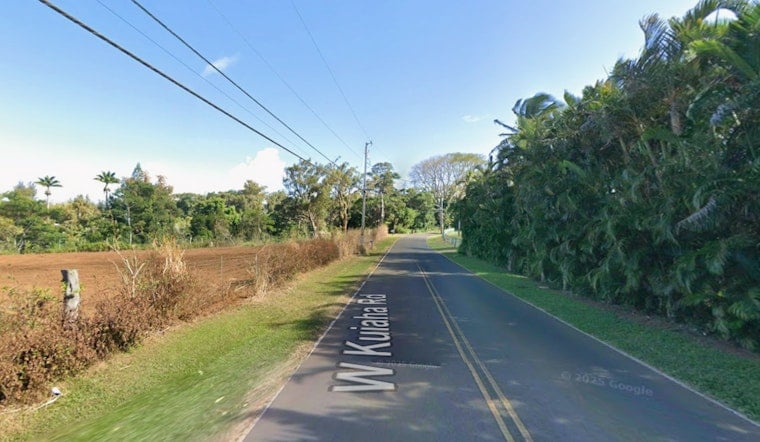
A major electrical failure has knocked out a municipal well serving the West Kuiaha and Awalau areas of Haʻikū, leaving roughly 200 customers with low water pressure or no water at all since Sunday. Crews have responded by parking nine emergency drinking water tanks, known locally as water buffaloes, at spots throughout the neighborhood while they work to diagnose and fix the pump.
The Department of Water Supply issued a news flash on Sunday notifying customers of the outage, according to Maui Now. The well itself is out of service due to major electrical issues affecting its pump, and DWS crews are now working on the pump while monitoring the broader system. As of the outlet's report, the department had no estimated timeline for when service would be restored.
The tanks have been stationed throughout the affected area until service comes back online, giving residents a place to fill containers in the meantime. Three of the water buffaloes sit along West Kuiaha Road, at 1050, 1436, and 1860 W. Kuiaha Road. Two more are positioned along East Kuiaha Road, at 365 and 700 E. Kuiaha Road, and Hanzawa's Variety Store is hosting two additional tanks.
Where To Find Emergency Water
Beyond those locations, single tanks have also been placed at the bottom of Holokai Road off Hāna Highway, at the bottom of Hahana Road off Hāna Highway, at 185 Peʻahi Road, and at 650 Pakanu Street. DWS is directing customers to sign up for its news flash notifications and to check mauicounty.gov/water for general water supply information as the situation develops.
The well failure lands just a week after Tropical Storm Lala passed south of the islands, triggering widespread power grid disruptions that left more than 200,000 utility customers across Hawaiʻi without electricity, as reported by Honolulu Civil Beat. A county advisory issued in the storm's aftermath noted that DWS depends directly on Hawaiian Electric's grid to run its groundwater well pumps, treatment plants, and distribution facilities, meaning grid instability can quickly ripple into households losing water pressure.
A System Already Under Strain
Haʻikū's water is part of the larger Upcountry system, which also serves Upper and Lower Kula, Makawao, Pukalani, Hāliʻimaile, and rural communities including Kokomo, Kaupakalua, Ulumalu, Kēōkea, ʻUlupalakua, and Kanaio, according to county operational records. That interconnected network has leaned on backup sources before: Maui Now reported in September 2025 that DWS activated backup pumping from Hamakuapoko Wells 1 and 2 to prop up the Upcountry system after surface water at Piʻiholo Reservoir ran low, a stopgap Hoodline covered in a piece on the county's move to tap alternative wells amid drought.
The region's water troubles run deeper than any single storm. University of Hawaiʻi hydrologist research published by Civil Beat in June found that Haʻikū sits on a leeward-windward climate gradient where a 100-year drying trend has steadily reduced stream flows and groundwater recharge across East Maui. That long-term pressure has fed into local political fights as well; Maui County Council records from 2023 show the Hawaiʻi Commission on Water Resource Management ordered a dedicated study of the Haʻikū aquifer's yield after residents raised concerns about drawing local well water for other regions.
Upcountry's water status has swung sharply over the past year. DWS lifted a multi-month Stage 1 water shortage for the area in March after heavy Kona storms refilled reservoirs including Piʻiholo, only for Tropical Storm Lala's grid damage to expose the system's continued vulnerability to power loss five months later. Under county rules, Stage 2 shortages would still limit outdoor irrigation in Haʻikū, Kokomo, and Ulumalu to Tuesdays only, underscoring how tightly conservation and water availability remain linked in the area.
Residents dealing with low pressure, main breaks, or water quality concerns can reach the county's 24-hour DWS emergency line at (808) 270-7633. Deploying water buffaloes during pump outages and major pipe breaks is standard practice for the department in Upcountry and South Maui, county emergency response records show, a tactic Hoodline has also documented during a prior boil water advisory in Upper Kula following a storm-induced main line break.





