

























































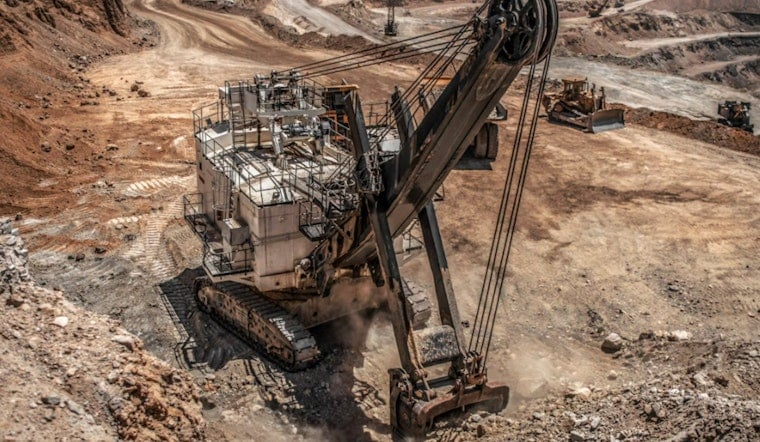
The Bureau of Land Management has approved a massive open-pit gold mine roughly 25 miles southwest of Elko, Nevada, clearing the way for a project that will employ up to 600 construction workers before settling into about 300 full-time jobs once mining begins. Gold Standard Ventures Inc. plans to construct, operate, and reclaim the South Railroad Mine Project site over the next 16 years, using cyanide heap-leaching across four open pits and large waste rock dumps in Elko County.
The approval came after the Federal Permitting Improvement Steering Council designated South Railroad as a covered FAST-41 project, placing it on an accelerated, coordinated multi-agency review schedule, according to the Las Vegas Sun. The designation lines up with the Trump administration's push to boost domestic mineral extraction and cut U.S. reliance on foreign supply chains, and the BLM's decision itself aligns with executive orders prioritizing expedited federal permitting for critical and valuable domestic mineral resources, the Sun reports. The Federal Permitting Improvement Steering Council made the FAST-41 designation official in November 2025, according to the Federal Permitting Improvement Steering Council.
A Fast Track Built on a 150-Year-Old Law
The mine operates under the General Mining Law of 1872, signed by President Ulysses S. Grant, which allows companies to extract publicly owned minerals without paying royalties and governs hardrock mining across more than 15% of all U.S. land — roughly 350 million acres, per the same Las Vegas Sun report. Congressional reform efforts have floated an 8% royalty on hardrock extraction, but those proposed reforms have not passed into law.
Roger Flynn, director of the Western Mining Action Project and an adjunct law professor at the University of Colorado, told the outlet that cutting out public review reduces the ability to make mines less damaging and more protective. He argues that cutting public review stages removes opportunities to minimize environmental harms before they happen, not after.
Sage-Grouse Habitat and Tribal Lands at Stake
The ecological stakes are laid out in the BLM's own August 2025 Notice of Intent, which found the project is expected to remove 892 acres of priority greater sage-grouse habitat — 586 acres temporarily and 306 permanently — while disturbing 18 active sage-grouse leks with operational noise, according to a filing in the Federal Register. Gold Standard Ventures is required to purchase credits through the Nevada Conservation Credit System to offset that habitat loss. The Center for Biological Diversity has separately raised concerns about threats to the greater sage-grouse, potential degradation of local water basins, and impacts to indigenous cultural resources, per the Sun's reporting.
John Hadder, director of Great Basin Resource Watch, said a lack of transparency has interfered with permitting and mining projects. Critics argue that mining has contributed to pollution in an estimated 40% of western headwaters, a figure cited in the Sun's coverage of the broader industry's environmental record. A coalition that includes the Center for Biological Diversity, Great Basin Resource Watch, Earthworks, and the Western Shoshone Defense Project submitted formal comments in September 2025 challenging the BLM's review process over impacts to Western Shoshone ancestral lands, cultural sites, and regional aquifers, according to Great Basin Resource Watch. The Western Shoshone Defense Project represents traditional tribal leadership asserting unceded rights under the 1863 Treaty of Ruby Valley.
The Numbers Behind the Boom
The financial case for South Railroad is substantial. Vancouver-based Orla Mining Ltd. acquired Gold Standard Ventures Corp., the project's original developer, in a deal valued at approximately $242 million, expanding its low-cost, open-pit, heap-leach gold portfolio into Nevada's Carlin Trend, according to a report from Newswire. Orla's updated feasibility study, released in January 2026, projects the mine will produce an average of 130,000 ounces of gold annually during its first five years at an average all-in sustaining cost of $1,485 per ounce, with an after-tax net present value estimated at $783 million at $3,100 per ounce gold, expanding to $1.7 billion if gold reaches $4,500 per ounce, per filings with the U.S. Securities and Exchange Commission.
The proposed mine plan boundary spans 8,548 acres in Elko County, made up of 4,624 acres of public land managed by the BLM and 3,924 acres of private land — a split that makes federal NEPA authorization mandatory because more than half the site sits on public ground. As of early 2026, Orla had secured its Class I and Class II Air Operating Permits and fulfilled initial water rights allocations, but its Water Pollution Control Permit remained under review by Nevada state regulators, meaning chemical heap-leach operations and dewatering cannot begin until that state-level approval clears.
Why Elko, and Why Now
South Railroad sits at the southern terminus of the Carlin Trend, a 100-mile gold belt that has yielded more than 90 million ounces of gold since microscopic deposits were first commercially developed there in the 1960s, according to Mining Technology. Nevada produces over 70% of all gold mined in the United States and ranks as the fifth-largest gold-producing entity in the world, while sitting atop the Fraser Institute's 2025 Investment Attractiveness Index. Elko County remains the epicenter of that industry, a status underscored by Hoodline's own recent coverage of gold-driven demand in the region.
South Railroad is not the only domestic mineral project riding the FAST-41 track this year. Hoodline has also reported on a Carolinas lithium project cleared federally under the same expedited review framework, and on a Florida case where critics have raised sharper objections over environmental justice. Revised National Environmental Policy Act rules have curtailed public scrutiny of fast-tracked hardrock mining nationwide, and the South Railroad approval has drawn criticism from conservation advocates and legal experts who say the compressed timeline leaves less room to catch problems before they happen.



