

























































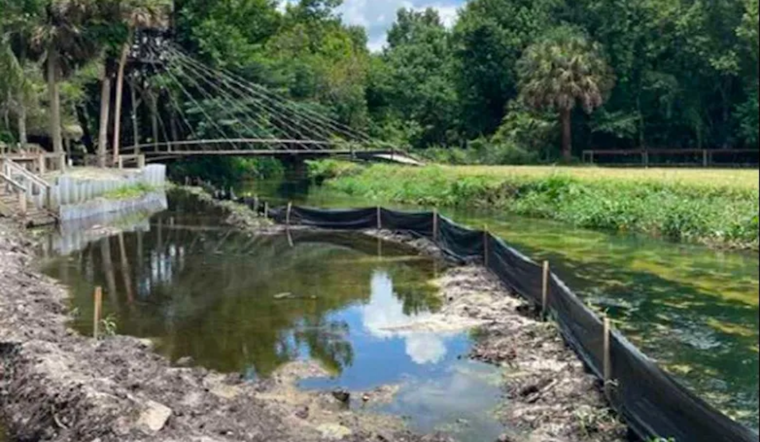
A 77-year-old former Central Florida bail bondsman who is headed to prison for coercing jailed women into sex has also been fined for tearing up the shoreline of the fragile Little Wekiva River with a rented backhoe. Russell Bruce Moncrief used the equipment in early July to strip aquatic vegetation and sand from the riverbank behind his Starbuck Run property, work that Seminole County code officers say was done without any of the required permits.
The dual reckoning for Moncrief, who built a bail-bond empire across four Central Florida counties starting in 1975, is laid out in reporting from the Orlando Sentinel. County staff recommended a $15,000 fine for the shoreline destruction, though Seminole County's special magistrate, Sherry Sutphen, ultimately ordered Moncrief to pay $1,000 and obtain proper permits for a gazebo, seawall, walkway and stairs within 90 days, following an August 13 hearing. Sutphen said the shoreline work likely damaged the river's ecology and could affect downstream property owners.
A Backhoe on a Protected Waterway
Moncrief owns a two-acre property with a 3,200-square-foot home off Starbuck Run, and he told investigators he believed he was simply removing sediment and restoring his own shoreline. County inspectors found otherwise, documenting dredging and fill activity within a wetland and surface water without a valid state environmental permit. The St. Johns River Water Management District sent Moncrief a compliance assistance letter in July requiring a report on correcting the unauthorized dredging and fill work, according to the letter cited by the Sentinel.
The Little Wekiva River is a roughly 15-mile waterway that flows north from Orange County, passing under State Roads 436 and 434 in Altamonte Springs before joining the Wekiva River west of the Alaqua Lake subdivision. Florida lawmakers designated it an Outstanding Florida Water in 1984, and Congress designated the broader Wekiva River a protected National Wild and Scenic River in 2000. Those protections exist because the river has a documented history of ecological collapse — a 2020 drying crisis, detailed by the Sierra Club, saw portions of the Little Wekiva shrink from a wide channel to a dry riverbed during heavy summer rains, prompting public outcry and eventual state action.
Millions Already Spent on Restoration
That outcry led Governor Ron DeSantis to sign Senate Bill 976 in June 2021, mandating multi-agency studies into sediment accumulation in the river and directing environmental agencies to enforce permit compliance, according to 1000 Friends of Florida. Seminole County itself spent $4.3 million to restore 3,500 feet of the Little Wekiva River, with that restoration project completed in 2025. Federal advocates also secured $688,000 in federal funding in 2022 to support the county's restoration work and pushed for a U.S. Army Corps of Engineers study into flow obstruction, per reporting from WESH.
Orange County voters underscored just how seriously the region takes the watershed when they approved a 2020 charter amendment granting legal rights to the Wekiva and Econlockhatchee rivers, recognizing the waterways' right to exist, flow and maintain a healthy ecosystem, the Sierra Club reported. Environmental advocate Christina Seckinger said channelizing a river can lower its velocity, smother the riverbed with sand and destroy the native baseline ecosystem — the exact kind of damage county officials say Moncrief's backhoe work risked inflicting. Moncrief has since erected silt fencing along the shoreline to help prevent further erosion and says he plans to settle the code enforcement issue before January.
A Family Legacy Turned Upside Down
The irony of the code violations is not lost on those familiar with Moncrief's family history. His parents, Katie and Russ Moncrief, operated Katie's Landing as a canoe outfitting business on the Wekiva River starting in 1974, before selling the six-acre site to the Florida Department of Environmental Protection in 2012 for inclusion in the state park system, according to CMF Public Media. Katie's Landing is now part of Lower Wekiva River Preserve State Park. Katie Moncrief worked for decades to protect the Wekiva River, its tributaries and surrounding wilderness before her death in 2024 at age 98; Russ Moncrief died in 2015 at age 92.
Sex-for-Bail Scheme Spanned Decades
The environmental case is a footnote compared to what awaits Moncrief in January. He pleaded no contest in April to a racketeering charge involving pressure on women seeking bail to have sex with him, while prosecutors dropped five human trafficking charges as part of the deal. A police investigation found that Moncrief had developed a system to exploit desperate women through his bail-bond business, according to reporting from WKMG. The Metropolitan Bureau of Investigation opened its inquiry in October 2021 after victims of Melbourne attorney John Gillespie, arrested in 2020 on human trafficking charges, disclosed that Moncrief had forced them into sexual acts in exchange for securing bail.
Complaints about Moncrief's conduct reached authorities far earlier than that. As early as 2011, a rival bondsman reported to the Florida Department of Law Enforcement that Moncrief loitered in jail parking lots to target female inmates who lacked standard collateral, according to Law & Crime. That means authorities received warnings about Moncrief roughly fifteen years before his eventual conviction.
Moncrief opened his first Orlando bail bond office in 1975 and expanded over nearly five decades into Orange, Osceola, Brevard and Pinellas counties before surrendering his license this year, FOX 35 Orlando reported. Moncrief Bail Bonds has since retired, and Moncrief has forfeited his bond license entirely. He has served seven months in custody without bond.
What Comes Next
Under the plea agreement, Moncrief must pay $80,000 to the women affected and $23,795 to the Orange-Osceola State Attorney's Office, and he will serve six years of probation in addition to his prison term. The deal recommends just over 34 months in prison, and Moncrief will be required to register as a sex offender once his sentence is complete. An Orange County judge is scheduled to sentence Moncrief on January 8, 2027, the same window in which he says he intends to resolve his outstanding shoreline permit violations.



