

























































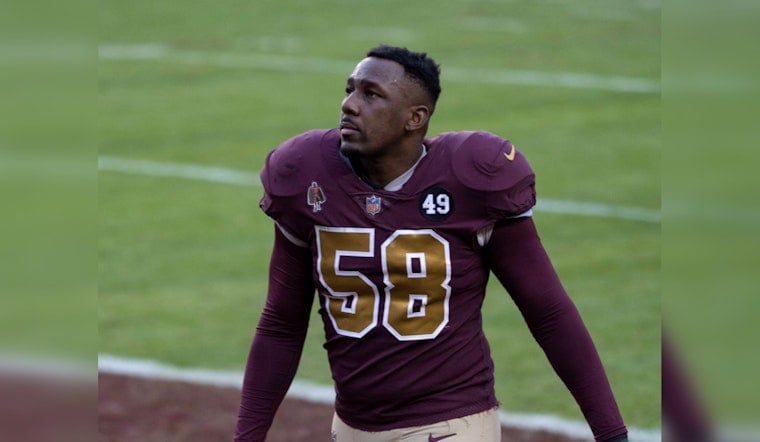
Thomas Davis, the longtime Carolina Panthers linebacker who is still a familiar face around the team's Charlotte facility, has gone public for the first time about an opioid addiction that took hold toward the end of his 16-year NFL career and that authorities say connected him to a nurse practitioner accused of issuing more than 900 illegal prescriptions nationwide.
Davis discussed his drug problem publicly for the first time on The Pivot Podcast, according to the Associated Press, which reports Davis played 14 of his 16 NFL seasons in Carolina and became addicted to opioid painkillers late in that career. Authorities allege Davis received more than 13,000 pills of oxycodone and Percocet between November 2019 and March 2024. Davis blamed the addiction for the breakup with his wife and damage to his reputation, the wire service reports, and he said he takes full ownership of everything that happened in his life.
At the center of the broader case is Joan Rubinger, a Stockton-based nurse practitioner who was listed as a pain-relief provider for high-profile professional athletes, per the AP's reporting. Kelly Davis, Thomas Davis's now ex-wife, accused Rubinger in 2022 of fueling her husband's opioid addiction, saying Rubinger preyed on athletes' pain. The Drug Enforcement Administration opened an investigation into Rubinger that same year.
A Federal Case With No Criminal Charges
The Justice Department filed a federal civil lawsuit against Rubinger in January 2025, alleging she ran a nationwide scheme between November 2019 and June 2024 that issued more than 900 illegal prescriptions for controlled substances including oxycodone, Percocet, Xanax, and Adderall in exchange for cash sent via encrypted Telegram messages, according to the Drug Enforcement Administration. The complaint alleges Rubinger met clients in hotel rooms and other non-medical settings without physician supervision or diagnostic testing.
The same federal complaint alleges Rubinger disguised the volume of opioids she was dispensing by writing sham prescriptions under false names, including those of employees and friends of clients, and by instructing staff to mail the drugs nationwide to evade automated prescription-monitoring systems. The Controlled Substances Act requires that all Schedule II prescriptions be issued for a legitimate medical purpose in the usual course of professional practice, per the DEA complaint.
Despite court filings alleging 900 federal drug law violations, no criminal charges were ever brought against Rubinger, and federal prosecutors have declined to explain why, News4JAX reported in August 2026. A spokesperson for Rubinger told the outlet she was pursued civilly after being threatened and pressured by dangerous clients. Rubinger agreed in March 2026 to pay $1.4 million to settle the DOJ civil complaint without admitting wrongdoing, according to the same News4JAX report.
License Revoked, Client List Included NFL and Olympic Stars
In July 2026, a DEA administrative law judge officially revoked Rubinger's authority to prescribe controlled substances, citing egregious conduct in issuing illegal prescriptions to clients across more than 20 states, as reported by Newsday. Rubinger's promotional materials touted treating 169 NFL Pro Bowlers, 29 NBA and WNBA champions, and 15 Olympic medalists, per the same report. The NFL has said it was unaware of Rubinger, according to the AP's reporting.
Davis's own NFL resume includes three Pro Bowl selections between 2015 and 2017, first-team All-Pro honors in 2015, and the NFL Walter Payton Man of the Year award. He returned from three torn ACLs in the same knee during his career and played in the 2016 Super Bowl despite a freshly broken arm, the AP notes. Former Panthers defensive lineman Dwan Edwards called Davis the heart and soul of the Panthers.
A Pattern Beyond One Case
Davis's experience echoes earlier federal enforcement against NFL team medical staff. Former Washington Football Team head athletic trainer Ryan Vermillion entered a one-year deferred prosecution agreement and paid a $10,000 fine after a DEA investigation found he illegally stockpiled and distributed oxycodone to players without doctor authorization, Front Office Sports reported in August 2022. Davis played for Washington in 2020, within the timeframe federal agents were investigating, and the AP separately reports that Washington's head trainer was found to have illegally distributed oxycodone to players that year.
The issue extends well beyond one team. Sealed federal court filings reviewed by the Washington Post in 2017 showed NFL team doctors admitting in depositions to violating federal drug laws, with a former NFL Physicians Society president testifying that a majority of clubs allowed athletic trainers to unlawfully handle controlled substances as of 2010. Those documents emerged from a federal lawsuit filed by more than 1,800 former NFL players challenging painkiller practices. The AP reports the NFL defended a lawsuit accusing its teams of over-prescribing opioids and other painkillers, which a judge dismissed in 2023 after deeming it overly sprawling — a separate case from the earlier class action Hall of Famer Richard Dent brought against the league, which Courthouse News reported was dismissed in 2019 after a federal judge ruled retired players failed to prove the NFL itself was directly liable for team doctors' improper painkiller distribution.
Research cited by ACI Rehab found that in 2012 alone, NFL teams prescribed an average of roughly 8,000 doses of narcotics and anti-inflammatories per club per season to keep athletes playing through injury, and retired players misuse opioid pain medications at rates nearly three to four times higher than the general male population. A study cited in the AP's reporting found 52 percent of former NFL players reported using prescription opioids during their careers, while a more recent NFL study found 10 percent of former players received opioid prescriptions between 2021 and 2022.
Life After Football, and After Addiction
Davis grew up in Shellman, Georgia, in the southwest part of the state, and moved in with an older cousin in Cuthbert, Georgia, according to the AP. He also played briefly for the Los Angeles Chargers in 2019. In 2018, the NFL found Davis tested positive for a banned estrogen blocker and handed him a four-game suspension, the AP reports.
Davis has four children, including Thomas Davis Jr., now a freshman linebacker at Notre Dame, and he says he is now focused on making things right with them. He has also continued sponsoring charity events. Kelly Thomas — identified in the AP's reporting as having been married to Davis — was arrested in 2025 for assaulting a woman she believed was sleeping with her husband, according to the wire service's account.
Davis remains an active presence at the Panthers facility in Charlotte and has stayed visible locally, signing on to co-host weekly Panthers programming on WSOC-TV as part of the franchise's new five-year local broadcast deal. Former Panthers linebacker Luke Kuechly was inducted into the Pro Football Hall of Fame in 2026, another marker of the era Davis helped define in Carolina. Davis says he has gotten the help he needs and takes full ownership of everything that happened in his life.





.jpg)