

























































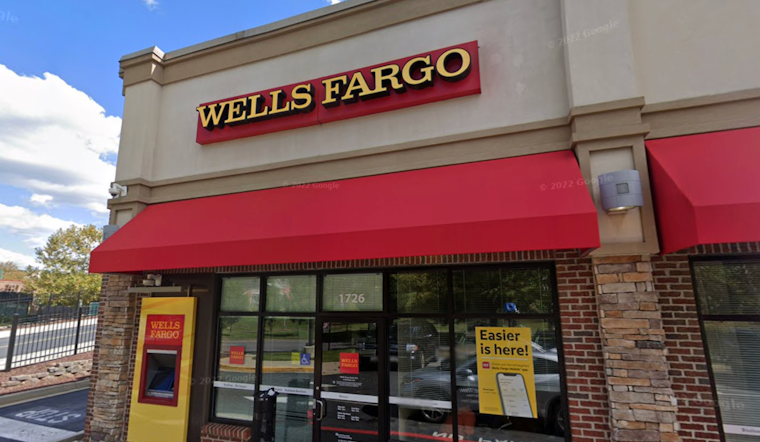
Baltimore Police discovered an unoccupied excavator sitting in the parking lot of a Wells Fargo Bank in the 1700 block of East Northern Parkway early Sunday, left behind after burglars used the heavy machinery to smash an ATM and damage the building's storefront. Officers responded to an alarm at the Northeast Baltimore branch at approximately 5:38 a.m., finding the construction equipment abandoned alongside the wreckage.
Police confirmed they investigated a burglary at the Wells Fargo location after the break-in, according to WBFF. The burglary damaged the bank building and smashed the ATM, and the property was subsequently declared condemned, per the station's report. The Wells Fargo building was boarded up Sunday afternoon as the investigation continued.
A Familiar Pattern in Northeast Baltimore
This is not the first time heavy machinery has been used to rip apart a Wells Fargo cash machine in this part of the city. In December 2024, thieves used a Bobcat skid-steer to tear a drive-through ATM out of the concrete at a Wells Fargo branch in the Parkside Shopping Center on Sinclair Lane, not far from East Northern Parkway, before fleeing in a U-Haul truck, according to Jewish Life News. Construction machinery was similarly abandoned on-site during that earlier heist, echoing Sunday's scene on East Northern Parkway.
The tactic fits into a broader, well-documented method used by ATM theft crews nationwide. Industry security reports note that many commercial heavy machinery models rely on standardized universal keys, allowing unauthorized individuals to easily start and operate unattended excavators and forklifts left at unmonitored construction sites overnight, according to Covert Access Team. Analysis from Bankpak similarly shows that so-called “hook and smash” ATM theft attempts grew by 220% between 2019 and 2020, driven largely by criminals grabbing heavy machinery from nearby job sites to physically rip cash machines from their foundations.
Part of a Wider Regional Crime Wave
Maryland has seen a string of similar heavy-equipment and heavy-vehicle ATM thefts in recent months. In May, federal prosecutors unsealed an indictment against four Washington, D.C. residents accused of using hydraulic rescue tools and stolen vehicles in a multi-jurisdictional ATM theft spree across Maryland and the District, as Hoodline reported in its piece on the ‘jaws of life’ ATM crew. That same month, Baltimore County police arrested a suspect following an overnight, multi-location ATM crime spree that used a U-Haul vehicle to hit locations across Catonsville, Towson, and Parkville.
Nationwide, the numbers behind this surge are stark. Statistics from the ATM Industry Association show that physical ATM-related crime incidents across the United States jumped by 600% between 2019 and 2022, according to Inquisitr. In response, joint guidance from the FBI and U.S. Secret Service has urged financial institutions to install reinforced ATM enclosures, anti-drill components, motion-activated surveillance, and automated alert systems specifically to deter heavy-equipment theft crews like the one that apparently targeted East Northern Parkway.
Potential Charges and Unanswered Questions
Under Maryland Criminal Code Section 6-203, breaking a commercial storehouse or bank with intent to commit theft constitutes second-degree burglary, a felony punishable by up to 15 years in state prison, according to the Smith Martella Law Group. Additional charges could apply depending on how the excavator was obtained and the extent of property damage at the Wells Fargo branch, though no suspects had been identified in connection with Sunday's incident.
Several key details remain unknown. It is not yet clear where the excavator was stolen from, whether any cash was successfully removed from the smashed ATM before the machinery was abandoned, or whether local or federal task forces are examining a possible connection between this burglary and other recent regional ATM theft syndicates operating across Maryland. Wells Fargo, which operates more than 4,000 retail branches and roughly 11,000 ATMs nationwide, has not stated the Northeast Baltimore incident.





