

























































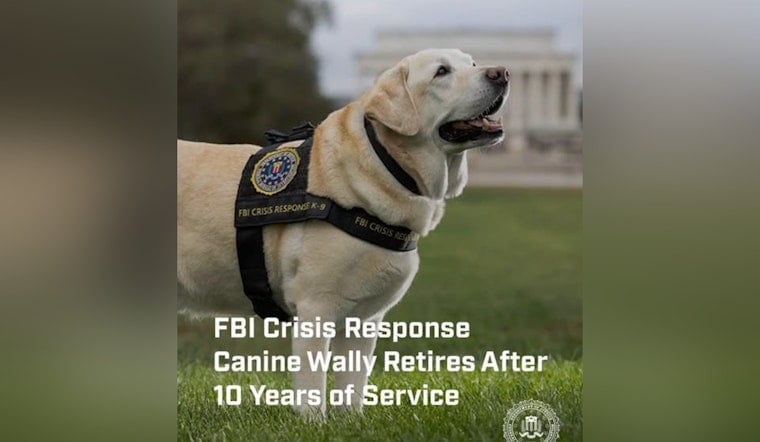
Wally, the first canine to join the FBI's Crisis Response Canine Program a decade ago, has officially retired from duty after a career that took him to the sites of some of the nation's deadliest mass shootings. The Labrador and his handler helped comfort more than 4,100 victims over ten years, work that began in the immediate aftermath of tragedy and often continued into federal courtrooms.
Wally joined the FBI's Crisis Response Canine pilot program in the spring of 2015, according to FBI Honolulu, becoming one half of the Bureau's original two-dog experiment alongside a black Labrador named Gio. His handler, Staci, first met Wally when he was just 18 months old, the FBI says, and the pair went on to become one of the program's defining teams. California was the first of 30 states Wally and his FBI team would eventually visit over the course of his career.
From San Bernardino to Orlando
Wally and Staci responded to the mass shooting at the Inland Regional Center in San Bernardino, and the team was also deployed to the 2016 Pulse nightclub shooting in Orlando, Florida. Those early deployments helped establish crisis response canines as a fixture of federal victim assistance, work built on a program that traces back to 2014, when the then-assistant director of the FBI's Victim Services Division observed international law enforcement partners using working dogs to comfort crime victims, according to the FBI.
Gio, Wally's partner throughout the pilot program, retired six months earlier in December 2025 at age 12 after completing more than 140 assignments across his own decade of service, per the FBI. Gio also holds a distinction of his own: he was the first facility dog to assist a victim during witness testimony in a federal courtroom, paving the way for Wally and other canines to help victims share their experiences in sensitive settings. Together, Gio and Wally supported over 4,100 victims during their careers, the FBI reports.
Why a Dog's Presence Matters in Trauma Response
The rationale behind the program is rooted in biology. Interacting with and petting a trained crisis response dog triggers the release of oxytocin in the human body, which lowers stress hormone levels and helps prevent victims from storing acute trauma in the immediate aftermath of a crisis, the FBI explains. Studies have found that victims interacting with trained crisis response dogs immediately after a crisis are less likely to store the trauma, which can also make them more able to share their stories with investigators and juries.
Crisis response canines are trained to bond with entire groups of people rather than a single handler, allowing them to mitigate victims' stress and anxiety in almost any place at almost any time. That training takes about two years to complete and is handled by Assistance Dogs of the West, a Santa Fe, New Mexico-based nonprofit that trains both the dogs and the Victim Services Division handlers who work alongside them.
A Program Built on Fines, Not Tax Dollars
Fewer than 20 staff positions within the FBI's Victim Services Division, and none of its specialized program costs, are paid for with federal tax dollars. Instead, the division is funded through the Department of Justice's Crime Victims Fund, which draws on criminal fines and penalties from federal convictions rather than direct taxpayer allocations, according to the FBI. The division is now led by Assistant Director Shohini Sinha, a former mental health counselor and therapist who was appointed to the role in March 2025.
Melody, another handler within the Victim Services Division, said the dogs are more than working animals. “They're brothers,” she said, per the FBI. Staci and Wally, the FBI says, exemplify the best of the crisis response canine program, and the pair were honored at a ceremony at FBI headquarters last month.
Expanding Beyond Washington
With Wally and Gio's retirements, the pilot program born in 2015 has grown into a nationally recognized federal facility dog program with a broader geographic footprint. To keep crisis canines closer to where emergencies happen, the FBI deployed two yellow Labradors, Taz and Peg, in April 2025 to regional field offices in Atlanta and Dallas, positioning them to deploy more easily to areas of future need, according to Texas Border Business. Taz is now stationed at the FBI's Atlanta field office, while Peg works out of the Dallas field office.
Wally's name has its own origin story tied to the program's earliest days. He was named after the Beatles song “I Am the Walrus,” part of a breeding line named for Beatles tracks, while Gio's full name, Giovanni, honored Saint Francis of Assisi because he was born on the saint's feast day, October 4, according to AARP. Wally is described by the FBI as having a joyful spirit, a trait that colleagues say helped define his decade on the job.





