

























































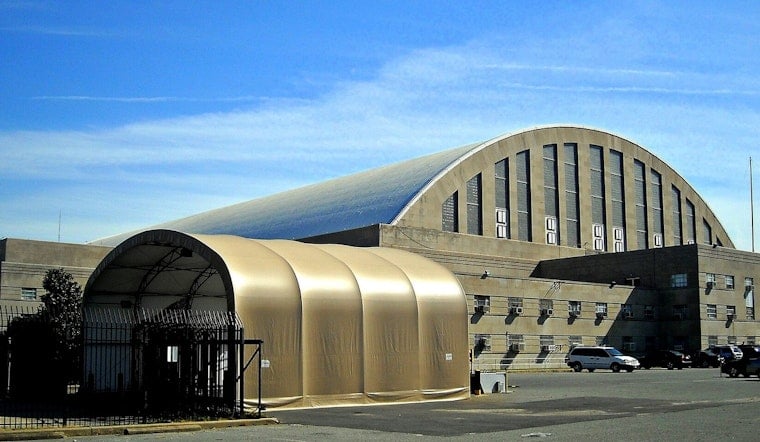
The National Park Service has proposed handing control of the D.C. Armory campus to the District government, a move that would clear the way for the city to shape the future of the roughly 10-acre site along East Capitol Street once the D.C. National Guard moves out. The Guard has occupied the property since 1941 and is now planning to relocate because a new football stadium is being built directly across the street.
According to NBC4 Washington, the Park Service filed formal notice with the National Capital Planning Commission outlining its plan to transfer jurisdiction of the Armory land to D.C., though the federal government would retain ownership of the land itself. The station's report, credited to reporter Mark Segraves, notes the proposal was first reported by the Washington Business Journal. The commission is scheduled to take up the proposed transfer on September 3, 2026, and NBC4 reports the deal could be finalized before the end of the year.
A Building the Feds Want Kept Standing
Under the federal proposal described in the same NBC4 report, the Armory building itself would have to remain intact — meaning any transfer would not, on its own, clear a path to tearing the structure down. Notably, the Armory is not currently listed on the historic register, per the station's reporting. Even so, any future demolition would still need sign-off from the National Capital Planning Commission, which would have to approve such a step separately from the jurisdiction transfer itself.
The Armory has carried outsized civic weight for a building most Washingtonians only think about a few times a year. Designed by District Municipal Architect Nathan C. Wyeth as a Works Progress Administration project, it opened on July 13, 1941, with an 80,000-square-foot column-free drill floor beneath an 88-foot-high domed roof, according to DC Historic Sites. Presidential inaugural balls became a tradition there starting in 1949 with President Harry Truman, continuing for every administration through President Barack Obama, per Events DC, which has managed the Armory's non-military sporting events, cultural bookings, and commercial operations as a 10,000-seat arena since the D.C. Armory Board dissolved in 1994. NBC4 also notes the building hosted the FBI during this year's America 250 celebrations.
Where the National Guard Is Headed Next
The Guard's departure isn't happening in a vacuum. As it plans its exit, the U.S. Army and D.C. National Guard are evaluating an 80-acre parcel at the Armed Forces Retirement Home campus near North Capitol Street and Irving Street NW in Northwest D.C. as the leading candidate for a new headquarters readiness center, according to The Independent. That relocation traces back to Congress's passage of the RFK Stadium Campus Revitalization Act in early 2025, which gave D.C. a 99-year lease over the surrounding 174-acre RFK campus for commercial, residential, and sports development — a sharp departure from the prior 50-year lease that had strictly limited the land to recreational use.
The Armory transfer would rely on a 1932 federal statute, the D.C. Public Land Transfer Act, which lets federal agencies and the District government shift administrative jurisdiction over public land for municipal purposes without a sale or new congressional action, according to the National Capital Planning Commission. The commission's filing under File 8804 covers approximately 9.4 acres of federal land within U.S. Reservation 343-F, the parcel encompassing the land beneath and surrounding the Armory.
What Happens to the Site Next
NBC4 reports that the proposed transfer is only a first step, and that any future use of the Armory site will require additional planning, an environmental assessment, and opportunities for public engagement and feedback. Once jurisdiction shifts, the District government would control development of the land and could determine how the site best serves residents and surrounding communities, with decisions informed by the Armory's role within the larger RFK campus. NBC4 describes the parcel as prime real estate, sitting near a Metro station amid the broader development taking shape around the Washington Commanders' new stadium.
That broader campus carries its own legal guardrails. The RFK Revitalization Act requires that at least 30 percent of the full 174-acre campus be permanently set aside for public parks and open space, a provision included, according to the U.S. Department of the Interior, to guarantee public access along the Anacostia River waterfront. How the Armory parcel factors into that 30 percent requirement remains an open question as planning moves forward.
The transit and financing pieces of the puzzle are already taking shape. D.C. and the Washington Metropolitan Area Transit Authority approved a $2 million agreement this year to study and design upgrades to the adjacent Stadium-Armory Metro station and plan a new Gold Line bus rapid transit connection, as Hoodline previously reported. The city's capital budget also sets aside an estimated $500 million for an RFK Campus Infrastructure Fund, to be financed through municipal bond sales meant to prepare the surrounding land and utility grid for major construction. Whether that funding will be enough to handle transportation demand at the Stadium-Armory station once the Armory site redevelops is still unresolved.





