

























































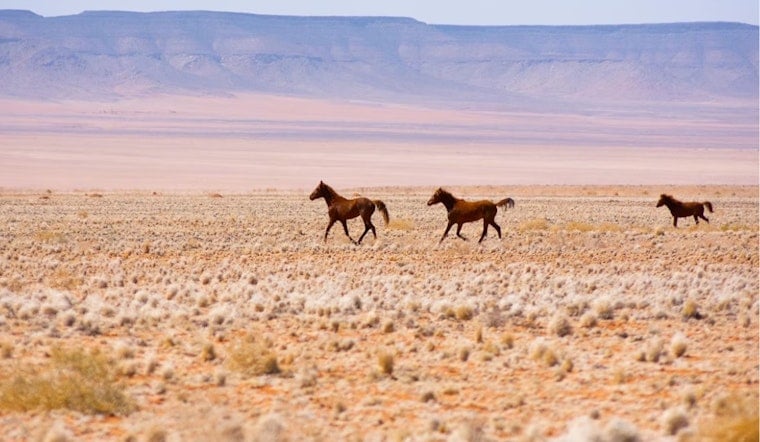
Federal contractors are in the middle of a monthlong operation to gather roughly 1,025 wild horses from rangeland near Rangely, Colorado, with plans to permanently remove 1,011 of them from the Piceance-East Douglas Herd Management Area and the neighboring West Douglas Herd Area. The Bureau of Land Management says the roundup, which began August 2, is necessary because the local herd has grown far beyond what the land can support.
According to the Denver Gazette, the BLM says the Piceance-East Douglas herd is currently running at 345 percent above the population the 190,130-acre habitat can sustainably support, which BLM officials put at just 135 to 235 horses. The West Douglas Herd Area, spanning 123,000 acres, has been deemed entirely unsuitable for wild horse management due to a lack of forage and water, per the same report. Of the horses gathered, 14 are slated to be returned to the Piceance-East Douglas HMA, with 10 of those receiving fertility control treatment before release.
The gather got underway fast and hot. During the first two days of the operation, contracted crews corralled 180 wild horses, but daily helicopter operations had to be halted around 11 a.m. both days as temperatures climbed toward 100 degrees, according to The Colorado Sun. Under the BLM's Comprehensive Animal Welfare Program, helicopter drive-trap operations must be suspended entirely once ambient temperatures hit 95 degrees Fahrenheit, the outlet reports, to keep horses from succumbing to heat exhaustion during the miles-long chases across desert terrain.
Contractor, Timeline, and Where the Horses Are Headed
The Herald Times identifies the outfit running the helicopter drive-trap operation as C D Warner Livestock LLC, and reports that horses marked for permanent removal are being shipped out of state to the BLM's Wheatland Off-Range Corral in Wyoming. That distant destination is itself a consequence of a decision made in Colorado. In October 2025, the BLM shut down its three-decade-old wild horse training program at the East Cañon Correctional Complex due to rising costs, ending the inmate-led training that once processed gathered mustangs locally, as the Colorado Sun reported at the time.
The full gathering process is expected to run about 30 days, originally slated to begin August 1 before starting a day later. An earlier helicopter drive-trap push on August 2 gathered 96 wild horses, per Steamboat Pilot & Today. Horses taken to holding facilities will receive veterinary care, vaccinations, identification and evaluation, with suitable animals made available for adoption or other placement through the BLM Wild Horse and Burro Program.
Limited Public Access to the Roundup
Public observation of the operation has been tightly restricted. The BLM is allowing viewing only three days a week, Monday through Wednesday, by reservation limited to 10 to 15 people per day, according to American Wild Horse Conservation. The temporary holding corrals themselves sit on private land, and the public is barred from accessing them entirely, the group notes.
Bill Mills, speaking on behalf of the BLM, said the gather will help maintain a healthy wild horse herd on a healthy landscape, adding that the Piceance-East Douglas herd is above the number of horses its habitat can sustainably support. The horses being removed resemble quarter horses and work horses in size and temperament, coming in colors including bay, gray, sorrel, black, roan and buckskin, according to the Denver Gazette.
A Lopsided Land-Use Fight
Wild horse advocates argue the ecological-balance framing leaves out a bigger piece of the picture. Official forage allocation records for the management area show livestock permittees are granted 57,105 Animal Unit Months of forage, versus just 2,820 AUMs allocated to wild horses, according to Wild Horse Education. The same organization notes the Piceance-East Douglas HMA is also heavily industrialized, containing more than 18,400 recorded historical and active oil and gas wells across its public and private acreage.
This isn't the herd's first large-scale removal. During a 2022 gather in the same area, the BLM captured 867 wild horses and permanently removed 771 after moving up the operation because of severe drought, the Colorado Sun reported. That same year, an Equine Influenza outbreak at the BLM's Cañon City holding facility killed 145 wild horses captured from western Colorado, a tragedy that prompted then-Governor Jared Polis and advocacy groups to call for a pause on helicopter gathers.
Statewide, the BLM manages four designated Herd Management Areas — Piceance-East Douglas, Sand Wash Basin, Spring Creek Basin, and Little Book Cliffs — under a combined maximum Appropriate Management Level of 812 horses across roughly 400,000 acres of public land, per the agency's own figures. With this gather targeting more than 1,000 animals from a single HMA, the current operation alone would remove more horses than the entire state's population ceiling allows.





