

























































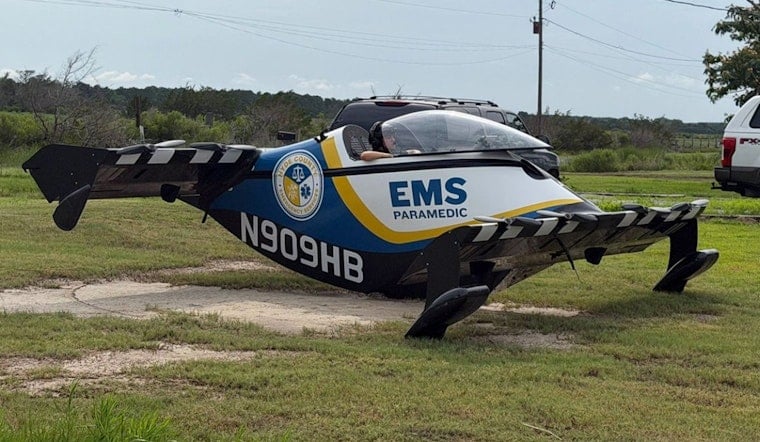
A paramedic in coastal Hyde County, North Carolina piloted a single-passenger electric aircraft straight to the scene of a 911 emergency, landing in the patient's yard and beating the ground ambulance by roughly 20 minutes. It's believed to be the first time a U.S. county has used an eVTOL during live emergency calls, according to the seed story's reporting.
The flights were carried out by Quinn Reece, a flight-trained paramedic and drone pilot, who flew an ultralight aircraft called the BlackFly to two separate emergency scenes, according to Axios. One call involved a patient suffering a diabetic emergency; the other involved a patient experiencing a cardiac emergency. Reece carried advanced life support equipment on both flights, which helped stabilize both patients before ground crews arrived. Hyde County's EMS chief, Brook Cox, said both patients had positive outcomes, per the same account.
The BlackFly is made by Palo Alto-based Pivotal Aero, which markets the aircraft as a single-passenger vehicle that needs no runway. It can take off and land on pavement, dirt, or grass, uses its entire airframe to tilt for vertical takeoff and landing rather than relying on complex rotating wings, and weighs just 254 pounds — light enough to qualify under existing Federal Aviation Administration ultralight-aircraft rules. It also floats on water and carries an onboard parachute that can lower the aircraft safely to the ground in an emergency.
Why the Aircraft Can Skip Years of FAA Review
That ultralight classification is the whole reason the flying-medic concept can exist right now instead of a decade from now. Because the BlackFly weighs under 254 pounds empty, holds no more than five gallons of fuel, tops out at 55 knots, carries a single occupant, and flies only during daylight, it falls under FAA Part 103 rules first established in 1982 for recreational light aircraft, according to the Experimental Aircraft Association. That exemption lets public safety agencies deploy flight-trained paramedics without the type-certification process that larger, multi-passenger air taxi developers face.
Pivotal CEO Ken Karklin said the project represents an entirely new approach to first response, and that flight-trained paramedics can now reach patients directly instead of driving around geographic barriers, per the seed story's account. Reece said the technology can change how emergency response is understood, especially in rural communities. The BlackFly's simple, lightweight design stands in contrast to the larger electric air taxis being developed by Joby Aviation and Archer Aviation, both of which still need certification of an entirely new aircraft class before they can carry passengers commercially.
Why Hyde County Needed a Different Answer
Hyde County spans roughly 1,500 swampy acres along with Ocracoke Island, terrain that has long made conventional ambulance response brutally slow. Ground ambulance response times in the county can stretch up to six hours, according to Carolina Public Press. The county's health-care access discussion also includes hospitals outside Hyde County.
Those geographic hurdles are part of a much larger national pattern. An estimated 4.5 million Americans live in what researchers call ambulance deserts, where the nearest emergency medical station is more than 25 minutes away — and 52% of those residents are rural, per the AMA Journal of Ethics. Hyde County's geographic delays provide local context for that national pattern. According to the Health Resources and Services Administration's National Advisory Committee on Rural Health and Human Services, staff shortages, distance, and terrain can leave some rural call areas without ambulance coverage.
A 60-Day Trial Before the Live Calls
The aircraft arrived for a two-month evaluation on March 14, requiring only a 100-by-100-foot landing area for dispatch, according to the Ocracoke Observer. North Carolina emergency medical training firm Code Blue Resources partnered with Pivotal and Hyde County EMS, with three part-time paramedic pilots participating.
Pivotal's newsroom says the program was planned for eight months and involved eight aircraft.
Limits of the Flying Medic Model
The BlackFly evaluated in Hyde County has a reported starting price of $190,000, a 20-mile range and a 75-minute recharge, according to specifications reported by Aviation International News. Pivotal was preparing to begin customer deliveries.
The technology has real limits. Because Part 103 restricts operations to daytime visual flight rules and sets visibility and cloud-clearance requirements, these ultralights cannot fly at night or when those conditions are not met, while the project vehicle will not transport patients. That means flying medics function strictly as rapid stabilization chase units rather than air ambulances, still requiring a ground ambulance or helicopter to complete the transport — which is exactly what happened in Hyde County, where the aircraft arrived roughly 20 minutes ahead of the ground ambulance rather than replacing it.
Pivotal isn't the only company chasing this niche. Competitor Jump Aero is developing the JA1 Pulse, a high-speed tail-sitter eVTOL funded in part by the U.S. Air Force and already ordered by global medical response firm Falck, designed to fly a single paramedic up to 250 knots to reach rural emergencies within an eight-minute window, according to EMS World. Unlike Pivotal's off-the-shelf ultralight, Jump Aero's aircraft is purpose-built for speed and specialized medical payload capacity, signaling that multiple aerospace companies now see a near-term rural emergency-response market emerging from North Carolina's pilot project.





