

























































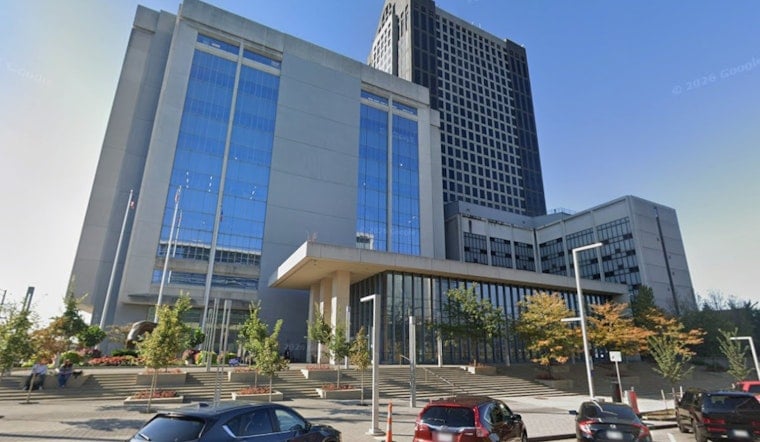
Franklin County is pulling the plug on the nonprofit it created six years ago to fight poverty, closing operations at the Rise Together Innovation Institute this Friday, August 21, and bringing some of its work back in-house. The five-person organization's employees will stop working after this week, capping a six-year, $4.9 million experiment in outsourcing big anti-poverty ideas to an independent nonprofit.
According to The Columbus Dispatch, Franklin County commissioners intend to formally dissolve the Rise Together Innovation Institute by the end of 2026 and move some of its work directly into county government. County Commissioner Kenneth Wilson told the paper he believes the county got a fair return on its investment, but he also said Rise Together did not meet his expectations and that it failed to generate much revenue from outside fundraising, which was central to its founding mission of leveraging county dollars with money from other sources.
Franklin County commissioners were the nonprofit's primary funder and appointed all of its board members, and the county terminated its grant contract with the institute on May 22, per the Dispatch's reporting. The county is now absorbing some of Rise Together's operations and contracts, according to Molly Thrasher, as county leaders confront a strained budget and cuts across county agencies heading into 2027 — cuts that come as federal changes to the Supplemental Nutrition Assistance Program could cost Franklin County more than $7 million next year.
An Ambitious Blueprint Meets a Tighter Budget
Rise Together traces back to a 2019 county-commissioned report, the “Rise Together Blueprint for Reducing Poverty in Franklin County,” which grew out of interviews with more than 200 low-income residents and laid out 13 primary goals and 120 specific action steps spanning housing, health, youth and workforce development, according to the National Association of Counties. The county formed the Rise Together Innovation Institute in 2020 to test ideas to counter poverty and to vet and advance big ideas, with the Columbus City Council later approving a $5 million grant agreement in June 2024 to support the blueprint's implementation, according to Columbus City Council records.
That original blueprint was responding to a poverty crisis with staggering numbers behind it. A December 2024 report from the institute estimated that poverty cost Franklin County $5.7 billion in 2023 through lost economic earnings, healthcare costs and increased social service demands, and found that 39% of county households struggled to afford basic necessities, according to WOSU Public Media. Franklin County's own 2025 budget guide, citing U.S. Census Bureau data, put the county's overall poverty rate at 15.0%, up from 13.5% before the pandemic, with nearly one in four Black residents and one in five children living below the poverty line.
Cash Pilots Showed Promise, But Fundraising Fell Short
Over its six years, Rise Together conducted two universal basic income pilots that provided direct cash to struggling families, held two poverty summits, and produced research on jobs, housing, health and youth, according to the Dispatch. One of those pilots, the Ohio Mothers Trust launched with nonprofits Motherful and UpTogether in December 2024, gave 32 low-income single mothers $500 monthly stipends for a year, the same WOSU report noted. A second pilot, called Stabilize Families, launched with the Community Shelter Board in May 2025, providing $1,500 one-time payments to 80 unhoused families and $500 monthly stipends for 11 months to 20 more families across Franklin County.
The institute was also tasked with piloting universal childcare in Franklin County but did not ultimately do so, per the Dispatch's reporting. An interim evaluation released in April 2026 by The Ohio State University College of Social Work found that 72% of unhoused families receiving the $1,500 direct cash transfer successfully secured lease housing, cutting their average emergency shelter stay from 113 days down to 44 days, according to the Community Shelter Board, which coordinates county shelters and services for homeless people.
Leadership Turnover and a Board Out of Step
Despite that research, county commissioners voiced frustration with how the nonprofit was run. Commissioner Kevin Boyce told the Dispatch that Rise Together's commissioners and board were not on the same page, and he said the organization had been asked to fundraise for its own operations — something it struggled to do. The institute lost its chief executive to another job in 2025; nonprofit tax filings show Danielle Sydnor served as CEO from late 2021 through late 2024, earning $262,397 in annual compensation, before Sonja Nelson stepped in as interim CEO in 2025.
The leadership churn came as Central Ohio's underlying housing shortage kept squeezing the population Rise Together was built to serve. The Federal Reserve Bank of Cleveland reported in May 2023 that the region was adding only about 8,000 housing units annually despite needing nearly 19,000 new units per year to keep pace with population growth — a structural gap no single nonprofit pilot program could close.
Homelessness Hits a Fourth Straight Record
The county's decision to wind down Rise Together comes as Franklin County's homelessness crisis has kept deepening. The county's annual Point-in-Time census in January 2026 recorded 2,587 people experiencing homelessness, a 1.2% increase from 2025 and a fourth consecutive annual record high, driven by a 43% single-year surge in unsheltered homelessness to 651 individuals — a spike Hoodline previously reported was thinning out shelter capacity across the county.
With that crisis mounting, Franklin County commissioners are now weighing funding for the Community Shelter Board directly, rather than continuing to route money through an independent innovation nonprofit. Franklin County invested $4.9 million in Rise Together over six years, according to the Dispatch, and county officials appear intent on redirecting future dollars toward front-line shelter services as the county absorbs some of the institute's remaining contracts in-house.





