

























































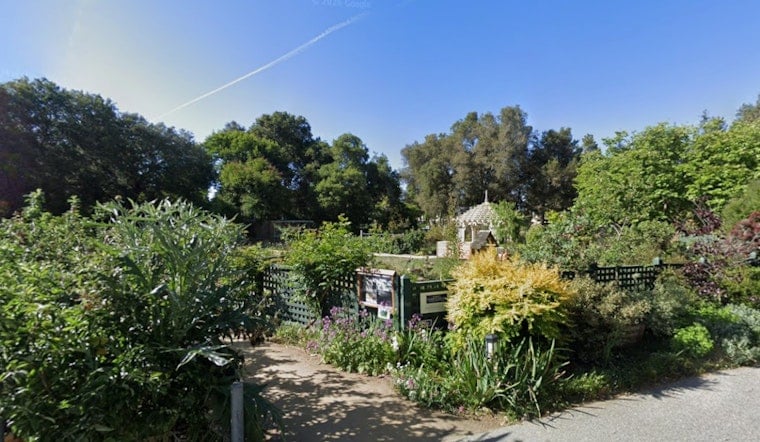
Gamble Garden's greenhouse in Palo Alto is about the size of a one-car garage, has no climate control, and hasn't kept pace with a nonprofit that now draws more visitors and volunteers than ever before. Today, the city's Historic Resources Board is set to review updated plans for an $8 million horticultural complex that would replace that greenhouse along with an aging potting shed, lath house, and storage building at the 2.5-acre Waverley Street estate.
The proposal, first detailed by Palo Alto Online, would relocate a new greenhouse closer to the parking lot, where it would get better access to solar energy, while adding office space, workshop space, and a community meeting room. Executive Director Mica Pirie, who has led Gamble Garden for two years, has overseen a period in which the nonprofit says it now offers more classes than ever and has logged more volunteer hours than at any point in its history. According to reporting from Verde Magazine, Pirie said in February that the new complex would let the garden expand its Roots and Shoots elementary school field trip program, launch a college internship program, and offer a wider range of public classes.
A Greenhouse Too Small for the Job
The strain on Gamble Garden's aging infrastructure shows up in small but telling ways: weekly master gardener visits, once a fixture of the property, have been scaled back to sporadic appearances, according to Palo Alto Online's reporting. The garden still manages to offer tours, classes, and tea parties on the grounds, and it remains open to the public every day for free, but staff have said the facilities beneath that public-facing program need work.
The push for an overhaul isn't new. Gamble Garden's Board of Directors formally approved a conceptual design for the Horticultural Complex Project in early 2024, following task force planning that began even before that, per Verde Magazine. The nonprofit has since lined up early philanthropic support, including a $50,000 grant from the Maud and Burton Goldfield Family Foundation earmarked specifically for the project, according to grant records reviewed by Verde Magazine.
City Land, Nonprofit Stewardship
The property's ownership structure explains why City Hall has a say in the design at all. The city itself owns the land, while the nonprofit Elizabeth F. Gamble Garden manages and funds day-to-day operations under a lease arrangement. Palo Alto's Policy and Services Committee approved negotiating a single 50-year lease renewal in November 2025, unifying existing agreements covering the Waverley Street property, the nearby Kellogg Parkette, and an adjacent nursery parcel, Verde Magazine reported — a move that gave the nonprofit the long-term legal footing needed to pursue fundraising and design work.
Because the site carries historic status, the horticultural complex has already gone through multiple rounds of city review. City consultants prepared a 108-page report in 2023 evaluating the property's historic elements, finding it appeared eligible for the California Register of Historical Resources. Gamble Garden is classified as a Category 2 historic resource by the City of Palo Alto, and city staff analyzed the current project against 10 standards for rehabilitation, concluding the plans comply with all of them, Palo Alto Online reported. The first rehabilitation project plans were sent to the city in 2025, with a revised version submitted this past May. Following Thursday's hearing, the Historic Resources Board will forward its recommendation to Planning and Development Director Jonathan Lait.
Roots Going Back to 1902
The estate's history stretches back well over a century. Elizabeth and Edwin Percy Gamble built their Colonial Revival-style house in 1902 for $6,039, constructed by contractor C.A. Bates, according to Palo Alto Stanford Heritage. Edwin was the son of Procter & Gamble co-founder James Gamble, and the family had relocated from Kentucky so Edwin could attend Stanford University. At the time it was built, the three-story main house was the first residential structure south of Embarcadero Road other than the Seale Ranch, and it required special municipal arrangements just to connect to Palo Alto's electrical grid, Palo Alto Stanford Heritage notes. The estate's primary gardens were added a few years after the house went up, and its formal grounds were laid out in 1908 by landscape architect Walter A. Hoff, according to the garden's own historical account.
Elizabeth Gamble later inherited the property, and her granddaughter, Elizabeth Frances Gamble, deeded it to the City of Palo Alto in 1971 while retaining a life estate. Following her death in 1981, the property transferred fully to the city, and the Garden Club of Palo Alto partnered with the city to establish the nonprofit's public garden lease in 1985. The Elizabeth F. Gamble Garden nonprofit has maintained the grounds ever since, and in 2025, the organization marked 40 years as a public nonprofit, drawing an estimated 40,000 visitors annually with free access every day of the year.
If the Historic Resources Board's recommendation moves forward as planned, construction on the horticultural complex is anticipated to start next year, with the nonprofit hoping to finish the project in 2028 — the first major expansion of the site's facilities in decades.



