

























































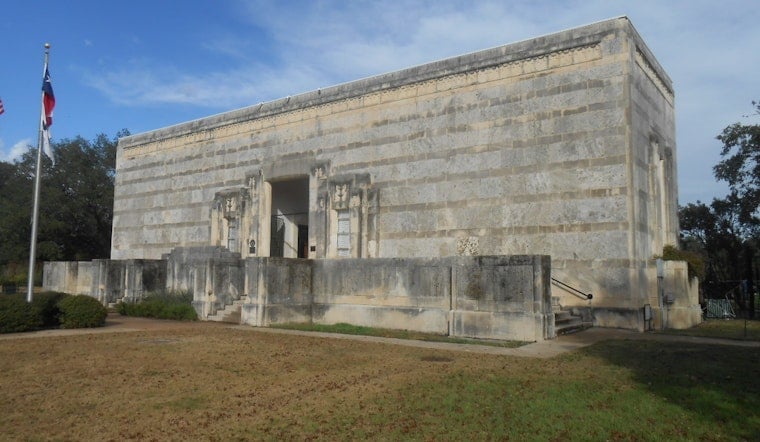
Every night in Gonzales, Texas, a 96-foot-wide limestone wall turns into a movie screen. The Gonzales Memorial Museum's facade now hosts a free, 34-minute live-action film projection called Texas Legacy in Lights, which tells the story of the Texas Revolution through the eyes of a teenage girl who helped sew one of the war's most famous flags.
A Museum Wall Becomes a Screen
The production is the flagship installation of Austin Film Crew's Heritage Light Series, and as reported by Texas Standard, it is directed by John Franklin Rinehart, who grew up in Gonzales. The film is projected onto the Gonzales Memorial Museum, an Art Deco building built in the 1930s that recently received a state-of-the-art update to support the installation. According to Blackmagic Design, the projection surface across the museum's exterior limestone facade measures 96 feet wide by 32 feet high, a canvas roughly one-and-a-half times the size of a standard IMAX screen.
To get the footage to sit correctly on the building's curved stone elements without warping, Rinehart used multiple cameras and image collages, per the Texas Standard report. Blackmagic Design notes that Rinehart and cinematographer Alex Walker shot the production with Blackmagic URSA Cine 12K LF and PYXIS 6K cameras, compositing multi-angle footage tailored to the building's specific contours. Rinehart has described making a film meant to be projected onto a building facade as “filmmaker on hard mode,” according to the same Texas Standard account.
Told Through a Teenager's Eyes
Rather than centering on the battlefield, Texas Legacy in Lights tells the Texas Revolution story from the perspective of Evaline DeWitt. The Texas State Historical Association notes that DeWitt worked with her mother, alongside Cynthia Burns, to paint the original “Come and Take It” banner in October 1835 — a black cannon and lone star rendered on white cotton cloth just before the skirmish that would kick off the fighting in Gonzales. Texians raised that homemade white banner as a defiant response when Mexican authorities came to reclaim a bronze six-pounder cannon that had been lent to Green DeWitt's colony back in March 1831 for defense against Native American raids, according to the Texas State Historical Association.
The film also highlights the Immortal 32 — young men from Gonzales who rode to the besieged Alamo and died there. The Texas State Historical Association records that these members of the Gonzales Ranging Company of Mounted Volunteers set out for San Antonio on February 23, 1836, entered the Alamo on March 1, and were among the fort's defenders killed in the final assault five days later. Rinehart told Texas Standard that the film presents a perspective different from the Alamo and the men who died there, and the story unfolds roughly 70 miles east of San Antonio, where the Battle of Gonzales itself took place.
From Standoff to Burning of a Town
Texas Legacy in Lights begins with the Runaway Scrape after the Alamo fell — the moment, according to the Texas State Historical Association, when Alamo survivor Susanna Dickinson reached Gonzales on March 13, 1836, with news that the fort had fallen. That prompted General Sam Houston to order the entire town of Gonzales burned, touching off a mass civilian evacuation. Per Texas Standard's account, residents were given just 15 minutes to gather belongings before fleeing, and the retreat that followed was brutally cold.
Rinehart told Texas Standard that women and children also pay the consequences of battles and wars, and he hopes the film reminds people about the resilience required to live in Texas. The vivid fire effect simulating the burning of Gonzales made an impression well before the film's official run began — Texas Public Radio reported that during technical test runs, local residents mistakenly believed the museum itself was on fire and called the local fire department.
Free Screenings Running for Years
Texas Legacy in Lights began preliminary nightly preview screenings in July 2025 before its official grand opening on October 2, 2025 — the 190th anniversary of the Battle of Gonzales and the date celebrated locally as Come and Take It Day, per Austin Film Crew. The projection plays Tuesday through Sunday at the Gonzales Memorial Museum, with showtimes of 8:25 pm and 9:15 pm in spring and summer and 7:25 pm and 8:15 pm in fall and winter, according to Texas Standard's report. Admission is free.
Rinehart told Texas Standard he expects the film's projection to play every night for about 15 years. The museum itself is home to what is said to be the actual “Come and Take It” cannon, per the article, adding a physical artifact to the digital storytelling happening on the building's walls each evening. Reflecting on the scale of the undertaking, Rinehart said small towns can accomplish major things by working together — a sentiment the Austin Film Crew's own account of the museum's 1930s design, with its limestone walls, reflecting pools, and front lawn built as an open-air amphitheater, seems to bear out nearly a century later.




