

























































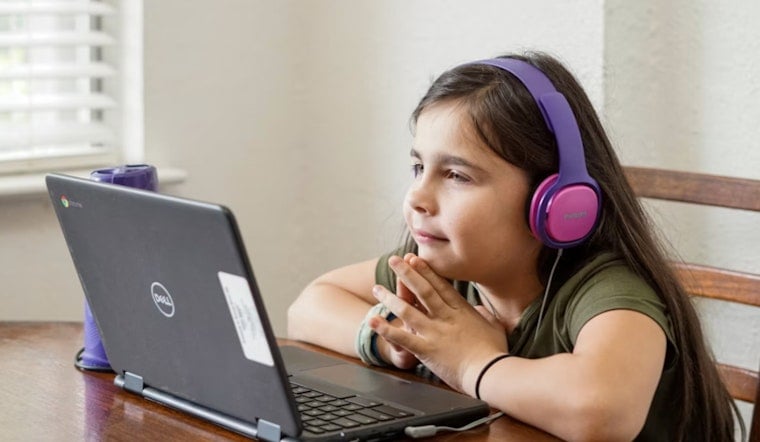
Granville County Public Schools has spent two years running technology-free days every Monday and Tuesday, and the numbers behind that decision are stark: J.F. Webb High School students used YouTube nearly 40,000 times over a 30-day stretch, according to district data. Now the North Carolina district is leaning further into paper and pencil, pulling devices from its youngest classrooms and requiring students to draft essays by hand before ever touching a keyboard.
A District Tracks Where Screen Time Actually Goes
The scope of the shift is detailed in reporting by WRAL, which found that YouTube ranked as the third-most popular app among J.F. Webb High students and the fourth-most popular among Granville Central Middle School students, even outranking Google Classroom, Google Docs, Gmail and Canvas in usage. Google search was the only tool that beat YouTube in popularity among the high schoolers, per the same report. Granville students had been logging onto laptops for dozens of hours per week, and some were also using their devices to cheat on assignments, WRAL reports.
Superintendent-level administrators have responded by removing devices entirely from kindergarten through second-grade classrooms and eliminating take-home devices for third through eighth graders, who now access laptop carts kept at their schools instead. High schoolers can still take a device home, though the district has banned some previously popular applications and now requires teacher approval before any new classroom app can be installed, according to WRAL's reporting. Granville County students currently cannot access YouTube at all on school networks.
Educators Split on What Screens Are For
Stan Winborne, a Granville official quoted in the WRAL report, said the value of technology depends entirely on how it gets used, adding that young people are spending too much time on devices generally. He expects students will still have time to build necessary technology skills even with the new restrictions, and he considers the added cost of paper nominal compared with the savings from reduced technology use — the district has bought more paper and now maintains physical English, math and science textbooks alongside dictionaries, calculators and novels.
Not everyone in the district is convinced the pullback goes far enough, or that it is working as intended. Granville teachers reported students were more mentally tired after technology-free days, and student survey respondents said the tech-free days had not substantially improved focus, reduced stress or increased calm, per WRAL. Some students also reported hand cramps from the increased handwriting, and survey respondents complained of insufficient paper for worksheets. Still, other Granville students reported having more conversations with classmates during technology-free days, and Wendy Wilkins, another figure cited by WRAL, said a laptop cannot provide empathy, understanding or connection the way in-person interaction can.
The Case for Handwriting and Human Connection
Mary Warehime, also quoted in WRAL's reporting, said handwritten essay drafts help teachers monitor student progress and verify students are doing the work themselves — part of the rationale behind Granville's new requirement that students write first drafts by hand. Michael Spradlin, another district voice in the report, said officials could see exactly what was appearing on student devices and generally advocates for technology use only when it clearly enhances learning. Lynn Cooper, cited in the same coverage, said students still need to talk and communicate through disagreements rather than defaulting to screens. Karl Johnson, an assistant professor at the University of North Carolina at Chapel Hill who works with the district, said Granville's education system had become too dependent on educational technology, according to WRAL.
Granville isn't operating in isolation. The North Carolina Department of Public Instruction issued statewide guidance on what it calls purposeful screen use, cautioning schools against passive and unstructured screen time and discouraging the use of screens as a reward or time-filler. The Salisbury Post reports the guidance instead encourages creative technology use guided by adults with rich feedback, following a “gradual release of responsibility” framework rather than rigid statewide time caps. That guidance followed Governor Josh Stein's July 2025 signing of House Bill 959, which required every North Carolina public school district to adopt policies restricting personal wireless device use during instructional time and add social media literacy to K-12 curricula, as detailed by Carolina Public Press.
Other Triangle Districts Are Rethinking Devices Too
Chapel Hill-Carrboro City Schools approved a three-year digital learning plan that will phase out one-to-one iPads for kindergarten and first-grade students and add YouTube restrictions and improved web filtering, though the district remains less restrictive overall than Granville County, per WRAL's reporting. That plan, which also mandates GoGuardian monitoring for grades 2 through 12 and cuts roughly $435,000 in instructional technology spending, was covered by Chapelboro.com. George Griffin, cited in WRAL's report, said Chapel Hill-Carrboro needs more dramatic measures to address its technology problems.
Wake County Public School System, the state's largest district, is weighing similar changes for its youngest students. Robert Taylor has floated eliminating district-issued devices for the youngest students, and other Wake County school board members have suggested the same, though Wake officials doubt eliminating those devices would save much money, according to WRAL. Burke County Public Schools got there first: its board became the first in North Carolina to declare pencil and paper the primary tools for assignments, a move Go Foothills reported back in June 2025.
Parents and Advocates Push for Limits
Kaitlyn Sanderson, a Wendell mother, started a group called Community Advocates for Responsible EdTech after growing fearful her daughter would spend too much time on a school-issued device, per WRAL. The group wants generative artificial intelligence eliminated from schools until a comprehensive policy is passed, and wants technology used only when it provides clear educational value. Granville County has tried to build in guardrails of its own, reviewing classroom apps for security and academic use, surveying students and faculty about the technology-free days, and making exceptions for career and technical education courses that require specialized software — though state-required progress monitoring and practice exams must still be completed online.
The debate is also grounded in cognitive research. Studies cited by WRAL found higher reading comprehension when students read print texts rather than digital ones, a pattern documented more broadly in a 2024 meta-analysis by University of Valencia researchers described by Oxford Learning as a consistent “screen inferiority effect.” Additional research suggests excessive screen time carries negative health consequences more broadly, even as computers have been a growing presence in American classrooms for roughly 50 years, dating back to when Apple began marketing personal computers to schools in the late 1970s.
The financial pressure behind these decisions traces in part to the expiration of federal COVID-19 relief funding that once subsidized one-to-one laptop programs nationwide, a shift Carolina Public Press reports has forced North Carolina districts to reassess whether keeping a device in every student's hands is financially sustainable long term. That reckoning follows a rapid buildout: North Carolina districts including Burke County starting in 2014, and Charlotte-Mecklenburg, Cumberland and Carteret counties by 2018, had all rolled out full one-to-one Chromebook programs during the previous decade's rush toward classroom technology.





