

























































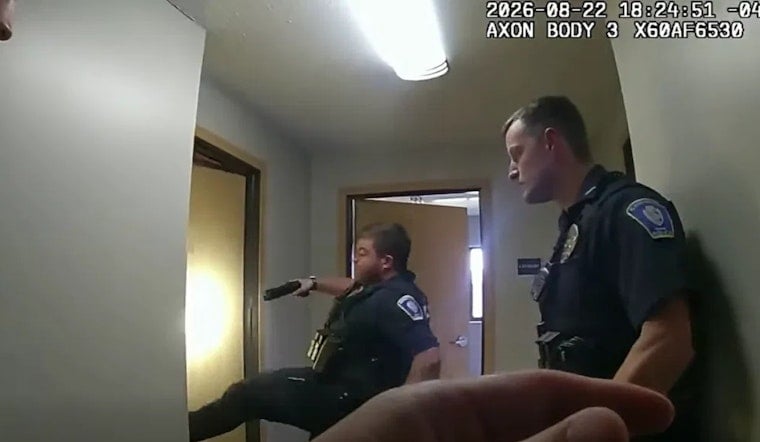
Greenville police officers forced their way into a home last Saturday after hearing a 10-year-old child crying for help inside, removing the child and taking an armed adult man to the hospital for psychiatric evaluation. Officers had responded to a call about the man on August 22, and what they found inside led to both a child-welfare intervention and an emergency mental health hold.
Officers Heard Crying, Then Went In
According to police, officers saw and heard the child crying for help from inside the home, prompting them to enter without waiting for a warrant. As reported by WKEF, officers located the man, who had been reported as armed and was allegedly refusing to let the 10-year-old leave the residence. Police say the man exhibited threatening behavior before officers took control of the scene.
Under the Fourth Amendment's emergency-aid doctrine, officers are permitted to enter a residence without a search warrant when they have an objectively reasonable belief that an occupant — particularly a minor — faces imminent danger, according to Police1. Courts have generally held that a genuine cry for help from a child inside a home supersedes the standard requirement to obtain a warrant first.
Child Removed, Man Sent for Evaluation
Once inside, officers removed the child from the home and the man was found and taken into custody without further incident described in the account. He was brought to a hospital, where he received both medical and mental health assistance, the station's report states. Body-camera video from the responding officers has since been made available, according to the same account.
Ohio Revised Code Section 2151.31 gives officers the explicit authority to take a minor into emergency protective custody without a prior court order when reasonable grounds show a child is in immediate danger and removal is needed to prevent physical or emotional harm, per Ohio law. Police emergency custody actions of that kind must then be submitted to county juvenile authorities for review.
Separately, Ohio's so-called “pink slip” statute, Revised Code Section 5122.10, authorizes police to take a person into emergency custody and transport them to a hospital for psychiatric examination if officers believe the individual has a mental illness and poses a substantial risk of physical harm to themselves or others. Under the state's emergency psychiatric hospitalization rules, a patient admitted on a police hold must be clinically examined within 24 hours of arrival, and per The Treatment Specialist, can be held involuntarily for up to three court days before the hospital must either discharge the person or file a court affidavit seeking civil commitment.
What Happens Next for the Family
In Darke County, Child Protective Services operates under Darke County Job & Family Services, which investigates endangerment reports and coordinates protective placement and family support out of its Greenville office. Following an emergency removal in Ohio, formal emergency custody filings in family court require demonstrating an immediate and present danger of irreparable harm, and typically require a follow-up court hearing within 14 days, according to Vantage Group Legal Services. It remains unclear whether Darke County prosecutors will pursue criminal charges against the man once he is released from the hospital, or what long-term placement decisions county welfare officials will make regarding the child.
The Greenville Police Department, headquartered at 100 Public Square, is led by Chief Ryan P. Benge, an Army infantry veteran and Darke County native who was sworn in last July after the resignation of former chief Eric Roberts. The department has a notable history with exactly this kind of call: it was previously the first agency in the Darke, Miami, and Shelby County service region to have 100 percent of its officers complete Crisis Intervention Team training through the local mental health board, according to the Tri-County Board of Recovery and Mental Health Services. That training emphasizes de-escalation and connecting people in crisis to medical treatment rather than jail, and the regional board continues to plan and fund crisis and addiction recovery programming across Darke County.




