

























































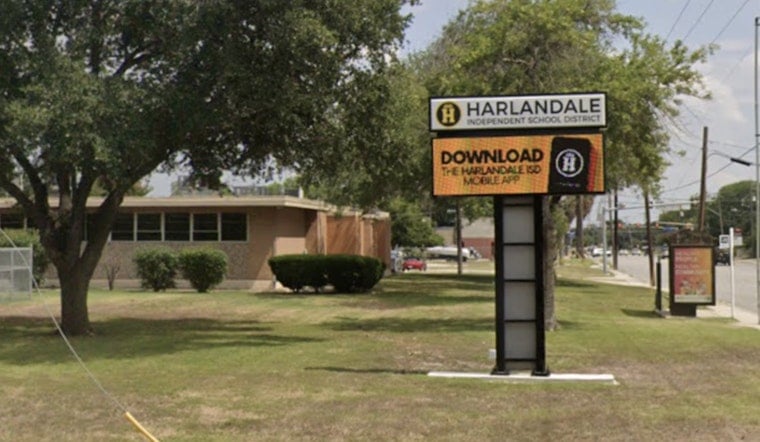
Harlandale Independent School District has announced that all students will be required to bring a clear or mesh backpack to school this year, joining a growing list of San Antonio-area districts that have adopted the see-through bag policy in recent years. District officials say the move is meant to strengthen existing safety measures and maintain what they call a safe and positive learning environment. But the policy arrives alongside mounting research questioning whether clear backpacks actually make campuses safer or simply make students feel watched.
Harlandale's new rule puts it in company with Southside ISD and South San Antonio ISD, both of which already require clear bags for all grade levels in Bexar County, according to the San Antonio Express-News. San Antonio ISD requires clear backpacks at select campuses, including Jefferson, Lanier and Burbank high schools, while further south, Edinburg CISD will require middle and high school students to use clear backpacks for the first time this year. Under most of these policies, students can still carry small opaque pouches inside their clear backpacks to hold personal items such as cellphones, keys or hygiene products.
A Trend Rooted in Uvalde
Clear backpack policies became common across Texas school districts after the 2022 mass shooting at Uvalde Consolidated ISD's Robb Elementary School, the newspaper's reporting notes. North East ISD had actually adopted a clear bag policy for middle and high school students back in 2018, years before Uvalde, but the district discontinued that policy in 2021 after parents voiced frustration with specialty bags breaking and needing replacement midyear. Bexar County reported that gun-related incidents in schools decreased after peaking in 2022, per the same reporting, though the article does not draw a direct causal line between that decline and clear bag mandates specifically.
Texas school districts have also had to adjust facilities and security measures to comply with House Bill 3, the state law that requires armed security guards on every campus and mandates districts update their facilities. As Hoodline has reported, the law increased the state's annual school safety allotment to just $10 per student and $15,000 per campus, even though hiring a single full-time armed officer can cost upwards of $85,000 annually per campus, according to KERA News. That funding gap has left many districts scrambling for lower-cost visible security measures like clear backpacks while they struggle to meet the armed-officer mandate.
Districts Claiming Exceptions to the Armed Guard Rule
The financial strain is not unique to any one district. As of January 2025, a Texas Senate Education Committee report found that 52% of Texas school districts had claimed good-cause exceptions to exempt themselves from the state's mandate to station an armed guard at every campus, citing funding shortfalls and officer shortages, per The Texas Tribune. That statewide non-compliance underscores how clear backpack rules often fill a budget vacuum left by harder-to-fund security requirements.
Regionally, the pattern has played out for years in the Houston area, where Cypress-Fairbanks ISD adopted clear backpacks for middle and high schools in 2018, followed by Aldine ISD, Crosby ISD and Cleveland ISD. Cleveland ISD enacted its requirement in April 2023 immediately after a middle school student made a violent threat, according to the Houston Chronicle. Dallas ISD took an even broader approach, instituting a mandatory clear or mesh backpack policy for middle and high school students in 2022 before expanding the requirement to all elementary and pre-K students for the 2023–2024 school year.
Do Clear Bags Actually Work?
Nationally, clear backpack mandates remain relatively rare despite the attention they draw. Only 4% of U.S. public schools required clear backpacks or banned book bags on campus during the 2021–2022 school year, down from 5.5% a decade earlier, according to data from the National Center for Education Statistics. And the backlash to such policies is not new: after the 2018 mass shooting at Marjory Stoneman Douglas High School in Parkland, Florida, officials mandated clear backpacks for returning students, but dropped the requirement within months following student protests and privacy complaints, as reported by CBS News at the time.
Research into whether the policies work at all remains murky. A 2025 study by the University of Southern California's Center for Risk and Economic Analysis of Threats and Emergencies found that students and staff view clear backpack policies as invasive, with two-thirds of surveyed students saying the bags felt like an invasion of privacy. The same study found the policies often create feelings of surveillance instead of safety. University of Michigan School of Public Health researchers reached a similar conclusion in a December 2025 study, finding that evidence on the effectiveness of school safety measures against gun violence remains limited and inconclusive.
Broader academic reviews echo those findings. A 2020 report by the RAND Corporation concluded that physical school security equipment is effective only when implemented as part of a multi-layered system that combines site design, clear policies, emergency response planning and student mental health support. More recently, a 2026 scoping review of 20 years of empirical studies on K-12 weapon carriage found mixed and inconclusive evidence that physical security measures successfully deter weapons, warning that visible target hardening can actually reduce students' overall sense of safety, according to research published in PubMed Central.
Weighing Cost Against Trust
The stakes go beyond privacy complaints. U.S. schools now spend more than $4 billion annually on physical security measures, yet a May 2026 synthesis from the Learning Policy Institute, reported by K-12 Dive, warned that research on the effectiveness of that technology remains sparse and that intrusive measures can diminish students' sense of trust and psychological safety. Beyond backpacks, districts have rolled out police presence, metal detectors and anonymous reporting tools as additional safety interventions, part of a layered approach that mirrors what researchers say is necessary for any single measure to be effective.
For Texas districts like Harlandale, the calculus remains difficult: state law mandates armed guards that many campuses cannot afford, while research questions whether visible measures like clear backpacks meaningfully reduce risk in the first place. Under Texas Education Agency guidelines, districts receiving federal funds must still file annual Gun-Free Schools reports and submit campus incident forms whenever a student is found carrying a firearm on school property, a bureaucratic backbone that continues regardless of which physical security measures a district chooses to adopt.





