

























































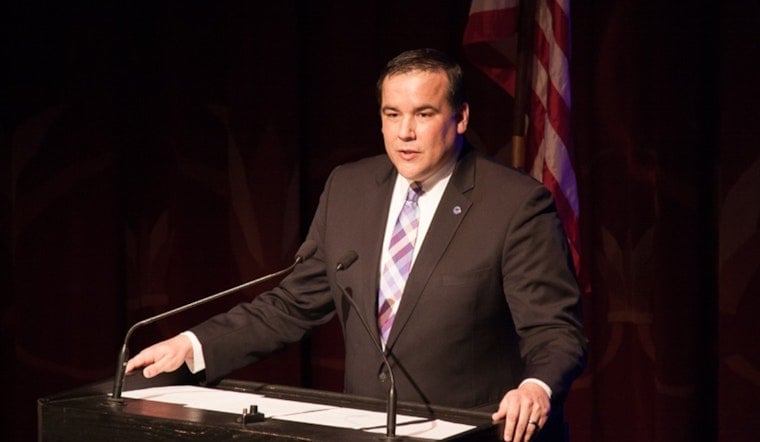
Columbus Mayor Andrew Ginther’s campaign just picked up $32,615.67 from people tied to the Haslam sports empire — the same ownership group behind the city’s new women’s soccer franchise. The donations landed in mid-July, months after City Council approved a $25 million public financing package tied to the team. The timing is likely to invite questions, but the filing itself does not explain why the contributions were made.
The Donations Arrived After Columbus Approved The Soccer Package
Friends for Ginther’s second-quarter campaign finance report, filed Friday, lists three Haslam-connected contributions, according to WSYX. Susan Haslam, listed as CEO of River Media, gave $16,615.67 on July 16, while Whitney Haslam Johnson and James Johnson each contributed $8,000 on July 20 and July 21.
Whitney Haslam Johnson and James Johnson are both listed as managing partners of Haslam Sports Group, which is part of the ownership group bringing a National Women’s Soccer League club to Columbus. The contributions came after City Council approved the soccer agreement in April, creating a straightforward timeline that is politically awkward even though it does not, by itself, establish an improper exchange.
The City Deal Included $25 Million And McCoy Park Land
The public arrangement was not a minor stadium refresh. Columbus’ approved legislation authorized a development agreement involving the city, Franklin County, the Confluence Community Authority and the NWSL ownership group, according to the Columbus City Council legislation file.
The package covers improvements at ScottsMiracle-Gro Field and a planned training facility on city-owned McCoy Park land. The city has said its investment would be repaid through admissions-related revenue generated at the stadium, while the team’s ownership group agreed to provide money toward replacement park improvements.
The vote was contentious because residents had expected McCoy Park to become a therapeutic recreation space and broader community asset. WOSU Public Media reported that Council approved the agreement in a 5-to-3 vote after amendments, with supporters touting women’s sports and economic development and opponents criticizing the loss of promised park space.
Ohio Rules Do Not Set A General Local Donation Cap
Ohio’s campaign-finance handbook says contribution limits generally apply to statewide and legislative candidates, not county or local candidates, though cash contributions and local charter rules can be exceptions. The Ohio Secretary of State also requires campaigns to disclose contributions and provides guidance on reporting and compliance.
Nothing in the campaign filing cited in the current reporting indicates that the Haslam-connected donations violated Ohio law. The report does not include an explanation for the contributions, meaning the available record shows the amounts, dates and donor affiliations — not the donors’ intent.
Ginther’s Campaign Is Sitting On More Than $1.7 Million
Friends for Ginther reported raising $472,913.38 during the second quarter and spending $124,889.09, leaving the campaign with $1,713,332.19 cash on hand. Ginther has confirmed that he plans to seek reelection in 2027, giving the newly disclosed donations an added political backdrop.
For now, the hard facts are a cluster of contributions from Haslam-connected donors arriving after a major city financing vote and a campaign report that offers no reason for the payments. The next phase of the story is likely to center less on whether the donations were disclosed — they were — and more on what Columbus voters think the timing says about access, influence and City Hall’s relationship with the team’s ownership group.





