

























































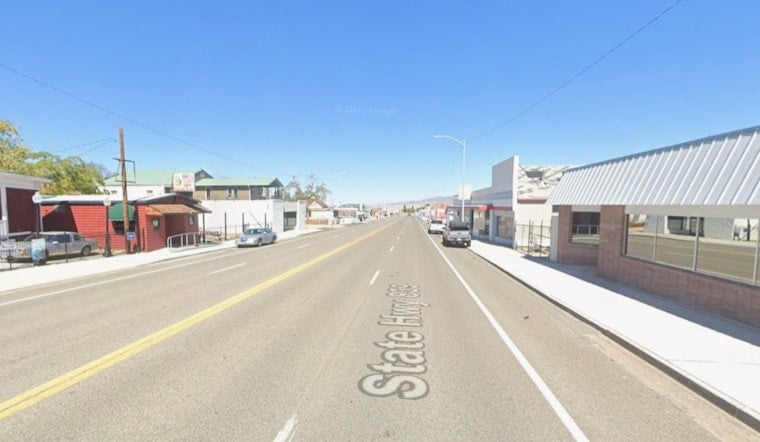
A weathered log-façade storefront on E Street in Hawthorne, Nevada, that sat condemned and shuttered for years has landed a spot on the Nevada State Register of Historic Places. The Log Cabin, now operating as Chooch's Log Cabin, opened its doors on May 27, 1949, and state historians say it stands as the only known historic programmatic log cabin storefront in Nevada.
The designation, announced by the state historic preservation office, was made official on August 13, 2026, according to the Las Vegas Sun. The building sits about 300 miles northwest of Las Vegas at 633 E Street, and it was assigned the tracking number SRIS 260166 as part of its formal listing, per the Nevada Department of Conservation and Natural Resources. State historians evaluated the property under Criterion C of the Nevada State Register, a category reserved for buildings that embody distinctive characteristics of a building type — in this case, programmatic architecture, a style in which structures are built to resemble the products or services they sell.
The nomination was written by Kansas Bowling, a film director who lives in Hawthorne, marking her second successful nomination to the register following her earlier work on the town's Cactus Theatre. Bowling has said she wants to bring attention to Hawthorne's often-overlooked history, per the Sun's reporting. She previously worked with the Commission for Cultural Centers and Historic Preservation to rehabilitate the Cactus Theatre, and she leads the non-profit Old Glory Theatre Company, which acquired that 1940s steel Quonset hut on 6th Street with plans to convert it into a 35mm revival cinema and military memorial venue, according to the Nevada State Historic Preservation Office. That theater, built during World War II as a recreation hall for ammunition depot workers, was added to the state register in 2023.
From Condemned Building to Community Hangout
The Log Cabin's path to preservation nearly ended in demolition. Owner Andy Beach purchased the condemned structure in 2022, telling the Sun that nostalgia prompted him to buy and save it from becoming a parking lot. He reopened it as Chooch's Log Cabin in 2023, and the bar now hosts live bands outdoors and occasionally welcomes food trucks onto its patio.
Beach installed a 1954 map of Hawthorne inside the building, and it has become a gathering point where military veterans and longtime residents identify historic landmarks and trade memories, according to the Nevada Department of Conservation and Natural Resources. The building's commercial life stretches back decades before Beach ever bought it: Stuart Higgins ran it as a bar and saloon until the early 1970s, the Times of Mineral County occupied the space starting in 1978, and the building returned to bar use as the Sierra Station Bar in 1984. It briefly operated as the Dog House sometime in the 2010s before sitting shuttered and eventually condemned.
A Boomtown's Boom-and-Bust Past
Hawthorne's commercial corridor has weathered more than its share of setbacks. The town lost major portions of its downtown to fires in 1926 and again in May 1942, leaving few pre-1940s business structures intact along E and F Streets, according to the Mineral County Independent News. Founded in 1881 as a Carson and Colorado Railroad town, Hawthorne saw its population sink to just 436 residents by 1900, and it suffered another economic blow in 1905 when the Southern Pacific Railroad built a bypass east of Walker Lake to Mina, stripping the town of its status as a regional rail hub.
World War II reversed that decline dramatically. The expansion of the Hawthorne Naval Ammunition Depot — established after a catastrophic 1926 military explosion in New Jersey pushed Congress to seek isolated storage sites — swelled the town's population to more than 13,000 residents as it became the nation's primary production and storage center for Navy mines and depth charges, per the Mineral County Independent News. That wartime boom is what drove the kind of post-war commercial construction that produced the Log Cabin in 1949.
Rules of the Register and What Comes Next
Nevada's State Register of Historic Places was created in 1979, and Nevada Revised Statutes § 383.085 authorizes the Administrator of the State Historic Preservation Office to set the standards and agreements used to maintain it, according to Justia Law. To qualify, a resource generally must be at least 50 years old, must retain strong physical evidence of its history, and must possess genuine historical significance. Local residents can submit their own nominations to the state or national registers, and Jean-Guy Tanner Dubé serves as Nevada's state and national register coordinator overseeing that process.
Mineral County has just a handful of properties carrying formal historic designations, among them the Mineral County Courthouse, the Sixth Street School, and the Hawthorne U.S.O. Building at 950 E Street — a 1941 structure built to serve defense workers and military personnel that now functions as the Hawthorne Community Center, per the National Park Service. Statewide advocacy group Preserve Nevada, directed by UNLV history professor Michael Green, has emphasized that adaptive reuse of rural historic structures helps drive regional heritage tourism across the state, according to the UNLV News Center. For a town that has cycled through booms and busts for more than a century, the Log Cabin's new status offers a small but tangible foothold for that kind of revival.





