

























































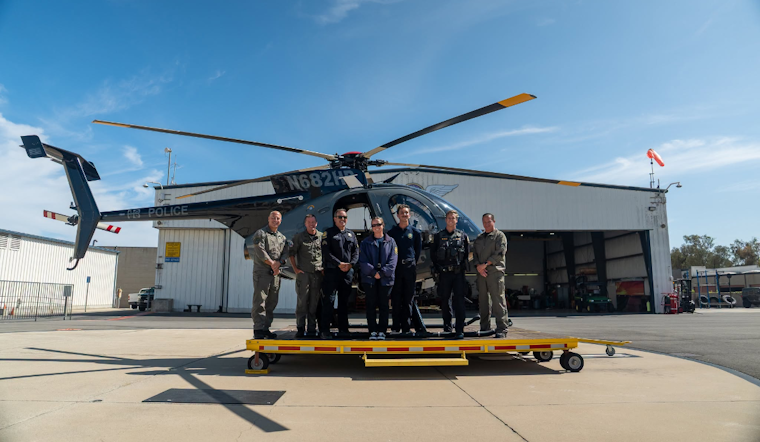
A swimmer vanished into the darkness and thick ocean mist off Huntington State Beach the night of Saturday, August 1, prompting a multi-agency scramble that ended with the person pulled from the water roughly 200 yards offshore and rushed to a hospital. The rescue leaned heavily on a police helicopter's thermal cameras to cut through conditions that had left rescuers searching blind along the shoreline.
According to the Huntington Beach Police Department, California State Parks lifeguards, peace officers and rangers responded to a report of a missing swimmer at Huntington State Beach and began an aquatic rescue effort. The department says its Air Support Unit helicopter, known as HB1, helped locate the swimmer from the air and guided rescuers to the exact spot in the water. Huntington Beach Fire Department personnel evaluated the swimmer once they reached shore, and the person was transported to a local hospital for further treatment, per the department's account.
A California State Parks report adds further detail to the timeline, noting the call came in at 8:42 p.m. near Tower 8 at Huntington State Beach, where 3-to-4-foot surf combined with dense ocean mist severely obstructed visibility from the shoreline. That combination of darkness and fog is precisely why HB1's onboard technology proved decisive: the department's fleet, upgraded in a $10 million replacement completed in February 2023, carries Night Vision Imaging Systems, Garmin glass cockpits, forward-looking infrared thermal cameras and high-intensity searchlights, according to MD Helicopters.
A Helicopter Program Built for Exactly This Moment
Huntington Beach's police helicopter unit is not new to bridging gaps like this one. The city's Air Support Unit was founded in 1968, making Huntington Beach the first city in Orange County and the fifth in the nation to use helicopters for public safety, per the City of Huntington Beach. The unit still flies out of the Bob Morrison Heliport in largely uncontrolled airspace, which a May 2021 Costa Mesa municipal report says allows HB1 to get airborne within 90 seconds of ignition and lets it provide contracted regional air support to Newport Beach, Costa Mesa and Irvine as well.
That speed and reach matter because Huntington State Beach and Huntington City Beach, though they share a continuous stretch of sand, fall under separate jurisdictions with different operating hours. Huntington State Beach's official hours run from 6 a.m. to 10 p.m., and its lifeguard towers go unstaffed after dusk, according to Visit Huntington Beach. That leaves nighttime swimmers without the immediate shoreline surveillance that daytime beachgoers rely on, which is exactly the visibility gap HB1 was called on to fill once the mist rolled in Saturday night.
Agencies Celebrate the Save With a Heliport Meet-and-Greet
In the days after the rescue, the police department's Air Support Unit invited the State Parks lifeguards who worked the call to visit its heliport, where the HB1 pilots and officers who located the swimmer met the ground crews who pulled them from the surf. The department framed the gathering, and its social media post about it, under the header “From the Sky to the Sea: A Partnership That Saves Lives,” crediting State Parks lifeguards, Huntington Beach Fire Department and its own Air Support Unit collectively for the successful outcome.
The rescue also lands amid a punishing stretch for Southern California beach safety this summer. Orange County lifeguards saved more than 400 swimmers over a single weekend in late July across Huntington Beach and Newport Beach amid severe rip current warnings, according to CBS Los Angeles. Separately, lifeguards along Bolsa Chica and Huntington State Beaches had treated more than 3,100 stingray stings by mid-August, more than double all of 2025's total, as sustained 60-degree water temperatures drove increased marine life activity, the LA Times reported.
Why Night Swims Off Guarded Beaches Carry Outsized Risk
California State Parks lifeguards conduct roughly 10,000 water rescues annually across more than 300 miles of state coastline and have saved over 266,000 people since the state lifeguard service began in 1967. Huntington State Beach itself has had a dedicated State Parks lifeguard presence since 1950, when former Newport City lifeguard Robert Isenor launched the state's first 17-person seasonal lifeguard operation there across the park's 121 acres.
National data underscores just how much the odds shift once those towers close for the night. The chance of a fatal drowning at a beach patrolled by certified lifeguards is roughly 1 in 18 million, according to 2026 figures from the United States Lifesaving Association — a benchmark that highlights how dramatically risk climbs once swimmers enter the water after lifeguards go off duty, as happened off Tower 8 the night HB1 was called in.
HB1 has featured in other high-profile Huntington Beach responses, including a dramatic police pursuit in the city and an emergency plane landing at Huntington State Beach in July that drew responses from both State Parks lifeguards and the police department. Saturday night's rescue adds another entry to that record, this time turning a potential tragedy in the dark surf into a swimmer safely delivered to a hospital.




