

























































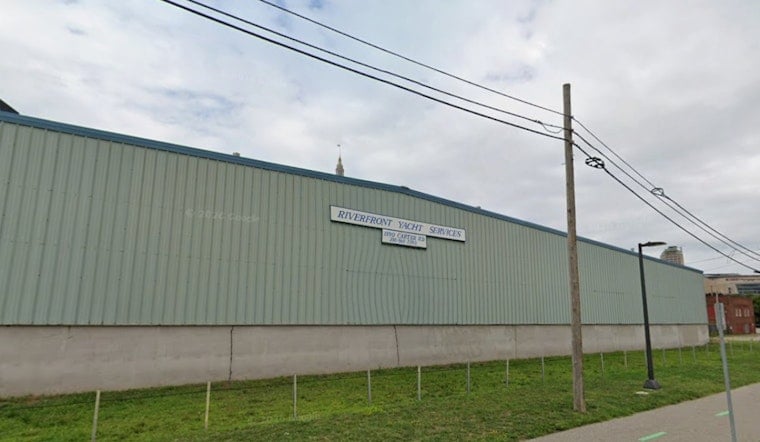
A 63-year-old sailboat that once trained U.S. Naval Academy midshipmen and later spent nearly 35 years teaching Lorain County kids to sail is now sitting in a Cleveland boatyard, stripped down to its bones as crews work to bring it back to life. The vessel, known as Intrepid, was hauled from Spitzer Marina in Lorain to Riverfront Marina in Cleveland this summer, and restoration crews say the project is roughly 10% complete with no major setbacks so far.
According to the Morning Journal, the move from Lorain to Cleveland was completed without major issues, and the boat had no significant leaks afterward. Intrepid is a 44-foot Luders yawl, one of 12 custom-designed sailboats built for the Naval Academy, and it was delivered to the academy in Annapolis, Maryland, in 1963. Per the same account, it served as a training vessel for midshipmen until 1983, when it was transferred to the Lorain Sea Scouts, who used it for training and educational programs for nearly 35 years before it fell into disrepair.
The vessel carries the official designation Hull NA-1, believed to make it the first fiberglass naval training yawl of its class built for the Naval Academy in the 1960s, according to The Chronicle-Telegram. The Chronicle-Telegram reports that Intrepid was lowered into Cleveland Harbor and towed up the Cuyahoga River to Riverfront Yacht Service in July, marking the first time it had floated since 2020.
Why the Fiberglass Fights Back
Mitch Scholle, foreman for the restoration team, has experience restoring large vessels and is overseeing the work alongside Chris Smith, who works for Riverside Sales and Yacht Services and serves as lead designer for the restoration team. The Morning Journal reports that Intrepid has extensive fiberglass reinforcement throughout the vessel, making it exceptionally strong but also making material removal and modifications more difficult for the crew.
That reinforcement traces back to the original Navy specifications of the 1960s. The U.S. Naval Academy replaced its original 1930s fleet of 12 wooden Luders 44 yawls with fiberglass versions built to identical hull lines but updated with auxiliary engines and navigation spaces, according to the USNA Sailing Center. Those fiberglass hulls were engineered to extreme structural standards so they could be transported across the country on flatbed railcars lying on their sides and lifted at sea using masthead lifting rings, according to the Sailing Adventures of Mai Tai website. Naval architect Alfred Edward “Bill” Luders Jr., who designed the original 44-foot training yawl for the academy in 1938, was an early innovator in yacht design and among the first to use epoxy resin in hull construction, per the Sailing Museum & National Sailing Hall of Fame.
A standard Luders 44 yawl carries a deep 6.2-foot draft, a total displacement of approximately 23,400 pounds, and 9,000 pounds of lead ballast, and was originally designed to berth a crew of eight midshipmen plus officers, according to Sail Magazine. Fiberglass Luders 44 yawls served as the Navy's primary offshore sail-training craft until 1987, when Congress began funding replacement Navy 44 sloops designed by McCurdy & Rhodes, per the USNA Sailing Center.
Making Room for Wider Doors and Easier Stairs
Crews are continuing interior demolition of Intrepid while removing decades of paint from the hull, according to the Morning Journal. Work so far has focused on improving accessibility: crews enlarged the hatch opening, reduced the slope leading into the cabin, and made other changes intended to ease movement aboard.
Larry Amato, deputy director of the Lorain County Veterans Service Commission, said the hatch and slope changes make the stairs easier to navigate. Amato described Intrepid as a training vessel and said its future will continue to center on education and training. The interior demolition is meant to prepare the boat for a new layout and planned modifications, and crews will turn their attention to the interior once the exterior hull restoration — the next major phase of the project — is complete.
A Project Built on Estate Gifts and Veteran Support
The restoration has drawn funding from state grants and private donations, including a contribution from the estate of John and Melva Oseka. Melva Oseka was interested in creating sailing opportunities for students and veterans, according to the Morning Journal. American Legion Post 30 and AMVETS Post 22 have also supported the project, and Amato said the project reached its fundraising goal.
Organizers plan to begin another fundraising campaign this fall to help hire a certified captain who will lead academic and veteran-focused initiatives, and to support the project's broader programs. Once restored, Intrepid is expected to provide opportunities for high school students interested in maritime careers, adults pursuing maritime certifications and licensing, and veterans learning sailing skills. Volunteers are needed for the project, with boatswains' mates particularly sought after.
Organizers also plan to launch the Intrepid Rebuild Podcast this fall, which will provide information about the boat's history and give the public a chance to follow the restoration as it unfolds. The boatyard doing the work, Riverfront Marine, sits along the Cuyahoga River at 1890 Carter Road in downtown Cleveland's Flats neighborhood, according to Riverfront Marine Sales & Service. Organizers are aiming to complete the restoration by June 2027, after which they intend to bring Intrepid back to Lorain multiple times each summer so local youth can get hands-on sailing experience on Lake Erie.



