

























































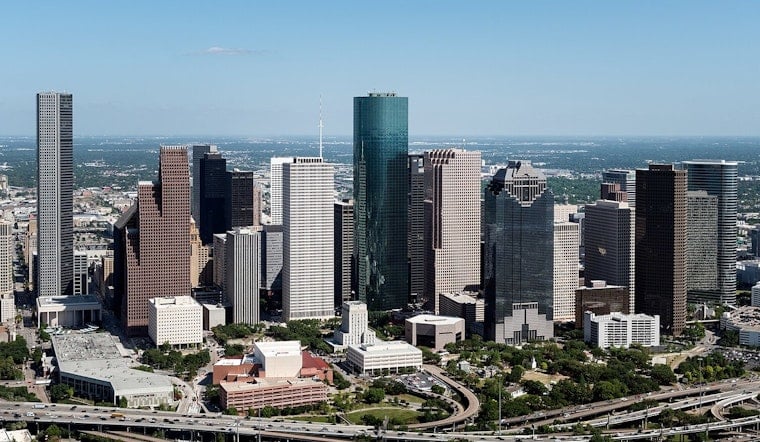
Houston created 39,700 jobs in fiscal year 2025-26, enough to rank third among major U.S. metro areas for job growth over the past year, even as the region's unemployment rate climbed above both the state and national averages. The city trailed only New York, which added 69,100 jobs, and Dallas, which added 54,600, according to the Greater Houston Partnership's annual midyear economic update.
Colin Baker, the Greater Houston Partnership's director of economic research, said Houston accounted for about 8% of the nation's job growth over the past 12 months, even though the metro represents a much smaller share of the country's total workforce. As reported by Community Impact, Baker said Houston created jobs at roughly four times the pace of the rest of the country and told the outlet that Houston had a healthier job market than the rest of the country. The U.S. added around 531,000 jobs total over the same 12-month period, with Los Angeles adding 37,400 and Phoenix adding 33,200. Washington, D.C. was the only major metro mentioned with significant job losses.
Construction Leads, Fueled by Public Infrastructure Spending
Construction was Houston's fastest-growing industry, adding 15,000 jobs over the past year, per the same report. Baker attributed much of that growth to significant investment in public infrastructure projects, pointing to roadway repaving, electrical infrastructure work, water projects, investment at the Port of Houston, and the expansion at George Bush Intercontinental Airport as key drivers.
That public-capital wave lines up with a string of specific projects moving through Houston right now. United Airlines and the City of Houston are funding a $2.6 billion redevelopment of Terminal B at Bush Intercontinental, and Houston City Council approved a $300 million municipal payment toward Phase 3 of that project in July, according to Community Impact. The project will add 40 new gates and replace terminal facilities dating back to 1969.
Port Houston's governing commission, meanwhile, approved a $726 million operating budget and a $569 million capital plan for fiscal year 2026 to expand container capacity and support channel dredging, according to BIC Magazine. That spending builds on the port's Project 11 expansion, a multi-year effort to widen and deepen the 52-mile Houston Ship Channel that began with $430 million in dredging contracts awarded in 2022 and remains under active construction through 2030.
On the utility side, Texas regulators approved a $2.7 billion Systemwide Resiliency Plan for CenterPoint Energy in August 2025, authorizing grid-hardening investments across Greater Houston through 2028, per Utility Dive. The Community Impact report notes CenterPoint's resiliency plan among the electrical infrastructure projects fueling Houston's construction hiring, though Baker also said some infrastructure hiring has started to level off.
Healthcare and Admin Jobs Round Out the Gains
Healthcare, which Baker said is typically Houston's No. 1 job-growth sector, added 6,800 jobs over the past year. Administrative-support roles, including employment services and temporary-worker positions, added 10,000 jobs, with Baker noting that Houston businesses have been in demand of temporary workers. Restaurants and bars added 4,500 jobs, professional, science and tech services added 3,100, and retail added 2,200.
Baker described Houston as a metro that is not as dominated by white-collar professions as some other major metropolitan areas, offering blue-collar work, professional accreditations, associate's degrees and workforce-entry support alongside its higher-education and corporate job tracks. Local training programs are reinforcing that pipeline: Houston City College received a $17 million grant from Bloomberg Philanthropies in June to launch Gulf Coast TradeUp Careers, a three-year initiative connecting more than 1,350 local students to paid apprenticeships in electrical work, plumbing, HVAC, and construction, as Hoodline previously reported.
Not Every Sector Is Growing
Houston posted losses in several industries even as its overall numbers climbed. Arts and recreation, real estate and equipment rentals, oil and gas extraction, and finance and insurance all saw job declines over the past year, according to the Greater Houston Partnership's update. The oil and gas pullback tracks with broader forecasts: the Partnership had projected in a late-2025 report covered by the Houston Chronicle that oil and gas extraction would lose roughly 3,200 jobs in 2026 due to lower crude prices, while healthcare was expected to account for nearly 45% of all regional job gains this year.
The job growth also comes against a backdrop of rising local unemployment. Greater Houston's unadjusted unemployment rate rose to 5.2% in June, leaving 204,365 residents actively seeking work, according to Workforce Solutions. That rate is higher than both the Texas state average of 4.9% and the national rate of 4.4%, and it has climbed steadily from 4.6% in May and 4.5% a year earlier. Total nonfarm payroll employment across the metro reached a record 3,521,500 positions in June after employers added 14,400 jobs that month, nearly 40% above the metro's pre-pandemic June hiring average.
Houston's Gains Fit a Statewide Pattern
Houston's ranking arrives as Texas as a whole led the nation in job creation. The state added 177,900 nonfarm jobs between June 2025 and June 2026, a 1.2% growth rate that outpaced the national rate by 0.9 percentage points, according to the Texas Workforce Commission. Texas reached a record 14,469,600 total jobs statewide in mid-2026, a milestone Hoodline covered as part of the state's broader run atop national job-growth rankings.
Houston's civic and academic institutions are adding to that momentum too. Texas Southern University generated an estimated $1.6 billion in annual regional economic activity and supported 15,676 jobs across Harris, Fort Bend, Brazoria, and Galveston counties during the 2023-24 academic year, with alumni earnings accounting for $1.3 billion of that total impact, Hoodline has reported. Taken together, the numbers point to a Houston economy expanding faster than most of the country, even as it works to absorb a labor force that, for now, is growing a little faster than the jobs arriving to meet it.





