

























































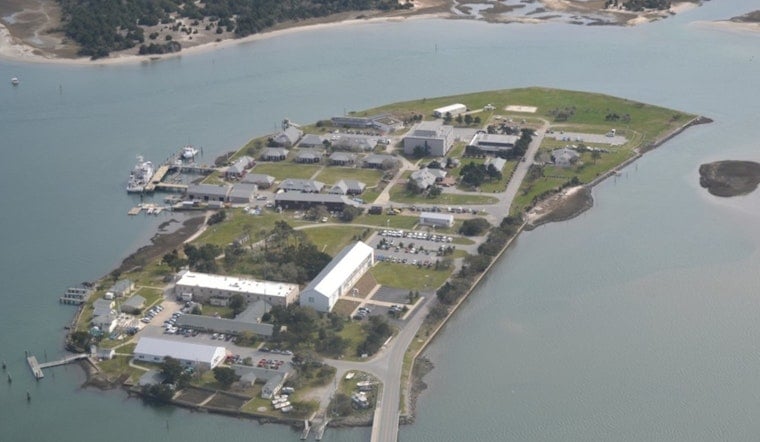
NOAA is moving ahead with a $64 million rebuild of its historic Beaufort marine laboratory after hurricane damage left the facility's main building unsafe to occupy. The lab, which sits on Pivers Island in North Carolina's estuarine waters roughly 155 miles southeast of downtown Raleigh, has anchored federal marine science along the coast since 1899. Construction on the replacement building is expected to begin in 2027, with the new structure engineered to sit above the floodplain and withstand future storm and flooding events.
NOAA shuttered the lab's main building in October 2024 after routine inspections uncovered severe foundational damage tied to hurricane impacts, according to the National Centers for Coastal Ocean Science. NOAA determined that the foundational damage made continued occupancy of the 62-year-old structure unsafe, and the building had housed the majority of lab space on campus, including offices for half of its staff, as reported by The Charlotte Observer. NOAA announced the rebuilding plan in an Aug. 27 news release, per the Observer's account.
NOAA Administrator Neil Jacobs said the new facility will enable the agency to continue its groundbreaking research, per the Observer's report. The rebuild is being funded with $64 million from the 2025 Disaster Relief Supplemental Appropriations Act, a federal emergency measure that designated more than $1.65 billion in disaster grants for North Carolina, according to Carolina Cattle Connection.
Keeping Science Running While Waiting on Construction
While the new building is planned, NOAA has renovated existing structures on the Pivers Island campus so displaced staff can keep working locally, per the National Centers for Coastal Ocean Science. Those renovations include new staging space for uncrewed underwater vehicles, an upgraded SCUBA dive locker, additional administrative areas, and a new greenhouse for research on marine organisms. That interim work is allowing scientists to continue projects such as uncrewed underwater vehicle mapping and harmful algal bloom tracking ahead of the scheduled 2027 construction start, the outlet's report notes.
The finished facility is meant to expand NOAA's scientific capabilities well beyond replacing lost lab space. Plans call for specialized infrastructure to forecast harmful algal blooms, deploy uncrewed underwater systems for coral restoration and mapping, evaluate natural coastal protection barriers, and serve as a regional South Atlantic fisheries management hub, according to the same NCCOS account. The Beaufort Laboratory is home to NOAA's National Marine Fisheries Service Southeast Fisheries Science Center as well as the North Carolina Coastal Reserve and National Estuarine Research Reserve, per the Observer.
A Federal Foothold More Than a Century in the Making
The lab's roots on the North Carolina coast predate NOAA itself by more than 70 years. It started in 1899 as a field station for the U.S. Commission of Fish and Fisheries, operating out of rented quarters at the historic Gibbs House on Front Street in downtown Beaufort before the federal government had land of its own, according to Coastal Review. When Congress established the field station in 1900, it left out funds for a permanent site, so five universities — Johns Hopkins, UNC, UVA, UGA, and USCA — joined private donor Alonzo Thomas to raise $400 in 1901 to buy three acres on Pivers Island, Coastal Review reports. The lab moved to that island site in 1902 and became part of NOAA's National Centers for Coastal Ocean Science in 1999, the Observer notes.
That history makes Beaufort the nation's second-oldest federal marine science laboratory, trailing only the Woods Hole Fisheries Laboratory in Massachusetts, which opened 14 years earlier in 1885, according to a NOAA Fisheries comparison. The lab isn't the only tenant on the 24-acre island: Duke University established its own marine laboratory on Pivers Island in 1938, and it continues to share the island with NOAA's campus today, per Coastal Review's account of the academic-federal cluster.
A Facility That Has Weathered More Than Storms
The rebuild follows a stretch of institutional turbulence that predates the 2024 hurricane damage. The lab previously faced closure in March 2014, when President Barack Obama's proposed FY2015 federal budget targeted it for shutdown as part of a broader effort to consolidate ocean science spending, according to The Fisheries Blog. Community and congressional pushback saved the facility, which at the time employed roughly 100 federal workers, the outlet reported. More than a decade later, it was hurricane damage rather than budget politics that forced the current main building to close, underscoring the site's long-running vulnerability to both storms and shifting federal priorities.





