

























































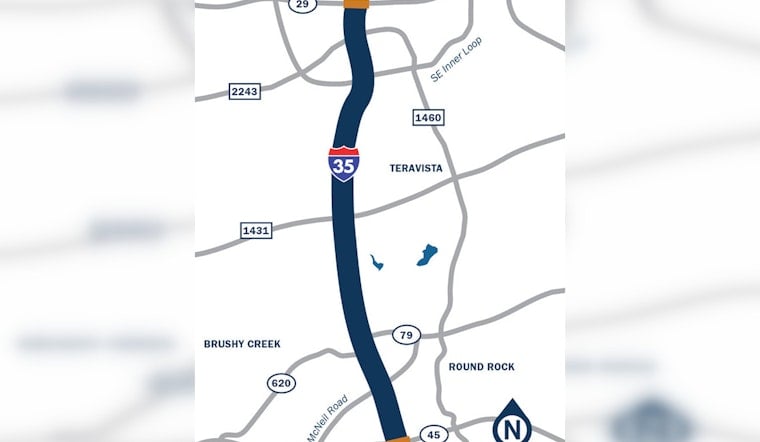
Drivers stuck in the daily grind between Round Rock and Georgetown could soon see a much wider Interstate 35, but the plan comes with a catch: it would require demolishing an overpass that's home to one of Central Texas's largest bat colonies. The Texas Department of Transportation is asking the public to weigh in on the 13-mile widening project before a public comment period closes Friday, August 28.
TxDOT held an in-person meeting last Thursday, August 13, at the Williamson County Georgetown Annex to walk residents through preliminary designs for the stretch of highway between Texas 29 and Texas 45, according to TxDOT. As reported by the Austin American-Statesman, the project is still in preliminary design, and the corridor already carries up to 217,000 vehicles on any given day — a number the agency says is only going to climb. TxDOT modeling projects that segment could see 380,000 daily vehicles by 2055.
Why TxDOT Says the Highway Can't Keep Up
The push for a wider I-35 traces directly back to how fast this part of Texas is growing. Georgetown's population surpassed 100,000 residents for the first time, reaching an estimated 101,344 after growing 47.5% between 2020 and 2024, according to the Williamson County Sun. The broader county has grown just as fast — U.S. Census Bureau data ranked Williamson County 10th in the nation for annual numeric population growth, with the county adding nearly 25,000 residents between July 2022 and July 2023 to approach 700,000 total residents.
TxDOT says that growth has pushed I-35's capacity through the corridor past its limits for current and projected traffic demand, per the Statesman's reporting. Without the widening, the agency's modeling projects up to two hours of afternoon-peak congestion and up to 36 minutes of morning-rush delays. With the expansion built, TxDOT projects travel times through the stretch would drop to around seven to nine minutes.
Safety is central to the pitch as well. The corridor logged nearly 8,600 crashes and 31 deaths from January 2021 through June 2026, per TxDOT — an average of more than four crashes a day, with crash rates 28% above the state average for urban interstates. TxDOT has said the expansion would reduce crashes by 20% to 50%.
What Would Actually Get Built
The proposed design includes one main lane in each direction added between Texas 29 and RM 1431, plus two high-occupancy vehicle lanes in each direction through the corridor, the Statesman reports. Plans also call for relocated entrance ramps and exits, reconstructed bridges and intersections, bypass lanes, and pedestrian and bicycle infrastructure running the length of the corridor.
This 13-mile stretch is the northern extension of TxDOT's broader Mobility35 program, which spans nearly 80 miles of highway improvements across Williamson, Travis, and Hays counties, according to WSP. That program also includes the massive Capital Express projects moving through Austin, including the $4.5 billion Capital Express Central overhaul that broke ground in October 2024 to lower I-35's main lanes through downtown — a project Hoodline covered in Texas's infrastructure revamp earlier this year.
A Bat Colony and a Cave Complicate the Plans
The project's environmental footprint is drawing scrutiny well beyond traffic engineers. The corridor sits near Inner Space Cavern, the Edwards Aquifer Recharge Zone, and a bat habitat, and TxDOT would need to temporarily displace thousands of bats to demolish the McNeil Road overpass, the Statesman reports. That overpass hosts an estimated seasonal colony of Mexican free-tailed bats that ranks as Central Texas's second-largest urban bat colony after Austin's Congress Avenue Bridge, according to Community Impact.
The colony's vulnerability isn't theoretical. Bat conservation experts estimated roughly 500,000 bats across Central Texas died from extreme freezing and food scarcity during Winter Storm Uri in February 2021, before local bridge colonies began recovering, the outlet's report notes. TxDOT has said a new McNeil Road bridge would provide more roosting space for the bat colony once construction wraps, though the McNeil Road overpass bat colony would be disturbed by the project in the meantime, per the Statesman.
Inner Space Cavern, a popular tourist stop that is home to endangered karst invertebrates, adds another layer of complexity. The cave was originally discovered in the spring of 1963 by a Texas Highway Department core-drilling team testing ground stability for the original I-35 overpasses in Georgetown, when drills broke through 33.5 feet of bedrock into the subterranean chambers, according to Inner Space Cavern. TxDOT says it is working with conservationists to study and reduce impacts to the underground ecosystem, and the agency must comply with special regulations protecting groundwater in the aquifer.
Those regulations aren't optional. Highway construction over the Edwards Aquifer Recharge Zone in Williamson County falls under Texas Commission on Environmental Quality Chapter 213 rules, which require approved Water Pollution Abatement Plans and permanent stormwater best management practices, according to TCEQ. This isn't the first time TxDOT has tweaked this exact stretch of highway either — the agency held a public hearing in June 2021 for a $19.2 million safety project that realigned frontage roads and modified access directly in front of Inner Space Cavern.
A Long Road Ahead, With No Funding Yet Secured
TxDOT began studying this segment of I-35 back in 2013, and the current phase of preliminary design and environmental analysis started in 2023, per the Statesman's report. The environmental study is expected to take another two to three years, and final design and construction could take another eight years combined after that — meaning TxDOT has not given a completion timeline for when drivers might actually see relief.
Funding remains an open question, too. TxDOT has not identified funding for final design and construction, the newspaper reports, leaving the project's ultimate timeline dependent on future budget decisions well beyond this month's public comment window.
For now, TxDOT is seeking public feedback on the proposal, which residents can submit through the agency's website, by email at [email protected], by voicemail at 737-345-2971, or by mail to the I-35 Georgetown to Round Rock project office at 13620 Briarwick Drive, Suite 100, Austin, TX 78729. Comments are due by Friday, August 28.


