

























































The Jersey City Redevelopment Agency board voted to move forward with a study aimed at addressing the displacement of longtime residents, even as it pressed ahead with contested environmental cleanup work at the Morris Canal Redevelopment Area. The anti-displacement study advanced, while the Morris Canal environmental services contract was reported inconsistently: first as a unanimous 4-0 voice vote and later as a 3-1 vote.
According to Hudson County View, the JCRA plans to issue a request for proposals to hire a consultant for the study, a measure that had been carried twice previously before finally advancing. JCRA counsel Joe Baumann told the board the cost of the study will remain unknown until proposals come in, and officials said it will be funded through grant funds rather than taxpayer money.
JCRA Commissioner Jonathan Schwedel said the study represents the first step toward a possible 20 percent inclusionary zoning ordinance, though he cautioned that such a policy could increase rents or push more developers toward PILOT arrangements instead. Commissioner Stephanie Startz noted that the agenda item had been reworded to strip out specific inclusionary zoning language, and she floated an alternative idea: diverting consultant funding directly to residents to help offset rising rents.
Board Members Split Over Zoning Implications
Not every commissioner was on board. Omer Calakos-Mano opposed the redevelopment and affordable housing study, arguing that rents continue to rise while very little affordable housing gets built in the city. Akshay Verma also opposed the measure, citing concerns about the implications of a future inclusionary zoning ordinance, and another commissioner pointed to the track record of inclusionary zoning failing elsewhere across the country.
The debate arrives against a backdrop of legal upheaval. Jersey City has lacked a binding inclusionary zoning law since August 2021, when a Hudson County Superior Court judge struck down the city's prior Inclusionary Zoning Ordinance following a lawsuit from the Fair Share Housing Center. The court found the ordinance had unlawfully let developers sidestep affordable housing commitments through informal side deals and had skipped required planning board review, according to Hudson County View. The discussion also referenced a downtown Jersey City project with inclusionary zoning standards and a PILOT arrangement.
Jersey City Open Data records show that officials reviewed and discussed an inclusionary zoning ordinance on November 30, 2021, including a requirement that applicable developments include mandatory onsite affordable housing.
Morris Canal Cleanup Reopens Old Wounds
The environmental services contract vote proved just as contentious. JCRA acting executive director Christopher Fiore confirmed the agency already holds an existing contract for Morris Canal environmental services, and the ongoing work is recommended by the New Jersey Department of Environmental Protection. A licensed site remediation professional had specifically recommended the current phase of work, and Baumann told the board the cleanup cannot simply be halted. That claim tracks with state law: under New Jersey's Site Remediation Reform Act, environmental investigations and cleanups are overseen by Licensed Site Remediation Professionals, a framework the New Jersey Department of Environmental Protection maintains shifts daily oversight away from state agency staff and directly onto LSRPs. Commissioner Michael Griffin voted against the contract, while Mary P. Noonan and Douglas Carlucci were absent from the vote.
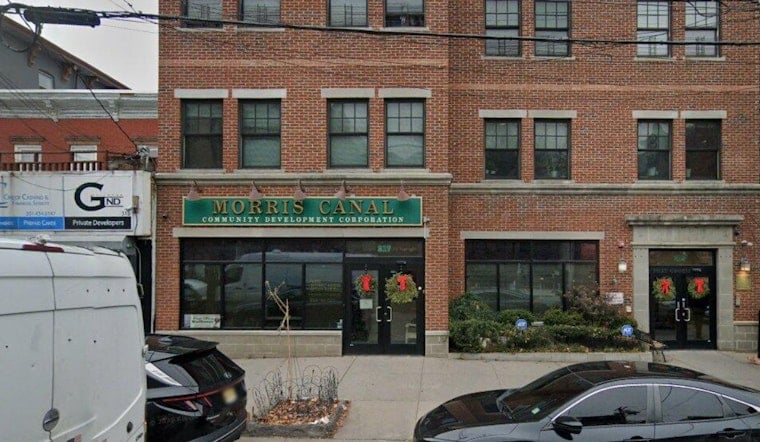
Morris Canal Community Development Corporation consultant Veronica Sutton told the board her organization has spent $600,000 on the project and said the JCRA had repeatedly stopped the work for reasons she characterized as irresponsibility and negligence. Sutton said 46 residents could have become homeowners before the pandemic worsened, referring to a homeownership project the nonprofit had originally planned for the site.
A Redevelopment Dispute Dating to 2022
The friction traces back to February 2022, when the JCRA board voted 7-0 to remove the Morris Canal CDC as designated redeveloper for the 408-420 Communipaw Avenue project, ending a status the organization had held since 2003. The removal came amid a dispute over the project, as previously reported by Hudson County View. Morris Canal CDC Executive Director June Jones accused the JCRA of following former Mayor Steve Fulop's orders to take the project away from her organization at that time.
Jones went further at the recent meeting, accusing the JCRA of taking and delaying the Morris Canal project and saying the surrounding community is being left out of the development happening around it. She also alleged that Mayor James Solomon told her the organization would get the project back, though that alleged assurance has not translated into any reversal by the agency. Despite the ongoing dispute in Jersey City, Hudson County Executive Craig Guy appointed Jones in November 2024 to the inaugural 11-member Hudson County Affordable Housing Task Force, a countywide body tasked with formulating policy on low- and moderate-income housing, according to Hudson County Government.
The Affordability Backdrop
The dispute over the anti-displacement study lands amid a broader affordability crunch that has reshaped Jersey City even as it has built more housing than almost anywhere in the region. Between 2010 and 2022, the city added nearly 26,000 housing units, more than triple the per capita production of the broader New York metropolitan region, yet market rents climbed 50 percent since 2015, leaving 60 percent of households earning under $94,000 cost-burdened, per the Regional Plan Association. Census data show Jersey City's median gross rent reached $2,007 between 2020 and 2024, while the citywide median market rent has since climbed to $2,512 per month.
Not every measure paints Jersey City as uniquely unaffordable. A WalletHub study using Census data found the city's median gross rent absorbed 24.65 percent of its median annual household income. Still, that high local median income can mask significant hardship for lower-income, longer-term residents who have not shared in the city's wage gains.
This is not the first time zoning fights have flared in the Lafayette neighborhood surrounding Morris Canal.
The JCRA now faces a monthslong process of evaluating proposals and hiring a consultant for the anti-displacement study, a process Baumann said will take months. Meanwhile, the Morris Canal environmental cleanup continues under the LSRP's ongoing supervision, with Baumann saying the current work should not be stopped even though the contract can be terminated, regardless of how the redevelopment dispute with the Morris Canal CDC ultimately resolves.





