

























































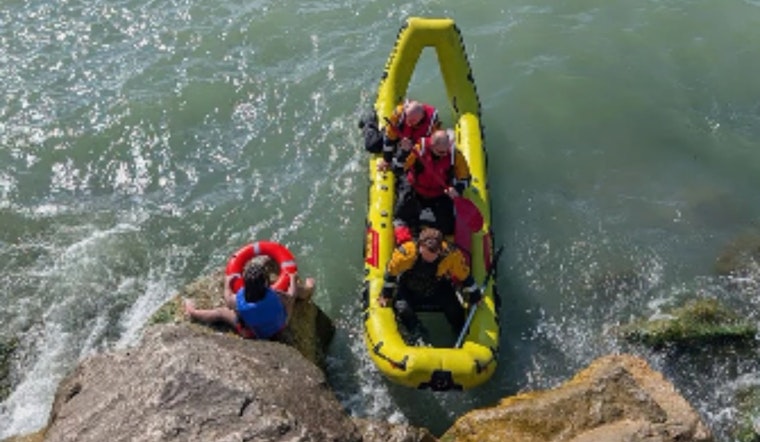
A kayaker got trapped on rocks near the pier at Euclid Beach on Tuesday afternoon after falling into Lake Erie, with waves crashing over the area as Cleveland Fire crews scrambled to reach them. No injuries were reported to the kayaker or to the firefighters who carried out the rescue.
Cleveland Fire's Technical Rescue 1 unit responded to the scene and deployed an inflatable rapid deployment craft to reach the stranded paddler, according to FOX 8 News. The department's Facebook post detailing the response noted that Marine 21, Cleveland's fireboat, arrived just as the rescue was wrapping up. Cleveland EMS and Cleveland Metroparks Police also assisted on scene.
Crews sent the rescue boat out to where the kayaker had become stranded on the rocks, ultimately bringing them safely back to shore. Cleveland Fire officials reminded the public afterward that conditions on Lake Erie can change quickly, even on days that look calm from the shoreline, the station's report noted.
Calm Forecast, Dangerous Shore Chop
The mismatch between forecast and reality was stark that afternoon. The National Weather Service's marine forecast for nearshore waters near Euclid Beach had called for a low swim risk and wave heights around just 1 foot. Yet nearshore waters near piers and breakwalls can develop localized crashing waves that catch paddlers off guard, even when the broader lake forecast looks tame.
Part of the reason lies in the lake itself. Lake Erie is the shallowest of the Great Lakes, with an average depth of just 62 feet, a trait Hoodline has previously reported makes its open waters uniquely prone to sudden chop and rapid wave buildup whenever wind direction shifts. That shallow basin lets wind energy transfer quickly into steep surface waves, particularly around fixed structures like piers.
A Familiar Playbook For Cleveland's Rescue Crews
Using the inflatable craft instead of the larger fireboat let Technical Rescue 1 reach the rocks without risking damage to Marine 21 or endangering the crew navigating close to the breakwall. Marine 21, a 43-foot vessel named the Garrett A. Morgan after the local inventor, was commissioned in 2024 and can pump 6,000 gallons per minute, having replaced a boat that dated back to 1961.
The unit has stayed busy this month. Earlier in August, Technical Rescue 1 used a tethered rescue boat to pull a teenager from tree branches above a swollen creek in Cleveland Metroparks, an operation Hoodline covered in its report on the crew pulling a teen from raging Big Creek. Technical Rescue 1 is based at Station 17 in League Park and specializes in swift-water and high-risk rescues.
A Rough Season On The Water
The Euclid Beach rescue adds to what has already been a difficult year for Lake Erie. As of this month, the Great Lakes Surf Rescue Project had recorded nine confirmed drownings in Lake Erie for 2026, part of more than 35 drownings across the Great Lakes system, according to figures reported by Military.com. Lake Erie has historically averaged around 21 drowning or missing-person incidents per year.
Kayaks and canoes make up a real share of that risk statewide. Non-motorized watercraft accounted for 3 of Ohio's 14 fatal boating incidents in 2024 and 4 of 10 in 2023, per the Ohio Department of Natural Resources. That risk exists alongside enormous popularity: an ODNR survey found non-motorized boating accounted for 128 million of the 315 million total boater hours logged on Ohio waters in 2022.
What Ohio Law Requires Of Paddlers
Ohio law requires every kayak on state waters to carry at least one U.S. Coast Guard–approved wearable life jacket per person, and children under 10 must wear one on any vessel under 18 feet, per ODNR guidance. Adults, however, are not legally required to wear a life jacket continuously while paddling, only to keep one readily accessible, an ongoing point of emphasis for water safety advocates. Kayaks must also be registered with the state on a three-year cycle and carry a sound-producing distress device such as a whistle or horn, according to The Backpackers Shop.
It remains unknown whether the Euclid Beach kayaker was wearing a life jacket at the time of the fall, what caused them to go into the water in the first place, or whether Cleveland Metroparks Police issued any warnings or citations related to lake conditions that day. The Euclid Beach incident follows a string of Lake Erie water emergencies this summer, including a boat capsize that left a 73-year-old man missing nine miles offshore off Conneaut earlier this month.





