

























































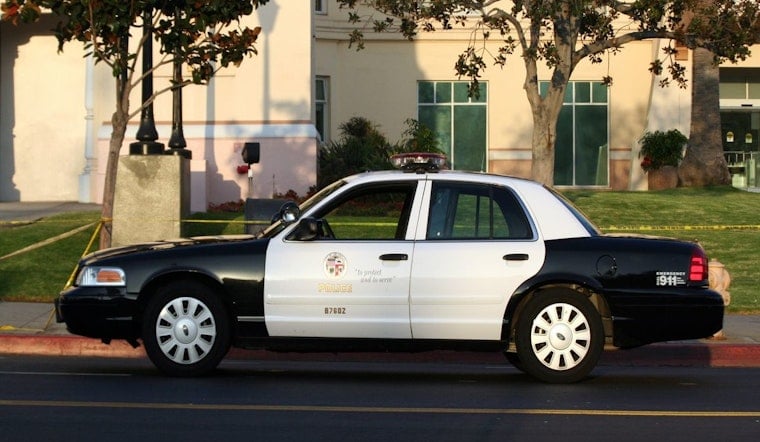
Los Angeles police are rolling out a siren that drivers and pedestrians won't just hear, they'll feel it in their chests. The Rumbler, a low-frequency siren system built around a 10-inch speaker, is being installed on 20 black-and-white patrol vehicles as part of an initial deployment concentrated in the downtown Civic Center area, with plans to eventually expand to roughly 2,000 of the department's 5,000 vehicles over the next couple of years.
The technology, developed by Illinois-based Federal Signal, works by interacting with a standard police siren and amplifying its sound through speakers, delivering blasts in eight-second intervals, according to the Los Angeles Times. A standard police siren generates around 110 to 120 decibels, but the Rumbler is designed to penetrate solid materials so that vehicle operators and nearby pedestrians can physically feel the sound waves rather than merely hear them. Federal Signal says the system is highly effective in dense urban environments with heavy vehicle traffic, per the manufacturer.
LAPD Commander Blake Chow, who heads the department's Support Services Group, said the technology addresses a persistent problem: drivers failing to clear a path for approaching emergency vehicles. Chow said that during pursuits, three or four cars sometimes pass before everyone finally stops, according to the Times report. The rollout requires no extra funding because of existing vendor agreements, the paper's reporting notes.
Why Modern Cars Can't Hear the Siren Coming
Law enforcement agencies contend that modern vehicles are simply built to block out road noise, including sirens, using opposite-frequency technology, silicone-based door-seal coatings and noise-dampening window designs. The Times cited real-world figures to illustrate the point: the 2024 Hyundai Sonata N-Line recorded 51.9 decibels of interior road noise, the 2025 Kia K5 recorded 51.1 decibels, and the 2025 BMW X7 40i, 2025 Volvo XC90 Twin Motor Performance and Lexus TX 350 Luxury each recorded under 50 decibels. By contrast, a 1970s-era Chevrolet light utility vehicle registered just 86 decibels of interior noise, underscoring how much quieter modern cabins have become.
Acoustic research helps explain why a low-frequency approach cuts through that insulation better than a traditional siren. Federal Signal reduces a primary siren's frequency by 75 percent to emit low-frequency sound waves between 182 and 400 hertz, delivering up to 10 decibels higher sound pressure inside nearby civilian vehicles, according to background compiled on the technology. Research published in Acoustics Australia found that these systems work by low-pass filtering and frequency-shifting primary siren signals through sub-woofers, projecting acoustic power evenly across intersection angles where directional high-frequency tones tend to fade, since bass waves bend around obstacles rather than relying on straight-line propagation.
The Rumbler's origin story traces back to a Florida Highway Patrol officer whose original design was inspired by the bass-thumping audio systems of local cars, according to the Times. Long Beach installed the system in patrol vehicles in 2009, while the New York Police Department began using it the same year, starting with about 150 vehicles before expanding to 500 by the following summer.
Not Every Department Stuck With It
Long Beach has since moved on. The department switched to a different low-frequency system, the Whelen Howler, in 2023. A Long Beach police spokesperson said officers consider the Howler more effective than a traditional siren at getting drivers' attention, according to the Times report.
LAPD is also pairing the Rumbler with a sound and light syncing system that allows several police vehicles to broadcast synchronized public safety announcements while displaying the same light-signal pattern. Greg Field, a 27-year LAPD veteran and director of the department's motor transport division, said sync systems are useful for mass messages such as fire evacuations or unlawful assemblies. The Rumbler itself can play prerecorded messages, including “move to the right,” in both English and Spanish. Each unit costs between $600 and $1,000 depending on accessories, and Emada E. Tingirides will decide which vehicles receive the system after the initial deployment.
Critics Warn of an “Acoustic Assault”
Not everyone is convinced the trade-off is worth it. The Rumbler has drawn detractors who worry about what they describe as an acoustic assault on people who happen to be nearby when it activates. Richard Tur, founder of NoiseOff, said the blast is omnidirectional even though its speakers face forward, meaning bystanders far from the vehicle's nose can still feel the impact. Tur said the technology unnecessarily pounds through bystanders' bodies.
Hamid Khan, an organizer with the Stop LAPD Spying Coalition, said the impact of the Rumbler on the communities where it will be deployed is being overlooked. Khan said the additional noise ultimately affects sleep cycles, hearing and trauma among local residents. He pointed to a 2023 LAPD helicopter audit that found most helicopter calls were not high priority and often targeted communities such as South Los Angeles, drawing a parallel to concerns that Rumbler deployment could disproportionately affect similar neighborhoods.
The health stakes behind those concerns are backed by federal research. The National Institute for Occupational Safety and Health recommends an exposure limit of 85 dBA over eight hours, warning that every 3 dBA increase doubles acoustic energy, and that sirens emitting 110 to 129 dBA pose significant hearing loss risks to responders and nearby pedestrians, according to the CDC. NIOSH research indicates that up to 52 percent of law enforcement officers suffer measurable hearing loss tied to job-related noise exposure. OSHA separately sets 85 dBA as its own safety threshold, according to the Times.
The Legal Backdrop for LA's Streets
California law restricts sirens to authorized emergency vehicles in the first place. Under California Vehicle Code Section 27002, non-emergency vehicles are strictly prohibited from being equipped with or operating sirens, a rule that dates back to 1919 when the state first outlawed private motorists from using sirens to clear traffic, according to Justia Law. Once a siren is sounding and red lights are displayed, Hoodline previously reported that California Vehicle Code Section 21806 requires drivers to pull to the right-hand curb and stop until the vehicle passes.
California Code of Regulations Title 13 also sets acoustic standards, requiring Class A electronic sirens on emergency vehicles to produce a minimum sound pressure level of 120 decibels at 3 meters directly on-axis, while prohibiting frequencies below 100 Hz or above 5,000 Hz. Those state benchmarks roughly track national standards set by the National Institute of Justice, which divides sirens into Class A units producing at least 120 dB on-axis and Class B units producing at least 115 dB.
LAPD's push to clear intersections faster comes against a backdrop of dangerous vehicle pursuits. A 2026 review by the Los Angeles City Office of the Inspector General logged more than 4,200 police pursuits between 2018 and 2024, with roughly one in four resulting in collisions that injured or killed suspects, officers or bystanders. LAPD's stated goal for the Rumbler expansion is to give motorists and pedestrians earlier, more noticeable warnings of approaching emergency vehicles, and to help them recognize danger and respond safely, department officials said, according to the Times.




