

























































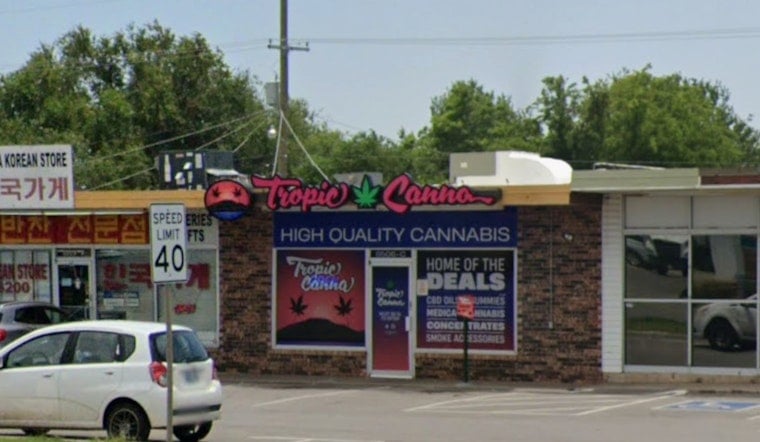
A Lawton dispensary owner facing the loss of four business registrations over four alleged illegal sales is taking his fight to both state and federal court, arguing regulators waited too long to tell him about the allegations to let him respond properly. Jason Miller owns Tropic Canna, Tropic Canna West, Tropic Canna Duncan and Jungle House, and he says the Oklahoma Bureau of Narcotics and Dangerous Drugs Control's push to pull his registrations could cost 51 employees their jobs and cut off veteran patients who rely on the businesses.
The dispute traces back to July and September 2025, when undercover agents allegedly bought medical marijuana at Miller's Lawton and Duncan locations without verifying the buyers were registered patients, according to KOKH Fox 25. OBNDD filed administrative actions against the companies on December 31, 2025, the same day Miller says he first learned of the allegations. The four alleged sales remain unproven and would represent an isolated sliver of the roughly 30,000 monthly transactions Miller's Tropic Canna businesses process, Fox 25 reports.
Miller told the station the months-long gap between the alleged sales and his notification stripped him of tools he needed to respond. He said he could have fired the employees involved had he been notified immediately, but the delay prevented him from identifying which staffers were involved or reviewing surveillance video that might have clarified what happened. Every employee is expected to check each customer's medical marijuana card and must complete training before working the sales floor, per the station's report.
Two Legal Fronts, One Looming Deadline
Miller is challenging the matter in both OBNDD's administrative court and federal court. On July 1, he and three affiliated business entities filed a federal civil rights lawsuit under 42 U.S.C. § 1983 in the U.S. District Court for the Western District of Oklahoma against OBNDD and Executive Director Donnie Anderson, according to court filings tracked by PacerMonitor. U.S. District Judge Timothy D. DeGiusti denied the dispensary owners' emergency motion for a temporary restraining order on July 14, ruling instead that a preliminary injunction hearing will be scheduled after state defendants file their formal response.
That means Miller must first go through OBNDD's administrative hearing, set for September 4, before he can pursue federal injunctive relief. His attorney, Felina Rivera, said OBNDD must prove its case at that hearing, and that other penalties could still apply if the allegations are proven, the station notes. OBNDD told Fox 25 it does not comment on pending cases.
Why Losing Registration Means Losing the Business
Oklahoma law forces the stakes this high because dispensaries must hold dual authorization to legally operate: an Oklahoma Medical Marijuana Authority commercial license plus an active OBNDD registration costing $300 annually per physical address, according to the Oklahoma Bureau of Narcotics and Dangerous Drugs. Losing that registration cuts off access to the state's inventory tracking system and forces immediate closure, regardless of what happens with the OMMA license itself.
Under Oklahoma's regulatory framework, dispensaries making unverified sales to non-cardholders face fines starting at $5,000 for a first offense, but a second offense within two years or a finding of willful negligence triggers mandatory license revocation, per Cova Software. Oklahoma law does allow for penalties short of revocation, including fines, corrective-action plans and temporary suspensions, and Miller says he wants regulators to work with businesses on compliance problems before shutting them down entirely.
Point-of-sale verification has also gotten stricter in recent months. Oklahoma Medical Marijuana Authority guidance updated in January 2026 requires dispensaries to verify patient status in real time through the state's OMMA Verify database, checking a government-issued photo ID alongside physical or digital approval credentials, according to the Oklahoma Medical Marijuana Authority. That is the exact compliance standard OBNDD's undercover agents were testing at Miller's stores.
A Business Six Years in the Making
Tropic Canna has operated in Lawton and Duncan for six years, with physical locations at 6506 NW Cache Road, Suite C, in Lawton and 1215 W Bois D'Arc Avenue in Duncan. Miller has said the businesses' employees and their families rely on the paychecks those four stores generate, making the revocation fight about more than a single owner's bottom line.
The case also lands against a backdrop of aggressive statewide enforcement. In September 2025 testimony before a U.S. House subcommittee, OBNDD Executive Director Donnie Anderson outlined enforcement priorities focused on curbing product diversion and unverified medical marijuana transactions across Oklahoma, a stance Miller's case now tests directly. Oklahoma law also complicates any quick fix through a sale or restructuring: under Senate Bill 1939, enacted in late 2024, any ownership change or business transfer requires pre-approval from both OMMA and OBNDD before a 15-day transfer window even opens.
For now, the fight remains unresolved on two fronts. OBNDD is set to present its case at the September 4 administrative hearing, while the federal lawsuit awaits the state defendants' formal response before a preliminary injunction hearing can be scheduled.





