

























































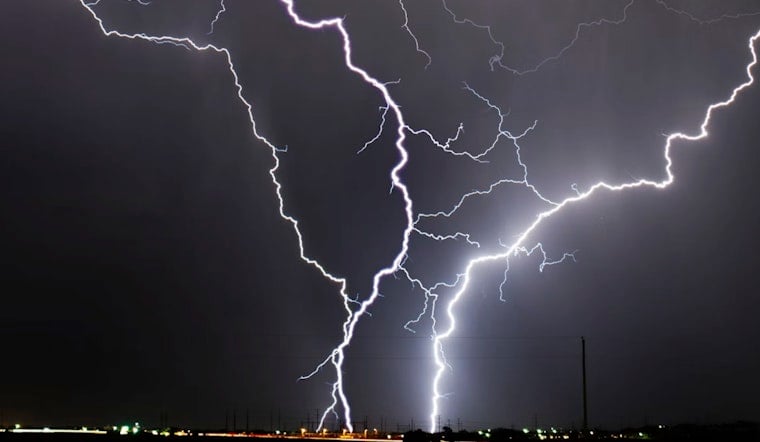
A bolt of lightning slammed into a house on Kendall Hill Drive in Willow Spring on Thursday afternoon, setting it ablaze as a line of severe thunderstorms tore across central North Carolina. Firefighters were called out as the same system downed trees, knocked out power to thousands, and dumped heavy rain on downtown Raleigh during the evening commute.
According to ABC11 News, firefighters responded to the house fire at the Willow Spring residence, and the Fuquay-Varina fire chief said the home was hit directly by lightning. The station reported no injuries from the storm despite the widespread damage across the region. Southeastern Wake County bore the brunt of the severe weather, with downtown Raleigh experiencing strong winds, thunder, and heavy rain as the storm cell pushed through.
Trees Down From Wake to Rocky Mount
Fallen trees were reported across a wide swath of central North Carolina, per the same ABC11 account, with damage noted in Wake County, Johnston County, Wilson County, and around Rocky Mount. Those downed trees caused power outages across the region, and forecasters with the outlet warned that a second round of storms was expected later Thursday evening, with additional cells possibly forming around midnight or shortly after.
The disruption extended into neighboring Johnston County, where nearly 2,000 Duke Energy customers lost power Thursday. Approximately 1,878 homes and businesses went dark in the McGee's Crossroads and N.C. 210 corridor just east of Willow Spring, according to JoCo Report. That corridor sits along the Johnston-Wake county line, close enough to the fire scene to illustrate how far the same storm system's damage spread.
Heat Advisory Set the Stage
Before the storms fired up, the National Weather Service had placed Wake County under a Heat Advisory Thursday, with forecast heat index values reaching as high as 106 degrees. That combination of extreme heat and humidity primed the atmosphere for the violent afternoon thunderstorm development that followed, per the agency.
Notably, lightning alone does not trigger a Severe Thunderstorm Warning under National Weather Service protocol, which requires radar or ground evidence of damaging winds of at least 58 mph or hail an inch in diameter. That distinction helps explain how a lightning strike capable of igniting a house fire can occur even when a storm hasn't met the formal thresholds for a warning.
A Costly and Familiar Threat
North Carolina's vulnerability to lightning is well documented. National Weather Service historical records rank the state third in the nation for lightning fatalities between 1959 and 2017, with 200 deaths recorded statewide, as reported by WSOC-TV. Research from the Cooperative Institute for Mesoscale Meteorological Studies has also identified a localized lightning flash density maximum stretching through the Sandhills and Central Piedmont toward Raleigh, driven by atmospheric convergence along regional soil boundaries and thermal troughs.
The financial toll is climbing too. The Insurance Information Institute ranks North Carolina seventh nationwide for homeowners insurance lightning loss claims, with 2,881 claims totaling more than $35.5 million in property damage. Nationally, insurers paid out an estimated $1.65 billion in lightning-related homeowners claims in 2025, a 59 percent jump over the prior year, with the average claim cost surging to $26,616 amid rising construction costs and increasingly complex home electronics, according to Business Wire.
A Well-Rated Response
The Fuquay-Varina Fire Department, which provides fire protection to the unincorporated Willow Spring area under contract with Wake County, earned a top-tier Class 1 fire rating for the town and an upgraded Class 2 rating for its rural district in August 2025. Fewer than 40 fire districts in North Carolina achieve that Class 1 standard, per the Town of Fuquay-Varina. The department traces its roots to around 1925 as a municipal volunteer department, merging with the Fuquay-Varina Rural Fire Department in 1999 to consolidate coverage across southern Wake County, and it now runs out of four stations.
Thursday's storm was the latest in a string of severe summer weather events to hit the Triangle. Wake County saw storms knock out power to roughly 13,000 homes on July 28, part of a recurring pattern of afternoon squalls bringing down trees and disrupting the region's power grid throughout the season.





