

























































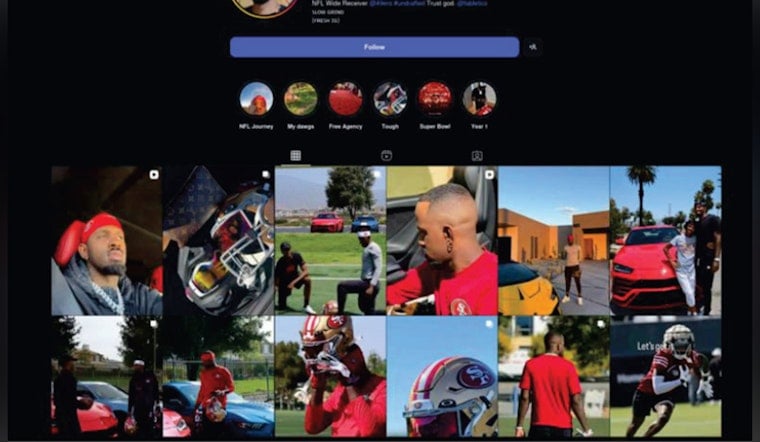
A California man accused of posing as a San Francisco 49ers wide receiver to seduce and financially drain women across four Western states was arrested last Monday at the Boise Airport, months after federal investigators say he began coaching victims to take out personal loans they would never see repaid. Daejon Labrayae Love, 35, of Stockton, and his alleged accomplice Taylor Jamie Chan, 18, now face federal charges of wire fraud and conspiracy to commit wire fraud tied to a scheme that investigators say defrauded at least 26 women of roughly $1.3 million.
Arrest warrants for Love and Chan were issued on August 17 in the U.S. District Court for the District of Oregon, according to The Outlook, roughly a week before FBI agents tracked Chan flying from California to Idaho to meet Love, leading to their arrest at the Boise airport. As reported by OregonLive.com, Love had allegedly traveled to New Mexico, California, Oregon, Nevada, Utah and Idaho since mid-July, with investigators saying he was in Idaho to meet new victims when agents caught up with him.
A Fake NFL Contract and a $30 Million Lie
According to the same report, Love met most of his alleged victims on dating apps including Tinder, Hinge and Facebook Dating between February 2022 and March 2025, telling women he wanted to settle down and build wealth together. He allegedly posted videos claiming he had received a 49ers tryout invitation and was signing a contract with the team, while also posing at times as a wealthy Swiss real-estate developer. He reportedly used aliases including Jon Love, Avril Lyto Love and Jordan Love, and claimed at various points to be worth more than $30 million, with his net worth supposedly rising from $300,000 to $17 million.
The alleged scheme followed a pattern investigators say repeated across victims: Love would conduct three-way FaceTime calls introducing Chan as his financial investor, who would then display what were purportedly Love's multimillion-dollar investment accounts. Federal court documents obtained by OregonLive.com indicate Love used fake bank-account apps and staged social-media photos to fabricate those balances, and that he sent Chan word-for-word financial-advisor scripts and asked her to create fake million-dollar stock accounts to show victims. Love allegedly promised the women their money would double or triple within days or weeks.
Loans, Threats and a Restraining Order
The individual accounts detailed in the charging documents describe a consistent playbook. M.R., who met Love on Facebook Dating in February 2022, was reportedly urged to invest $10,000 with Chan and was promised the sum would grow to $50,000 or $60,000 within three to four months; she was also allegedly asked to borrow $5,000 from a friend. N.W., who met Love on Hinge in the fall of 2023, allegedly gave him a credit card for emergencies and loaned him up to $30,000. A.A., who met Love on Tinder in March 2025, allegedly took out two loans totaling $17,200 before sending money to him. I.H., who met Love in person in July 2023, reportedly sent $7,000 via Apple Pay, while M.F., who connected with Love on Bumble in August 2024, allegedly sent $18,000 through Apple Pay and Western Union.
Victims transferred funds through Apple Pay, Zelle, Venmo, cash and personal loans, per the charging documents cited by OregonLive.com. None of the victims interviewed by the FBI ever received a return on principal, an investment payout, or a legitimate financial statement after sending money to Love and Chan, and agents found evidence that the pair never actually invested the money or repaid the loans they had promised. When victims asked too many questions or ran out of money, Love allegedly cut off communication. One woman who refused to invest more than $10,000 said Love physically threatened her, and she later obtained a restraining order against him.
Chan's Own Words to Investigators
Chan, in statements described in the federal documents, called Love a “master manipulator” and said he had money because he was “scamming these hoes.” The FBI suspects additional victims have not yet come forward, and investigators say the identified women came from Oregon, California and Washington, with the broader charging documents listing targets across Oregon, Washington, Idaho and California dating back to February 2022, according to The Outlook. Love and Chan are expected to be brought to Oregon for prosecution.
What the Charges Could Mean
Under 18 U.S.C. § 1343 and § 1349, a conviction for wire fraud or conspiracy to commit wire fraud each carries a statutory maximum of 20 years in federal prison, three years of supervised release and fines of up to $250,000, according to Medvin Law. Because each wire transaction or interstate communication can be charged as a separate count, the exposure can compound quickly. Federal wire fraud statutes give prosecutors jurisdiction whenever an interstate electronic transmission — a text, a video call, or a bank transfer — crosses state lines, which explains why a case rooted in dating-app messaging and FaceTime calls ended up in an out-of-state federal court rather than local proceedings, per Varghese Summersett.
Part of a Growing National Pattern
The case lands amid a sharp national rise in so-called “pig butchering” schemes, which law enforcement defines as hybrid scams that blend romantic manipulation with fake investment vehicles to build long-term trust before draining a victim's assets, as Hoodline has previously reported. Nationwide losses tied to online romance and confidence scams hit $929 million in 2025, up from $672 million in 2024, according to the FBI. Total cybercrime losses reported to the bureau's Internet Crime Complaint Center topped $20 billion last year, with investment fraud as the single largest category, and older adults alone accounted for more than $7.7 billion in losses across 201,000 complaints, making them the most financially impacted age group in the country.
The FBI runs a Recovery Asset Team within its Internet Crime Complaint Center that works with banks to freeze fraudulent transfers when victims report them quickly, though it remains unclear whether any of the money lost in this case has been recovered. The bureau is asking anyone with information about the case to contact it at 1-800-CALL-FBI or through its website.





