

























































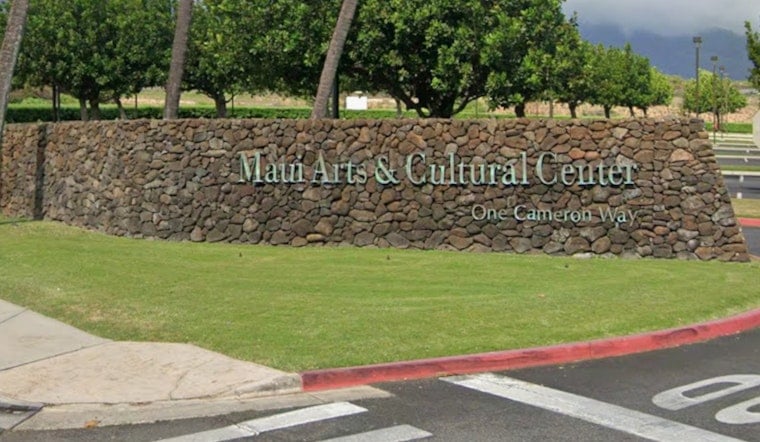
A free exhibition opening Tuesday at the Maui Arts & Cultural Center’s Schaefer International Gallery traces the origins of one of Hawaiʻi’s most recognizable garments back to a Chicago-born reporter who reinvented himself as a textile designer under the name Keoni. “Keoni of Hawaiʻi: Art of the Aloha Shirt” runs through October 3 and features original textile artworks, draft sketches, swatches, advertisements and vintage shirts tied to designer John “Keoni” Meigs, who moved to Honolulu in 1937 and began shaping the look of island fashion the following year.
According to Maui Now, Meigs was born in Chicago in 1916 and eventually settled in Honolulu, where he worked as a reporter for both the Honolulu Advertiser and the Honolulu Star-Bulletin before turning to design. He began designing textiles in 1938 under the name Keoni of Hawaiʻi and remained active in the islands through 1951, a run that produced roughly 300 aloha print designs, some of which remain in circulation today. Meigs, a self-taught painter, also studied kapa patterns at the Bishop Museum as he developed his design process, which involved drawing and painting patterns by hand before translating them into sewn shirts, per the same account.
A Biography Stranger Than the Prints
Meigs' backstory carries its own drama, separate from the shirts he made famous. He was kidnapped as an infant by his father in Chicago in 1916 and raised under an alias, only discovering his true legal identity when he tried to enlist in the military following the attack on Pearl Harbor in December 1941, according to the Fort Wayne Museum of Art. He later left Hawaiʻi and became a well-known Southwest landscape painter in New Mexico, and in 1969 NASA selected him for its Art Program to document the Apollo 11 moon landing mission. Meigs died in 2003, but his work found new life in 1996 when Japanese apparel company Sun Surf tracked him down in New Mexico and discovered unpublished 1940s design sketches in his possession, leading to a commercial re-issuance of the Keoni of Hawaii label that continues today, as reported by EIGHT-G.
From Plantation Workwear to Tourism Icon
The exhibition frames the aloha shirt itself as a collective creation of local designers and shirtmakers that emerged nearly a century ago, per Maui Now's reporting on the show. Its rise in the late 1920s and early 1930s paralleled Hawaiʻi's broader economic shift from agriculture toward hospitality and tourism, a transition also tied to the islands' move away from a plantation-based economy toward tourism, according to Texas A&M University Art Galleries. Before printed aloha wear took hold, the everyday shirt in Hawaiʻi was the palaka, a heavy plaid cotton work shirt worn by 19th-century plantation laborers that helped establish the collared cut later seen on aloha shirts, per ArcGIS StoryMaps. The garment itself blended influences from Polynesian tapa, Tahitian pāreu, and Japanese kimono and yukata, and the island clothing industry gradually shifted from workwear to sports and casual clothing.
The postwar period through the 1950s is often described as the aloha shirt's Golden Age, when returning military personnel and expanding commercial aviation carried the garment into mainstream American fashion, according to a history recounted in Google Books' account of the era. That influence didn't stop at fashion runways. In 1962, the Hawaiian Fashion Guild launched “Operation Liberation” by gifting aloha shirts to state legislators, a campaign that led to Hawaii's official adoption of “Aloha Friday” in 1966 and became the direct blueprint for corporate Casual Friday worldwide, according to Reyn Spooner.
A Rare Homecoming for the Designs
Maui Now describes the show as a rare chance to bring these designs home, noting that the aloha shirt has become an integral part of local lifestyle throughout the islands. “The aloha shirt is one of the great expressions of Hawaiʻi's identity across the ocean,” said Schaefer International Gallery director Jonathan Yukio Clark, per the outlet's report. The exhibition is curated by Dale Hope, a second-generation contributor to Hawaiʻi's garment industry and former art director for Kahala Sportswear, who authored “The Aloha Shirt: Spirit of the Islands” in 2000, a book later republished by Patagonia in 2016 as a definitive history of island textile design.
The show draws from the collection of Dan Eskenazi and additional private collections and previously toured throughout the continental United States. It's part of a broader national circuit organized by ExhibitsUSA, a program of the Kansas City-based Mid-America Arts Alliance that tours dozens of cultural exhibits to mid-sized American communities annually, per Museum of the Red River. Presented by the Maui Arts & Cultural Center with support in part from the Maui County Office of Economic Development, admission is free, and the Schaefer International Gallery is open 10 a.m. to 4 p.m. Tuesday through Saturday, as well as before select Castle Theater shows.
Related Events on the Calendar
Ahead of the main gallery run, the MACC hosted a free presentation called “Aloha Wear Identity” on August 8, featuring Hope alongside former ʻUkulele Clothing Company owner Lisa Starr, focused on leadership within local Hawaiʻi apparel brands, according to the Maui Arts & Cultural Center. Two more programs are planned during the exhibition's run. Activations: After Hours at the Gallery will take place September 4 from 5 to 8 p.m. at the Schaefer International Gallery and Yokouchi Pavilion & Courtyard, featuring a runway fashion show of vintage aloha wear, a DJ, and food and beverages for purchase, though it requires ticketed reservations through the MACC box office, which opens August 25.
Observe & Play Family Day follows on September 19 from 10 a.m. to noon at the Schaefer International Gallery, honoring Shirley Yokouchi and inviting families to wear aloha attire, tour the exhibition, and create patterns at activity stations. Registration is not required for that event. Together, the programming and the gallery show trace a straight line from a work shirt worn by plantation laborers to a global fashion export — and from a Chicago newsroom to the walls of a Maui gallery.





