

























































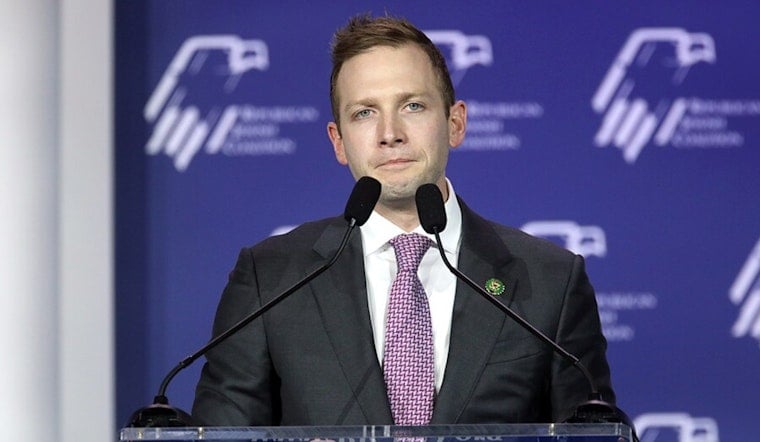
Rep. Max Miller's congressional campaign has sent cease-and-desist letters to Cleveland-area television stations, warning they could be named as defendants in a lawsuit if they keep airing an attack ad from a group called Affordable Ohio. The letters demand the stations pull the advertisement, which accuses Miller of voting to raise costs on virtually everything to pay for tax breaks for billionaires.
The dispute, first reported by Cleveland.com reporter Sabrina Eaton, centers on Affordable Ohio, one of 19 trade names registered to Opportunity Action Fund, a Washington nonprofit corporation. Affordable Ohio has spent more than $1 million to run its current ad on broadcast and cable television, and it previously ran a similar advertisement earlier this year opposing Miller. The group's paperwork was filed by Marc Elias's law firm, according to the outlet's reporting.
Miller's campaign spokeswoman said stations have an obligation to take immediate corrective action after receiving notice of legal and factual concerns, per the same account. The campaign has also filed a complaint about Affordable Ohio with the Federal Election Commission, arguing the advertisements violate federal broadcast disclosure rules. As of August 21, Affordable Ohio was not registered with the FEC, was not registered with the IRS, and was not registered to do business in Ohio — though Ohio law does not require that registration because the group does not conduct business in the state, the report notes.
What the Ad Actually Claims
The Affordable Ohio advertisement claims Miller voted to raise gas, grocery and utility costs, and it urges viewers to ask Miller to support the Ultra-Millionaire Tax Act, Democrat-backed legislation. That bill, reintroduced in March by Sen. Elizabeth Warren and Rep. Pramila Jayapal, would impose a 2% annual tax on household net worth between $50 million and $1 billion and a 3% rate above $1 billion — a proposal UC Berkeley economists project would raise $6.2 trillion over ten years, according to CBS News.
In response to the cease-and-desist letters, Affordable Ohio's attorneys sent their own letter to television stations Monday defending the advertisement, arguing its sponsorship disclosure is legally sufficient and that its content is accurate. The attorneys said Miller's vote in favor of the One Big Beautiful Bill raised costs, telling stations the ad is accurate and they should continue accepting it. The bill will cost Ohio households an average of $70 more annually on gas by 2030 and will raise Ohio electricity rates 7% to 11% by 2030, the ad's backers contend, and the legislation also rolled back vehicle emissions rules.
An Affordable Ohio spokesperson said the group is not coordinating with any other party committee, campaign or campaign committee, and maintained the ads do not advocate for the election or defeat of any candidate. The spokesperson also said Affordable Ohio is not required to file Federal Election Commission reports. A Daily Wire examination described Opportunity Action Fund as a dark money group poised to spend millions backing Democrats in the midterm elections, and noted the network has also registered Affordable Alaska, Affordable Michigan, Affordable Maine and Affordable North Carolina as trade names — with Affordable Maine placing a $2.5 million ad attacking Sen. Susan Collins.
Why Stations Can't Simply Refuse the Ad
The standoff hinges on a quirk of federal broadcast law. Under the 1959 Supreme Court decision in Farmers Educational & Cooperative Union v. WDAY, Inc., stations are barred from censoring candidate-sponsored ads and are immune from liability over what candidates say in them — but that protection does not extend to third-party ads from independent groups like 501(c)(4) organizations, according to the Broadcast Law Blog. That gap is why a cease-and-desist letter can put station managers on notice of potential liability for airing a non-candidate ad later proved false or defamatory. Still, under the landmark 1964 ruling in New York Times Co. v. Sullivan, an elected official suing over defamation faces the steep burden of proving actual malice — that the publisher knew a statement was false or acted with reckless disregard for the truth.
FCC rules require commercial television stations to upload political ad buy records, sponsorship disclosure forms and candidate dispute correspondence to an online public inspection file, which is how such disputes become traceable to the public.
A Campaign Already Under Siege
The ad fight lands amid mounting political and personal turmoil for Miller. He faces domestic abuse claims from his ex-wife, Emily Moreno, a dispute Hoodline detailed in its report on the Cuyahoga County defamation suit Miller filed against Moreno and her attorney in May. The House Ethics Committee has opened an investigation into the allegations against Miller — an inquiry Miller himself requested, and one he has said will clear him. He has said he intends to stay in the race regardless of pressure to leave.
That pressure has been considerable. Sen. Bernie Moreno, Miller's former father-in-law, called on him to resign his seat, and Ohio Lt. Gov. Jon Husted also called on Miller to resign from Congress. Tiffiny, a Parma public school teacher, has accused Miller of not making her life any easier. Political handicappers have shifted their race ratings in Democrats' favor as a result of the turmoil, and the Lincoln Project announced it will run a television advertisement of its own highlighting the abuse allegations.
A Crowded, Costly Primary Aftermath
Miller's Democratic opponent, Brook Park council member Brian Poindexter, emerged from a crowded primary field that Hoodline covered in its eight-way Democratic primary story in April. Outside spending has already shaped that race: Jobs and Democracy PAC, funded primarily by Public First, spent more than $500,000 on advertisements backing Poindexter ahead of the May primary, while BDA PAC spent more than $161,000 on mailers for him. On the other side, Jobs and Prosperity, a group funded by members of Miller's family, spent about $60,000 during the primary. Hoodline has also reported on the pending House Ethics Committee probe in connection with Miller's affiliated leadership PAC.
Whether the current dispute reaches a courtroom remains unresolved. For now, Cleveland-area stations are caught between competing legal letters — one demanding the ad come down, the other insisting it must stay up — while Ohio's 7th District, which covers Medina and Wayne counties along with portions of Cuyahoga and Holmes counties, heads toward a general election that both parties now view as competitive rather than settled.



.jpg)