

























































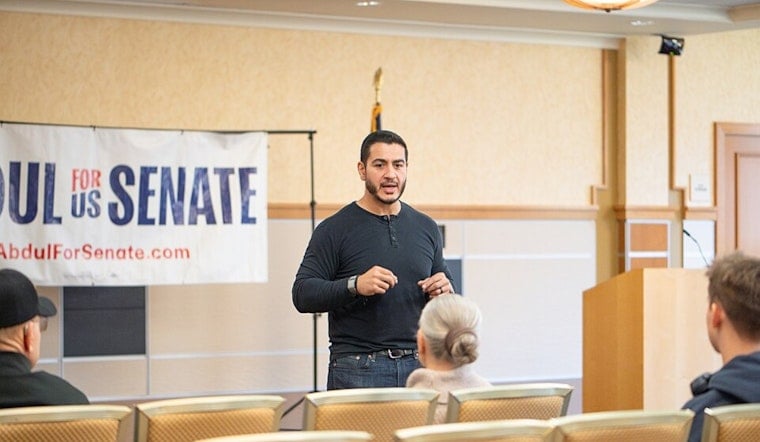
The Michigan Democratic Party Black Caucus has thrown its support behind Abdul El-Sayed heading into the general election for U.S. Senate, even though the group had backed his primary rival, Representative Haley Stevens, just weeks earlier. The endorsement comes after El-Sayed edged out Stevens by roughly one percentage point in last Tuesday's Democratic primary, a margin so thin it has already become a defining feature of the race.
According to Deadline Detroit, the caucus said Democrats must unite rather than continue re-fighting the primary while Republicans organize for November. The group described itself as committed to strengthening public education and healthcare, confronting the racial wealth gap through homeownership, entrepreneurship and capital access, creating jobs and protecting working families, and advancing voting and civil rights. Party officials framed the endorsement as a needed boost for El-Sayed's campaign at a moment when Democratic cohesion in heavily Black precincts could decide the outcome.
A Primary Decided by a Single Point
The final tally, per NPR, showed El-Sayed capturing 48.5% of the vote (743,455 votes) to Stevens' 47.5% (727,758 votes), with state Senator Mallory McMorrow taking 4.0%. That 0.98-percentage-point spread ranks as the second-narrowest Senate primary victory in Michigan Democratic Party history, trailing only Bob Carr's 0.95-point win in 1994, according to Smart Politics. The closeness of the result reflected a genuine split within the party, with progressive leaders and organized labor rallying behind El-Sayed while much of the establishment lined up behind Stevens.
Notably, the seed reporting from Deadline Detroit states that Stevens won the majority of the Black vote in Michigan during the primary, which makes the Black Caucus's pivot to El-Sayed all the more significant. El-Sayed, for his part, said the caucus has been the backbone of the Democratic Party for decades and that he has worked his entire career alongside the Black community to deliver public health successes for their neighborhoods. He added that Black leaders in Michigan understand the risk of Donald Trump's agenda, and said he is ready to deliver public health successes in the Senate.
Why the Seat Came Open
The race exists in the first place because two-term Democratic Senator Gary Peters announced in January 2025 that he would not seek re-election, according to Ballotpedia. Before the primary, Hoodline reported that Peters, Governor Gretchen Whitmer, former Senator Debbie Stabenow and Senate Majority Leader Chuck Schumer all endorsed Stevens over El-Sayed. On the other side of the ledger, El-Sayed picked up support from the UAW International and Senator Elizabeth Warren, underscoring the establishment-versus-progressive rift the Black Caucus's move now attempts to bridge.
El-Sayed brings a public health resume to the race. He served as executive director of the Detroit Health Department from 2015 to 2017 in the years following the city's municipal bankruptcy, then led Wayne County's Department of Health, Human & Veterans Services from December 2022 until resigning in April 2025 to run for Senate, per Wikipedia. Stevens, who has represented Michigan's 11th Congressional District in Oakland County since 2019, previously served as Chief of Staff to the federal U.S. Auto Rescue Task Force during the Obama administration.
A High-Stakes November in a Battleground State
El-Sayed will now face Republican nominee Mike Rogers, who spent 14 years representing Michigan's 8th Congressional District in the U.S. House, chaired the House Permanent Select Committee on Intelligence from 2011 to 2015, and ran as the GOP's Senate nominee in Michigan in 2024, according to Wikipedia. Republicans have not won a U.S. Senate election in Michigan since Spencer Abraham in 1994, even though Donald Trump carried the state's presidential electors in both 2016 and 2024, Ballotpedia notes.
That history is part of why turnout in Detroit and Wayne County matters so much this cycle. Black or African American residents make up 13.7% of Michigan's statewide population and roughly 75% of Detroit's population, according to U.S. Census Bureau estimates, giving Black voters outsized influence in a close statewide race. The primary itself drew enormous spending, with AdImpact tracking more than $46 million in ad reservations booked for the Democratic Senate contest by July, including over $10.7 million from the United Democracy Project super PAC backing Stevens, Hoodline previously reported.
With the general election now set, the Black Caucus's endorsement signals an effort to close ranks quickly rather than let primary wounds linger into the fall. Whether that push translates into the kind of Black voter turnout in Wayne County that Democrats will need against Rogers remains to be seen.





