

























































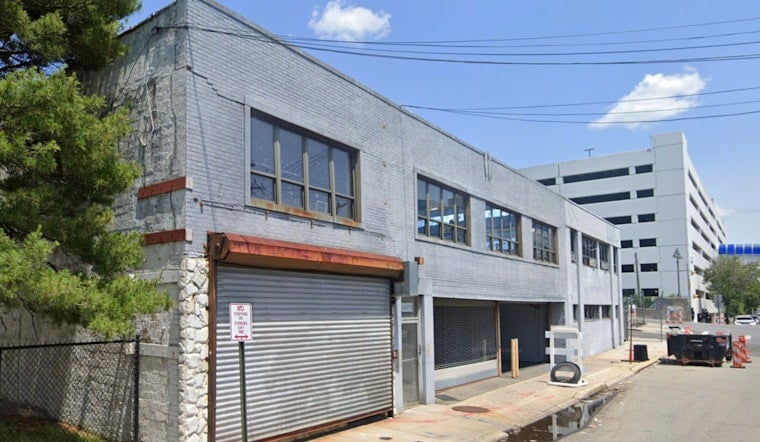
Construction has officially started on a nine-story, 101-unit condominium tower rising next to the Mineola Long Island Rail Road station, marking one of the first major for-sale housing projects to break ground in the downtown in more than a decade. The $130 million building, called The Bridge, sits at 212-214 3rd Street on a 0.64-acre site bounded by 3rd Street and Station Road, replacing a two-story commercial building and a taxi stand that once stood there.
The project is a joint venture between AJM Real Estate, Burman Real Estate, Caiola Real Estate Group, and Park It Management, according to New York YIMBY, which first reported the groundbreaking. William S. Novak Architect, PC designed the building, which will feature a facade mixing earth-toned brick and light gray stone, along with balconies tucked into recesses of the massing and a landscaped terrace. Renderings released by Burman Real Estate show a two-story podium supporting residential amenities above ground-level retail and parking.
The building will hold a mix of 25 one-bedroom homes, 60 two-bedroom homes, 15 three-bedroom homes, and a single penthouse suite, per the outlet's reporting. Underground parking will accommodate at least 180 vehicles, according to a development team post shared on Facebook, and residents will have access to a fitness center, rooftop terrace, golf simulator, sports court, swimming pool, and conference room.
A Rare Bet on Ownership Over Rentals
The Bridge stands out for what it is not: another rental building. More than 1,100 rental units have opened in downtown Mineola since 2010, according to Newsday, which reported that developers identified a complete absence of new luxury condo inventory to meet demand from local downsizers and commuters. That gap is what The Bridge is designed to fill, offering for-sale units instead of the leases that have defined the neighborhood's building boom.
Financing behind the project reflects its scale. The developers secured $111.3 million in floating-rate construction financing in June, jointly provided by Lionheart Strategic Management and Schroders Capital, according to the same Newsday report. Digital lender OakNorth followed in July with an $83.5 million note-on-note leverage facility for Lionheart — the firm's first debt investment in the Long Island market, per the outlet's reporting.
Nassau County's Industrial Development Agency also stepped in with incentives tied to the project. The agency provided nearly $2.8 million in sales tax exemptions, a roughly $360,000 mortgage recording tax exemption, and property tax exemptions valued at nearly $2.4 million, the developers' team noted. Those property tax benefits cover only the construction period, and homebuyers will pay full taxes once they purchase their units.
Steps From a Major Transit Hub
The Bridge sits directly next to the Mineola LIRR station, which serves nearly 14,000 daily commuters and ranks as the third-busiest station east of Jamaica, according to the Metropolitan Transportation Authority. The station connects the Port Jefferson, Ronkonkoma, Oyster Bay, and Montauk branches alongside NICE bus service, giving future residents direct access to New York City. It marked its centennial in 2023 following platform and elevator upgrades.
That transit capacity got a boost from the MTA's $2.6 billion LIRR Main Line Expansion Project, completed in 2022, which added a third track through Mineola and eliminated street-level grade crossings, expanding rush-hour train capacity by up to 45%, per the same Newsday coverage. The upgrade removed longstanding vehicle bottlenecks along the Main Line corridor, helping set the stage for denser development around the station.
Zoning Framework Traces Back to 2005
The project was made possible by Mineola's Downtown Overlay District, enacted in 2010 following a 2005 Comprehensive Master Plan, which permits higher residential density near the LIRR station in exchange for developer-funded community benefits. That framework covers the commercial and institutional corridors surrounding the station and is what allowed The Bridge's nine-story height to move forward.
Land-use attorney Jack Martins, a partner at Harris Beach and a New York State Senator who previously served as Mineola's mayor, represented the developers in securing local approvals. Martins pointed to Mineola's track record as evidence that municipalities can expand housing without state-mandated zoning overrides — a notable stance given Governor Kathy Hochul's past proposals for state overrides on transit-adjacent housing across New York, according to the developers' Facebook post.
The village's approach has produced results by at least one measure: Mineola has approved new housing units at a rate 15 times higher than Long Island as a whole since adopting its transit-oriented planning guidelines, per Newsday's reporting. Still, a Regional Plan Association analysis cited by the outlet found that comparable regional transit hubs, such as Morristown, New Jersey, issued roughly 2.5 times as many housing permits over a similar period — suggesting Mineola's suburban growth, while significant locally, remains modest against national peers.
Local Roots Among the Development Team
Ross Levine, principal of Third Street Associates, noted that his family has operated commercial businesses in the Village of Mineola for 40 years before joining the development team behind The Bridge. The building's 10,000-square-foot event space is planned to host live entertainment, art exhibits, fashion shows, and community programs once complete.
Developers anticipate The Bridge will open in January 2029. The project adds to a wave of suburban condominium activity nearby — Hoodline previously reported on a 90-unit condo-hotel rising from a shuttered TGI Friday's in neighboring Westbury, part of a broader shift toward ownership housing across western Nassau County's rail corridors.



