

























































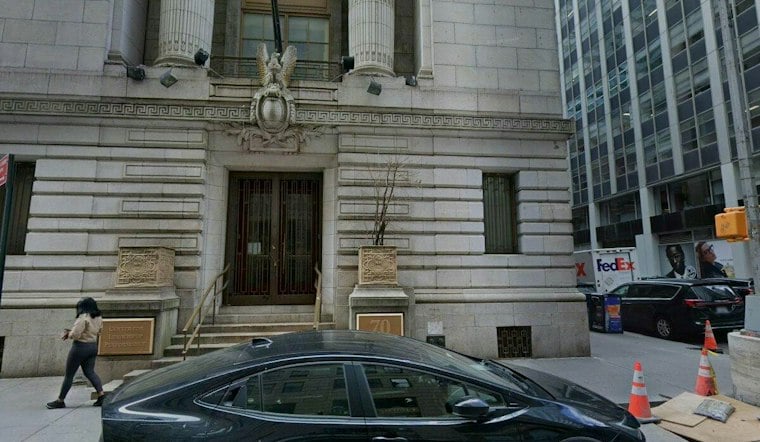
A five-story landmark in Manhattan's Financial District just traded hands for $9.35 million, a staggering comedown for a building that once sought $88 million and sat vacant for years while cycling through foreclosure and bankruptcy. The undisclosed buyer picked up 70 Broad Street for roughly $492 per square foot, a fraction of what the property's past owners once believed it was worth.
The sale closed after a tangled run through distressed-debt territory. According to Commercial Observer, the $9.35 million price marks an 89% discount from the building's $88 million asking price in 2016 and a 53% drop from the $20 million credit bid that former lender Wilmington Trust used to seize control of the property in 2025. Wilmington Trust, operating through special servicer Rialto Capital Advisors, took control after a federal judge entered a $24.7 million foreclosure judgment against former owner Winta Asset Management, which had defaulted on a $15 million note at the start of the COVID-19 pandemic in 2020.
As The Real Deal reports, Winta had valued the five-story building at $16 million when it filed for Chapter 11 protection, and an auction of the property was scheduled before being put on hold due to the bankruptcy. The outlet notes that a Cushman & Wakefield team represented the seller, while Louis Franco and Joseph Isa of Isa Realty Group represented the buyer. Wilmington Trust did not immediately respond to a request for comment from the paper.
From Currency Printing to Meditation Retreat
The building's past stretches back well before its recent distress. Erected in 1908 as headquarters for the American Bank Note Company, 70 Broad Street was intentionally designed as a low-rise structure with a granite and ashlar stone facade meant to contrast with the surrounding Financial District skyscrapers and project institutional stability, per Urban Archive. The company produced currency, stock certificates, and stamps; the U.S. Bureau of Engraving and Printing later became the sole U.S. currency producer. The company commissioned the same architects, Kirby, Petit & Green, to design its printing plant in the Hunts Point section of the Bronx, a facility built through 1911 and later became a landmark in its own right.
The building's identity shifted dramatically in the decades that followed. Between 2004 and 2010, it was owned by the Global Country of World Peace, a non-profit foundation established by Transcendental Meditation founder Maharishi Mahesh Yogi, which bought the property for $5.5 million and ran it as a meditation retreat and lecture center, renovating lower floors for instruction while using upper levels as guest apartments, according to The Real Deal's earlier reporting. The foundation sold the building for $18 million in 2010.
A Landmark With Built-In Limits
Designed in the Neo-Classical style, 70 Broad Street was designated an official New York City Landmark in 1997 and added to the National Register of Historic Places in 1999, a status that places real constraints on what any new owner can do with the exterior. The structure is also a contributing property to Lower Manhattan's Wall Street Historic District, per the NYC Landmarks Preservation Commission. Its low-rise five-story scale and landmark protections constrain large-scale redevelopment options compared to taller office towers nearby.
Still, the interior offers flexibility that few landmarked office buildings can match. The nearly 20,000-square-foot building includes three full-floor luxury residential apartments serviced by a private elevator, each with en-suite bathrooms and formal dining rooms, features that past marketing campaigns leaned on when pitching conversion into a single-family palace or boutique hotel, according to 6sqft's earlier coverage of the listing. That configuration alongside office floorplates could offer options ranging from residential to hospitality to single-tenant corporate use.
The building's long road to its current price reflects years of failed sales attempts. By 2018, the property's asking price had been reduced to approximately $43 million, a 51% cut from its 2016 asking price, in one of several unsuccessful attempts to sell before the bankruptcy, and the property sat vacant for more than seven years before this month's deal.
Part of a Broader FiDi Reckoning
The 70 Broad Street sale lands amid a wave of distressed landmarked office sales across Lower Manhattan. A comparable deal saw the vacant landmarked office property at 14 Vesey Street sell out of Chapter 11 bankruptcy for $13.5 million in September, a 29% loss from its 2021 purchase price.
Whether 70 Broad Street follows that same path toward apartments, reverts to office use, or finds a hospitality buyer remains to be seen. For now, the building that once housed a currency printer and later a meditation retreat has a new owner facing the same question that has vexed Lower Manhattan's smaller landmarked towers for years: what to do with a historic shell that modern tenants no longer want at the old price.





