

























































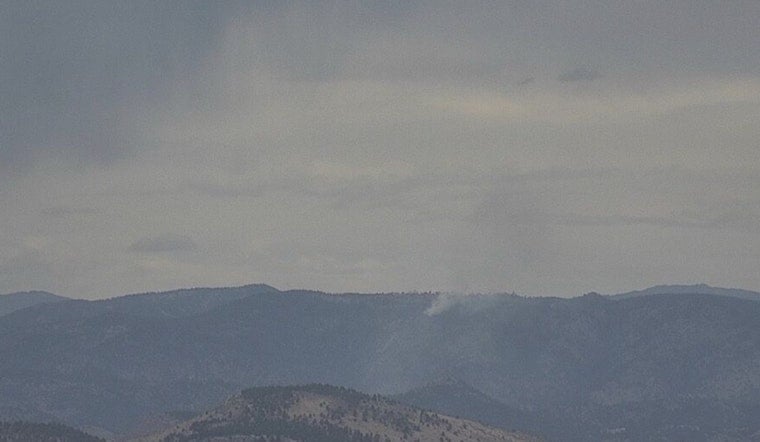
Officials ordered residents of Pinewood Springs to leave immediately on Friday as the Moose Mountain Fire prompted mandatory evacuations in the small Larimer County mountain community, while nearby Blue Mountain remained under a voluntary evacuation notice. The fire's size was not immediately known as crews worked to respond in the rugged foothill terrain along the U.S. Highway 36 corridor.
The evacuation order marked an escalation from earlier Friday, when officials had issued only a voluntary notice for the area before upgrading it to mandatory status, according to CBS Colorado. Blue Mountain residents were advised to gather essential items and prepare for the possibility of evacuation, per the outlet's report. Pinewood Springs sits in unincorporated Larimer County, roughly 5.6 miles northwest of Lyons and 11.3 miles southeast of Estes Park, according to the Colorado Gazetteer, placing it directly along the narrow highway corridor that serves as the community's main lifeline.
Residents were urged to check for updates online and were directed to NOCOAlert.org for the latest information, the CBS Colorado report noted. Larimer County's evacuation notifications run through the NOCOAlert system, managed by the Larimer Emergency Telephone Authority, which pushes geographic-specific alerts to landlines, mobile devices, and email accounts, according to LETA911. Residents must opt in on their cell phones to receive the localized text notifications that can prove critical during fast-moving incidents.
Smoke Drifts Into Boulder County, But No Orders There
Just across the county line, the Boulder County Sheriff's Office reported visible smoke from the fire in the Lyons area but confirmed no evacuation orders or road closures were required within Boulder County limits, per a Boulder County Sheriff's Office Facebook post. Pinewood Springs borders Boulder County near Lyons, making smoke drift a frequent cross-jurisdictional concern even when emergency orders stay confined to one side of the line.
Local response to the blaze falls to the Pinewood Springs Fire Protection District, a volunteer agency established in 1962 that covers a 40-square-mile service area spanning Larimer and Boulder counties along the U.S. 36 corridor, according to 5280Fire. The district operates out of a single station and relies on mutual-aid agreements with neighboring mountain fire agencies during wildland fires of this kind.
A Community With a History of Being Cut Off
Pinewood Springs has faced this kind of vulnerability before. During the catastrophic September 2013 Front Range floods, severe washouts along U.S. Highway 36 completely severed land access to Pinewood Springs and Estes Park, forcing the National Guard to conduct emergency airlifts to evacuate stranded residents, according to KUNC. That disaster underscored how heavily the community depends on the single highway for both evacuation and emergency ground response.
The Moose Mountain Fire also arrives amid a broader pattern of severe wildfire activity in Larimer County's mountain canyons. Just two years earlier, the Alexander Mountain Fire burned 9,668 acres in the Roosevelt National Forest near Highway 34 before crews reached 91% containment, according to Larimer County. That fire required extensive multi-agency evacuations and shelter operations across the region.
Part of a Statewide Escalation
State fire officials have documented a clear escalation in wildfire severity across Colorado in recent decades. All 20 of the largest wildfires in state history have occurred since 2002, with 17 occurring since 2012 and four of the top five since 2020, according to the Colorado Division of Fire Prevention and Control. That trend has increased pressure on wildland-urban interface communities like Pinewood Springs, where seasonal and vacation homes make up more than a quarter of the housing stock, according to a NeighborhoodScout estimate that puts the community's population near 1,927 residents with a 26.4% vacancy rate.
Larimer County has taken some proactive steps to address the risk. In June, the county launched its Home Ignition Zone program, offering mountain homeowners up to $4,000 in rebates for defensible-space wildfire mitigation work around their properties, as Hoodline previously reported. It is not the first sudden mountain evacuation the county has faced this year; a fast-moving fire along North Lake Avenue in Estes Park triggered a mandatory NOCOAlert evacuation order back in February, a pattern that has now repeated itself in Pinewood Springs. The exact acreage, ignition cause, and any structural impacts from the Moose Mountain Fire remained unknown as suppression efforts continued in the rugged terrain.





