

























































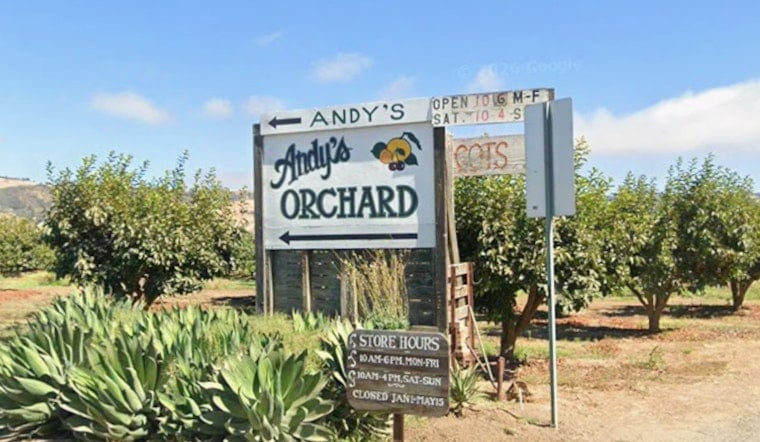
Andy Mariani is 80 years old, and he says he is the last of his kind. His family's Morgan Hill fruit farm, Andy's Orchard, is edging toward closure after decades of shrinking profits, warming winters and the slow disappearance of the farms that once surrounded it. Now a development firm holds an option to replace the more than 50-acre property with 376 homes, two parks and pickleball courts.
Mariani, who calls himself a dirt farmer, told NBC Bay Area that the other farms in the area are already gone and his is the last one standing. He said the orchard's possible sale marks the end of an era, and that survival is impossible without fruit production, which provides all of his income. This year, Mariani harvested only 5% of his cherry crop, and he says he hasn't turned a profit on cherries in the past decade.
A Family Farm Rooted in Displacement
The Mariani family purchased the Morgan Hill orchard in 1957, back when about 30 other farms surrounded the property, according to the NBC Bay Area report. Today, Andy's Orchard is home to roughly 7,000 trees, growing peaches, plums, figs and cherries that Mariani says are sold to high-end restaurants in New York. Longtime customer Greta Liebelt told the station that Andy's fruit is uniquely good compared with other fruit, and she and her husband Bernd Liebelt have visited the orchard's store in Morgan Hill every week for more than 20 years.
There's a bitter irony to where the Marianis landed. Before moving south to Morgan Hill in 1957, the family farmed stone fruit in Cupertino on a parcel directly across the street from what later became Apple's corporate headquarters, according to The Dissent. Nearly seven decades later, the same family's land is again positioned to be swallowed by growth — this time in the form of suburban housing rather than a tech campus.
Climate Change Compounds the Losses
Bernd Liebelt told NBC Bay Area that agricultural land is increasingly being replaced by housing across California, a trend that has directly reshaped Mariani's business. But according to the station's report, the biggest problem facing the orchard is climate change: cherries require a certain amount of winter cold to produce fruit, and warming winter temperatures have undercut Mariani's crops for years.
The orchard itself is a living catalog of agricultural history most Californians will never see again. Andy's Orchard cultivates nearly 300 stone fruit varieties, including rare heirlooms like the Blenheim apricot and the Black Republican cherry, both listed on Slow Food International's Ark of Taste catalog of endangered heritage foods, per Edible Silicon Valley. The region itself was once known as the Valley of Heart's Delight, the world's largest fruit-producing area until the 1960s, with more than 125,000 agricultural acres that have since shrunk to fewer than 18,000, according to the Santa Clara Valley Open Space Authority.
How a Housing Loophole Opened the Door
The company positioned to take over the land, Mana Investments, is a California real estate investment firm that holds an option to buy the Mariani ranch, according to NBC Bay Area. That option only becomes a sale if the development wins final county approval — until then, the Mariani family retains title to the land and collects holding fee payments while Mana Investments funds the state-mandated environmental review, according to the Morgan Hill Times.
Mana Investments submitted its 58.62-acre development application in August 2024 under SB 330, California's Housing Crisis Act, invoking the state's builder's remedy provision because Santa Clara County lacked a state-certified housing element between 2023 and 2025, the outlet reports. The project, marketed as Mariani Ranch, calls for 300 single-family homes and 76 duplex units, with 7% reserved for extremely low-income households — the same 376-unit total cited by NBC Bay Area. Mana Investments Managing Partner Orville Power said in 2024 that the firm could have legally pursued up to 1,500 homes on the site but chose to scale down to under 380 units to better match neighboring developments built by Toll Brothers and Tramell Crow, according to The Real Deal.
Environmental Groups Push Back
Andy's Orchard is far from an isolated case. During the county's gap in state housing compliance, developers filed at least 20 builder's remedy applications on agricultural land in unincorporated South County, threatening more than 330 acres and over 6,500 proposed housing units near Morgan Hill and Gilroy, according to San José Spotlight.
The Sierra Club submitted formal scoping comments in July opposing the Mariani Ranch project, arguing that builder's remedy does not legally apply because the site lacks public water and sewer connections. The group says the developer would need to build an on-site wastewater plant, two 200,000-gallon water storage tanks and 2.74 acres of leach fields to serve the project, according to the Sierra Club's filing. In response to the wave of builder's remedy proposals, Santa Clara County District 1 Supervisor Sylvia Arenas proposed a new Office of Economic Development in late 2024 aimed at promoting South County agritourism and keeping remaining farms economically viable, per San José Spotlight.
For now, Andy's Orchard remains open, and the county has not yet finalized any approval of the housing plan. Mariani Country Store will likely stay open until September of next year, per NBC Bay Area. But Mariani, who has watched the farms around him disappear one by one, describes the orchard's possible sale in stark terms — the end of an era he doesn't expect to see reversed.




