

























































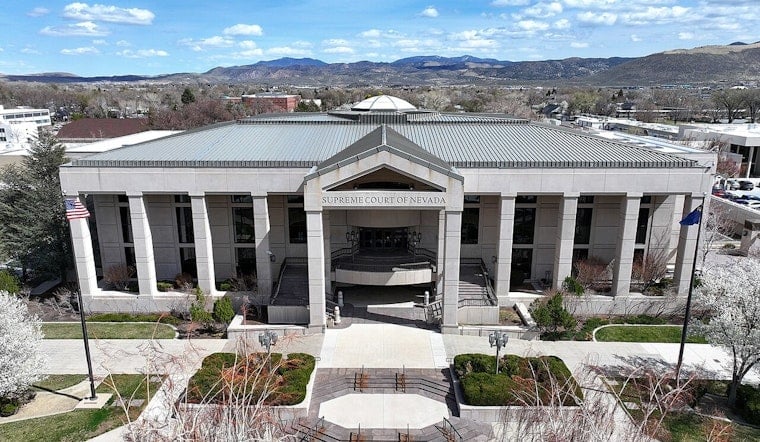
Nevada's highest court has ruled that Las Vegas police officers have no protected privacy interest in having their names and badge numbers posted on public meeting agendas, closing out a legal fight that began nearly three years ago when seven Metro officers tried to keep their identities out of civilian oversight paperwork. The Nevada Supreme Court's August 20 decision upheld a lower court ruling favoring the Citizen Review Board, the City of Las Vegas, Clark County, and the Las Vegas Metropolitan Police Department.
The case traces back to November 2023, when the Las Vegas Police Protective Association filed a lawsuit challenging the Citizen Review Board's practice of publishing officers' names and badge numbers on its agendas and meeting notices, according to the Las Vegas Review-Journal. The union, representing officers William Catricula, Justin Turney, Aristotle Legaspi, Jeremy Jacobitz, Raymond Kwan, Edwardo Garcia, and Matthew Glover, argued the practice violated their privacy rights, even though all seven had been cleared of wrongdoing in the underlying misconduct complaints.
The Citizen Review Board is a civilian oversight agency that reviews investigations by Metro's Internal Affairs Bureau, examining allegations ranging from use of force and neglect of duty to search and seizure, body-worn camera usage, and how officers handle impounded property. In its ruling, the state Supreme Court found that the officers failed to state a claim upon which relief could be granted, per the court's decision.
How the Legal Fight Unfolded
The union's lawsuit hit its first roadblock in 2024, when Clark County District Judge Jacqueline Bluth dismissed the case under Nevada's anti-SLAPP statute, ruling that publishing the officers' names and badge numbers on public agendas amounted to a protected communication on a matter of public concern. Bluth said at the time that the current law was not in favor of the plaintiffs' position, a determination the union then appealed to the state's highest court.
The Supreme Court's reasoning leaned heavily on a mechanism baked into Nevada's Open Meeting Law: because the Citizen Review Board is statutorily required to hold closed hearings on officer misconduct, that same requirement triggers a legal duty to publicly identify the officer involved on the agenda, according to HCAmag. The court also rejected the union's argument that its collective bargaining agreement should shield officer identities, finding that the review board is an independent civilian oversight body created by local ordinances rather than a party to that labor contract.
A Precedent Two Decades in the Making
The court's decision leaned on a 2020 Nevada Supreme Court precedent, also involving LVMPD and the Review-Journal, which held that officer names and badge numbers do not carry the same privacy concerns as personal photographs or home addresses. Under Nevada law, officers' names or badge numbers are not rendered confidential, and LVMPD policy already requires officers to identify themselves by name and badge number when interacting with the public, a practice the department has followed for years by disclosing that same information elsewhere.
Civilian oversight of Metro officers in Clark County is not a new concept — it dates back to 1997, when the Nevada Legislature authorized civilian police review under NRS 289.380, prompting Clark County and the City of Las Vegas to pass matching ordinances in 1999 that formally established the Citizen Review Board. The board is made up of 25 unpaid volunteer members who are legally barred from being current or former law enforcement officers, elected officials, or their immediate family, and who must complete 70 hours of training, including a 12-week Citizen Police Academy and a police ride-along. Misconduct complaints go before randomly selected five-person civilian panels that rotate every six months.
Union Signals It Isn't Done Fighting
LVPPA legal counsel David Roger, who led the Clark County District Attorney's Office for nearly a decade before retiring in January 2012 and who prosecuted the 2008 armed robbery case against O.J. Simpson, said personal records and employment decisions should be protected and that the union simply wants officers treated like any other public employee. Roger said the union accepts the court's decision but respectfully disagrees with it, and indicated the Nevada Legislature may still consider a legislative fix, meaning Roger plans to possibly pursue a solution in Carson City rather than the courts.
That legislative option would keep the underlying tension alive even though the litigation itself has ended. The Nevada Supreme Court previously weighed in on the review board's authority back in 2006, ruling that the panel can subpoena officers to testify in non-criminal administrative misconduct inquiries despite past union objections — a reminder that friction between Metro's rank-and-file union and civilian oversight in Clark County stretches back decades.
The dispute also lands amid a broader moment of political visibility for LVPPA leadership. Union president Steve Grammas launched a campaign for the Las Vegas City Council's Ward 6 seat, underscoring how active the union has become in local public safety politics even as it loses ground in the courtroom over officer transparency. For now, the Citizen Review Board will continue posting officers' names and badge numbers on its public agendas and meeting notices as it has all along.





