

























































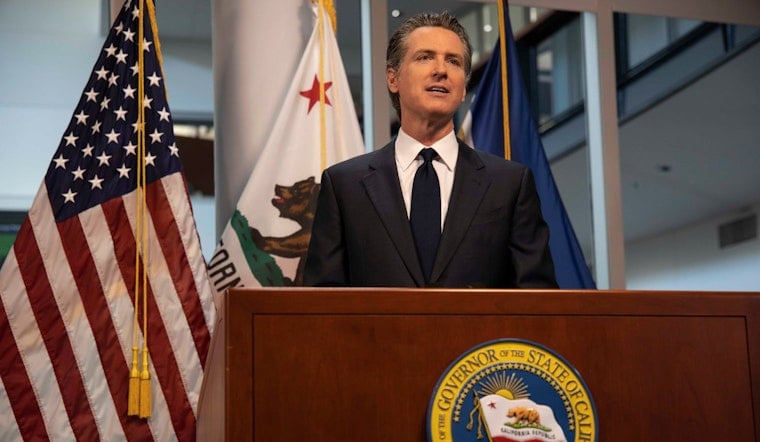
Gavin Newsom is heading south next week for a visit to Alabama and two days of political events in South Carolina, then will end the trip in North Carolina. The outing is billed as part of his self-styled Take It Back Tour aimed at electing Democrats in red areas and swing districts. The California governor plans to tour the Legacy Museum in Alabama, attend events with community leaders there, and support Democratic candidates in South Carolina districts that Donald Trump carried in 2024.
A Tour With a Familiar Name and a Bigger Backer
According to the San Francisco Chronicle, Newsom has named this outing the Take It Back Tour and will spend the two days on political events in South Carolina, the state set to hold the first Democratic presidential primary in 2028. The Chronicle's Sophia Bollag notes Newsom has not formally declared a candidacy for president, even as he has said he is considering one. The Legacy Museum, which the governor plans to visit in Alabama, focuses on the history of slavery and racial injustice in the United States, per the same report.
According to U.S. Census Bureau QuickFacts, Greenville County’s population age 16 years and older was 65.3% for 2020-2024, while females represented 59.1% of the civilian labor force.
The trip is funded through infrastructure Newsom built years ago. He started the Campaign for Democracy, a political action committee supporting Democratic causes in purple and red parts of the country. By July 2024, GV Wire had examined federal disclosures related to the committees.
Timing Lines Up With the 2028 Primary Calendar
The stops are not random. The Democratic National Committee voted on August 15 to solidify South Carolina as the first state on the 2028 primary calendar, setting its nominating contest for January 22, 2028, according to CBS News. Per Ballotpedia, the DNC's approved window places six states ahead of Super Tuesday — South Carolina, Nevada, New Hampshire, New Mexico, Michigan, and Virginia. The Chronicle reports Newsom took similar trips to Michigan and Nevada earlier this summer, both of which are swing states in presidential elections, and he also plans to headline a rally for Democrats in North Carolina, which the Chronicle describes as a critical swing state in the general election.
This is not Newsom's first run through red territory. He completed a comparable Southern swing in April 2023, visiting Arkansas, Mississippi, Alabama, and Florida to campaign against conservative state policies and meet with Black leaders, students, and community organizers, according to the Los Angeles Times. Later that year, in November 2023, he squared off against Florida Governor Ron DeSantis in a 90-minute televised debate moderated by Sean Hannity in Alpharetta, Georgia, billed by Fox News Channel as The Great Red vs. Blue State Debate.
A Governor on the Clock
Newsom cannot run for a third term in Sacramento. Under Article V, Section 2 of the California Constitution, governors face a lifetime limit of two four-year terms, meaning Newsom must leave office when his second term ends in January 2027, per Justia Law. He was re-elected in 2022 after surviving a 2021 recall election. The race to succeed him is already underway: former U.S. Health and Human Services Secretary Xavier Becerra and Republican commentator Steve Hilton advanced from California's top-two primary on June 2, setting up a November 3 general election, according to Ballotpedia. California has not elected a Republican to statewide office since 2006.
Newsom's national profile has been building in other ways too. Hoodline reported on a Hollywood fundraiser in April where Newsom introduced a lineup of potential 2028 Democratic presidential contenders at a Los Angeles gathering that raised more than $1.5 million for the Democratic Governors Association, with tickets ranging from $45,000 to $100,000. And last August, Hoodline covered Newsom's signature of California redistricting legislation aimed at flipping five Republican-held House seats in a November 2025 special election, a measure that generated $6.2 million in early Democratic fundraising as a direct counter to Texas gerrymandering efforts.





