

























































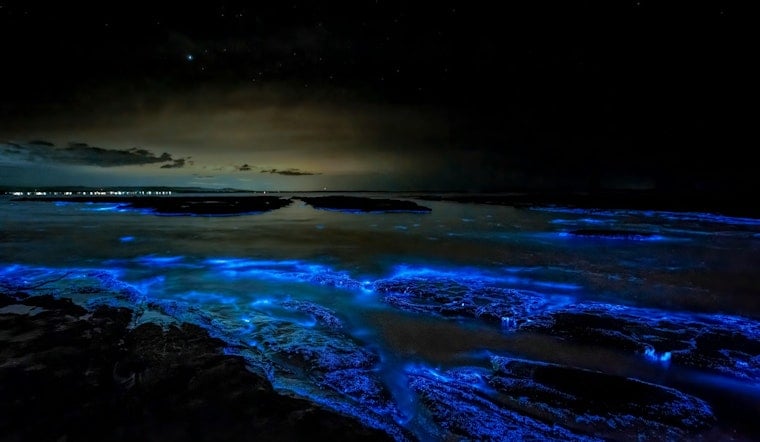
North Carolina's coastal waters are putting on a glowing show this summer, as microscopic phytoplankton light up electric blue whenever the water gets disturbed. The best place to see it isn't the open ocean but the calmer sound side of the Outer Banks, where kayakers paddling at dusk can watch their oars trail streaks of blue-green light across the water.
The phenomenon is called bioluminescence, and it happens as phytoplankton light up while they photosynthesize, according to a report from the Charlotte Observer. Eli Wisden, who owns Outer Banks Kayak Adventures in Kill Devil Hills, told the paper that the glow is most visible in the sound when wind blows from the southwest, and that it can be spotted throughout the summer months. He recommends paddlers start their trips at dusk so their eyes have time to adjust to the dark before the light show begins.
Spotting the glow requires total darkness away from ambient light, per the Charlotte Observer's reporting, which is part of why sound-side paddling routes tend to outperform beachfront viewing. Phytoplankton build up in pockets reached after paddling out at dusk, and observers can see a literal glow and glitter in the water with the naked eye once conditions align. The display is usually blue or green, though it has been documented in other colors as well.
The Chemistry Behind the Glow
The light comes from a chemical reaction inside dinoflagellates, the microscopic plankton behind most marine bioluminescence. When a wave breaks, a boat passes, or a kayak paddle stirs the water, that mechanical agitation triggers a reaction between a light-emitting compound called luciferin and an enzyme called luciferase, according to the American Chemical Society. Marine biologists believe the glow evolved as a kind of burglar alarm, startling would-be predators or drawing the attention of bigger predators that might eat whatever is bothering the plankton in the first place, the group notes.
Even so, North Carolina's coastal bioluminescence is less dramatic than the displays found in Costa Rica or Florida, per the Observer's report. Coastal viewing conditions depend on a mix of factors, including dark skies, low light pollution, southwest winds, warm water, and enough physical agitation to trigger the glow, according to NC Sea Grant. Ocean wave bioluminescence can also occur, but only sporadically, when plankton blooms wash ashore, the same publication notes — a rarer sight than the more dependable soundside glow that guided kayak tours are built around.
Where the Water Glows Brightest
One of the more striking documented ocean-side sightings came from photographer Wes Snyder, who captured glowing waves at Coquina Beach inside Cape Hatteras National Seashore after plankton swept north produced vivid blue displays, according to NC Sea Grant. Those kinds of oceanfront shows remain unpredictable compared to the reliable sound-side paddling spots that outfitters like Outer Banks Kayak Adventures build their nighttime tours around from mid-May through mid-September, navigating dark waters in Pamlico Sound and Roanoke Sound, per a report from OuterBanks.org.
Other regional outfitters have gotten in on the trend too. Kitty Hawk Kites also runs guided nighttime bioluminescence kayak excursions through North Carolina's coastal estuaries, according to Atlantic Destinations, a sign that nighttime paddling for glowing plankton has grown into a broader eco-tourism draw along the coast rather than a niche offering from a single company.
Dark Skies Make the Difference
Part of what makes the Outer Banks such a strong bet for these sightings is the region's protected darkness. Cape Lookout National Seashore earned certification as an International Dark Sky Park in December 2021, becoming the first Atlantic coastal Dark Sky Place in the entire National Park System, according to the National Park Service. That near-total darkness is exactly the kind of condition needed to pick out a faint glow in the water, and it's part of why the agency considers the stretch one of the premier East Coast locations for both night-sky viewing and natural light displays.
Bioluminescence in the ocean isn't limited to what happens at the surface, either. Oceanographers estimate that roughly 80 percent of marine animals living in the ocean's twilight and deep zones, between 200 and 1,000 meters down, produce their own bioluminescence, according to Outer Banks Coastal Life. Surface-level displays that beachgoers and paddlers can actually see, though, depend specifically on shallow dinoflagellate blooms close to shore.
Glowing Bugs Add a Mountain Counterpart
North Carolina isn't only a coastal story when it comes to natural light shows. The state is also home to synchronous fireflies, another bioluminescent species that lights up on land, according to the Charlotte Observer's reporting. In western North Carolina, Grandfather Mountain hosts Grandfather Glows events each summer, where naturalists guide visitors to watch synchronous fireflies, one of ten distinct luminous insect species found on the mountain, per the Grandfather Mountain Stewardship Foundation.
Synchronous fireflies also appear naturally in the Joyce Kilmer Memorial Forest within Nantahala National Forest in Graham County, giving visitors a public viewing spot that doesn't require entering a national park lottery, according to Graham County Travel. The mountains carry another glowing species too: the Blue Ghost firefly, a tiny insect measuring just 0.2 to 0.4 inches that emits a steady bluish-green glow lasting up to 15 seconds, rather than flashing in pulses like its synchronous cousins, per the Grandfather Mountain Stewardship Foundation.





