

























































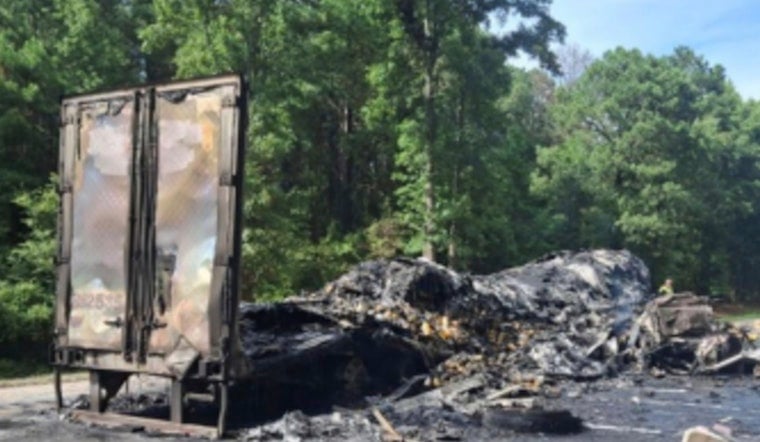
Five people died in a chain-reaction crash on northbound I-95 near Kenly in Wilson County on July 24, 2024, after a Freightliner tractor-trailer hauling orange juice failed to slow down for traffic backed up ahead of a highway work zone. A newly released federal investigation determined that driver inattention and a failure to respond to the visibly slow-moving vehicles ahead caused the crash. Truck driver Charles Haskell, 51, was traveling about 70 mph when he struck a nearly stopped Chevrolet Tahoe, triggering a pileup that ultimately involved five vehicles.
The National Transportation Safety Board's final report, detailed by The News & Observer, found that the wreck occurred in clear weather on a dry road during daylight hours, ruling out road conditions as a factor. After hitting the Tahoe, Haskell's rig also struck a Toyota RAV4 and two other tractor-trailers before finally coming to rest 332 feet past the point of the initial impact.
The crash killed Martha Warren Davis, 69; Linda Warren Whitehurst, 80, of Robersonville; Elizabeth Sharon Tucker, 66; William Carroll Tucker, 72; and Edward Carroll Davis, 68, of Greenville, according to the newspaper's report. The Tuckers lived in Hephzibah, Georgia, and all three truck drivers involved in the pileup escaped with only minor injuries.
NTSB Points to Driver Inattention, Rules Out Distraction
Investigators could not determine the exact reason Haskell failed to react to the slowing traffic, and they found insufficient evidence to blame cellphone distraction, according to the National Transportation Safety Board's final report, HIR-26-05. Haskell had two phones in the truck and had made or received hundreds of texts and calls in the days before the crash. He received a text from an unknown number at 1:21 p.m., and less than a minute later his phone placed a real-time text call to an out-of-service number with a 252 area code, a call that happened almost simultaneously with a call to 911. The NTSB said those calls were likely triggered automatically by Apple's crash-detection feature after the collision, not by deliberate use.
Haskell held a valid license and medical certificate and was considered an experienced driver, per the report. He refused to speak with federal investigators, and drug and alcohol tests administered afterward came back negative. Records show Haskell could have slept nearly nine hours before resuming his drive at 10:14 a.m. that morning, bound for Jersey City, New Jersey, after parking overnight in Florence, South Carolina.
Chain-Reaction Crash in a Congested Work Zone
Haskell stopped at a Flying J Travel Center in Kenly for 35 minutes, buying 95 gallons of diesel, before resuming his drive at 1:13 p.m. Nine minutes later, at 1:22 p.m., he rear-ended the Tahoe as it and other vehicles crawled at about 7 mph in traffic that had slowed ahead of a lane closure, the report found. The Tahoe's brake lights had been on for at least five seconds before impact.
The lane closure began about 1.7 miles from the crash site, marked by an electronic sign warning drivers to merge right, while N.C. Department of Transportation contractors cleared trees and spread mulch in the median. NCDOT work zone rules call for an additional electronic sign roughly four miles ahead of that first warning. The crash shut down all northbound lanes of I-95 near mile marker 113 for more than eight hours while state troopers and emergency crews conducted rescue operations, an investigation, and debris removal, according to WRAL-TV.
Misdemeanor Charges Still Pending in Wilson County
Haskell was charged with five counts of misdemeanor death by vehicle and failure to reduce speed, and his criminal case remains pending in Wilson County District Court, the newspaper's report says. Under North Carolina General Statute 20-141.4(a2), misdemeanor death by vehicle is a Class A1 misdemeanor punishable by up to 150 days in jail per count, according to Fanney Law Office, and a conviction carries a mandatory 12-month license revocation with no eligibility for a limited driving privilege.
A separate post-crash compliance review by the Federal Motor Carrier Safety Administration cited Haskell for multiple hours-of-service violations, including exceeding the federal 70-hour driving limit and submitting false duty-status logs, per the federal investigation. Haskell was hauling the orange juice for carrier Leonard's Express, Inc., under a contract with Double J Transport, LLC, records show. The truck itself was found to be in good condition and up to date on maintenance, though Haskell's prepaid cellphone was destroyed when the rig caught fire.
Work Zones Emerge as a National Flashpoint
The National Transportation Safety Board has called work zones high-risk areas and renewed its support for requiring collision-warning systems and driver-monitoring technology that can flag risky behavior and give drivers instant feedback in commercial vehicles. Nationally, commercial motor vehicles are involved in about 30% of all fatal work zone crashes, according to Federal Highway Administration data reported by Connect NCDOT.
In North Carolina, 217 people were killed in nearly 40,000 work zone crashes between 2019 and 2024, including 47 deaths in 2024 alone, per ATSSA. Nationwide, work zone crashes killed 850 people in 2024, a 45% increase in annual fatalities since 2010, according to the National Safety Council.
Federal Regulators Weigh Automatic Braking Mandates
Regulators have moved faster on passenger vehicles than on heavy trucks. The National Highway Traffic Safety Administration finalized a rule in April 2024 requiring automatic emergency braking on light passenger vehicles by 2029, but a joint proposal with the Federal Motor Carrier Safety Administration to mandate similar braking and forward collision warning on commercial trucks over 10,000 pounds remains pending, according to NHTSA.
The Kenly wreck echoes a similarly deadly work zone crash in Virginia, where a bus traveling from New York to Charlotte struck slowed traffic ahead of an I-95 work zone on May 29, killing five people, including a family of four from Massachusetts, per the newspaper's report. Whether federal regulators will move forward with mandatory automatic emergency braking for heavy trucks remains unresolved, even as the NTSB has long advocated for the technology as a way to prevent similar rear-end crashes in work zones.





