

























































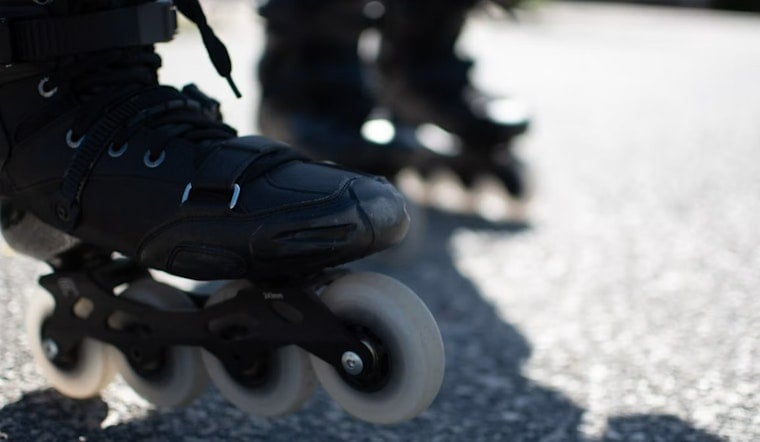
A disco ball now spins where cough syrup and greeting cards once sat. Rock and Roll Roller Rink debuted last month inside the former Bartell Drugs at 5700 E. Lake Sammamish Parkway S.E. in Issaquah, becoming the first brick-and-mortar roller rink to open on the Eastside in decades.
The nonprofit rink signed a short-term lease for the 16,366-square-foot standalone building, according to the Daily Journal of Commerce. The space had sat empty since Bartell Drugs, founded in Seattle in 1890, was folded into Rite Aid's collapse; Rite Aid acquired the chain for $95 million in 2020 before Chapter 11 bankruptcies in 2023 and 2025 forced dozens of store closures across Washington, according to Axios Seattle. As reported by The Seattle Times, the rink's landlord gave the nonprofit one year to prove it can sustain full operations before deciding on the property's future.
That timeline matters because the Eastside has gone without a dedicated indoor rink since Bellevue's Skate King closed in 2015 after 36 years in business, per the City of Bellevue. The Seattle Times reports the gap left a roughly 40-mile stretch between roller rinks, pushing Eastside skaters toward El Centro Skate Rink in Federal Way, Lynnwood Bowl and Skate, or Southgate Roller Rink and Arcade in Seattle — all at least a 30-minute drive from Issaquah.
From Pickering Barn Pop-Ups to a Permanent Address
Rock and Roll Roller Rink didn't just materialize inside a former pharmacy. The organization began as a monthly pop-up rink and built its following at Issaquah's city-owned Pickering Barn, receiving city approval in 2025 to host monthly sessions at the venue, according to the Seattle Times reporting. Those pop-ups, held at the historic event site at 1730 10th Ave NW across from Costco, sometimes drew more than 400 people in a single night, per Visit Issaquah.
Co-founder Ayla Web has skated since age 5 and worked at Bellevue's Skate King starting at age 16, ultimately spending nearly a decade there before it closed. Web, whose husband Spencer Web now volunteers at the rink, has said the new venue brings people together and provides healthy exercise. Co-founders Irene Pasternack and Ed Mills, meanwhile, came to skating later in life — both learned at age 44 through Skate Journeys, a regional skate school that instructs roughly 4,000 students annually across the Pacific Northwest. Pasternack and Mills later became certified Feldenkrais Practitioners after applying movement principles picked up from skating.
What a Day at the Rink Looks Like
The rink is open six days a week, closed only on Mondays, with daily attendance ranging anywhere from 10 people to dozens depending on the day, per the Seattle Times. All-ages open skates run Tuesday and Thursday from 4 to 8 p.m., Wednesday and Sunday from 1 to 5 p.m., and Friday and Saturday from 1 to 5 p.m. and 6 to 9 p.m., with an age-13-and-up session added Wednesday and Sunday evenings from 7 to 10 p.m. Hours are expected to shift again starting in September.
Tickets run $20 for individual skaters, $17.50 for groups of two, and $15 per person for groups of three or more, while visitors who only watch pay nothing. Every skater must sign a waiver before lacing up. The building sits on a linoleum tile floor over concrete, and the Greater Issaquah Chamber of Commerce notes the on-site rental inventory spans toddler size 7 through men's size 16 — though skaters bringing their own gear are advised that indoor/outdoor wheels perform best on that tile surface.
Ed Mills, a founder and the rink's treasurer, has helped raise funds and explore partnerships with Eastside cities and King County. The rink already offers daily skating sessions, monthly passes, summer camps, group-event hosting, themed nights and free DJ lessons, and it is eligible to offer community service hours. Volunteers currently include Spencer Web and Cliff Alcordo, and organizers plan to add more through a King County job training program designed to give participants job experience.
Regional Skating in Decline, But Not Gone
The Issaquah opening bucks a broader national trend. The Roller Skating Association International counted roughly 2,900 operational rinks nationwide in 2026, reflecting decades of decline driven by rising real estate values and insurance costs, according to Dataintelo. Closer to home, Tacoma's Skateworld closed in 2024, Auburn Skate Connection shut down in 2020, Everett Skate Deck closed in 2022, and Bremerton's Skateland closed in 2019 — a string of closures the Seattle Times ties to the same commercial pressures. Moderate roller skating can burn up to 600 calories an hour, and that fitness pitch has helped drive a post-2020 resurgence among health-conscious skaters, per the Roller Skating Association International's own research.
Rock and Roll Roller Rink is funded through donations and ticket sales rather than a traditional for-profit model, and it caps capacity at 230 people. Organizers say they expect groups of 80 to 100 once school resumes and cooler weather sets in. Regulars already include Matthew Flora, a monthly pass holder and speedskater who typically skates at El Centro Skate Rink, a nod to a region the Seattle Times notes was once a dominant force in indoor inline speed skating.
Betting on Permanence in a Shifting Commercial Corridor
The rink isn't the only new tenant reimagining Issaquah's empty retail boxes. Regional grocer Uwajimaya signed a lease in 2026 to open a market in a former Rite Aid on Gilman Boulevard by 2027, a move Hoodline previously reported, illustrating how landlords across King County are turning vacant pharmacy footprints into active community destinations. Issaquah's broader real estate picture has been in flux this year, too — the city paused a proposed $58 million City Hall project to weigh cheaper renovation and lease alternatives, even as private commercial reuses like the rink moved forward nearby.
For now, Rock and Roll Roller Rink's long-term future hinges on that one-year window its landlord set. Organizers plan to eventually purchase their current building or another property outright, converting it into a protected nonprofit asset rather than remaining at the mercy of a lease. Whether admissions, donations, and community turnout can carry the rink that far remains the open question hanging over the disco ball.




