

























































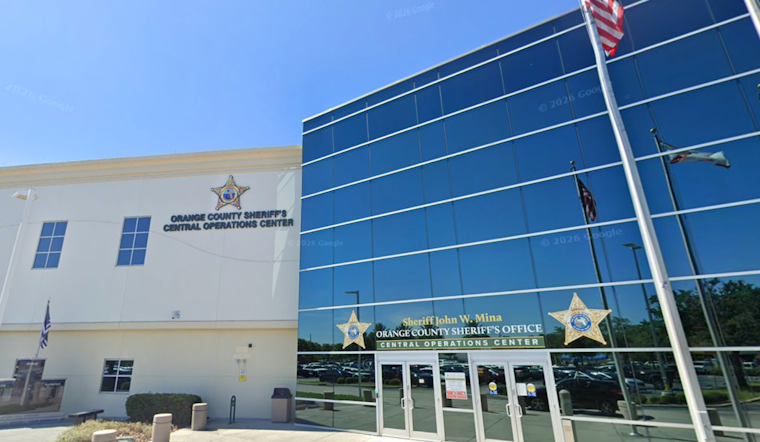
David Grassi was sitting in his patrol vehicle on Interstate 4 south of downtown Orlando, protecting a construction zone, when Neil Demetree slammed into him at 87 mph on December 11, 2021. Nearly five years later, Demetree still hasn't gone to trial, and new competency questions raised by his defense team could push any resolution even further into the future.
Grassi, who served as an Orange County Sheriff's Office Field Service Officer, was monitoring a lane closure for I-4 Express construction near the Kaley Street exit around 2:30 a.m. when Demetree's vehicle struck his patrol car under 100 percent acceleration, according to the crash report cited by WFTV. Investigators say Demetree slammed into Grassi's patrol vehicle that night, and Orlando police body-camera footage showed Demetree admitting he had been drinking — three beers at Rachel's, a local strip club — before the crash. Officers on scene did not arrest him; instead, they discussed helping him get home, and ultimately helped him call a ride.
A Slow Path From DUI Investigation to Formal Charges
Demetree was initially investigated for DUI manslaughter, but the State Attorney's Office didn't formally file charges until eight months later, in July 2022, ultimately charging him with vehicular homicide rather than DUI manslaughter. He entered a written not-guilty plea in January 2024. He now faces up to 30 years in prison if convicted.
The distinction between the two charges matters under Florida law. Vehicular homicide, under Florida Statute § 782.071, is a second-degree felony requiring prosecutors to prove reckless driving likely to cause death or great bodily harm, punishable by up to 15 years in prison, according to the Brancato Law Firm. DUI manslaughter, by contrast, requires proving impairment and carries a mandatory minimum sentence of four years. The case against Demetree has been delayed for years, and the vehicular homicide charge alone could expose him to double the prison time cited above if he faces two counts, per the case's charging structure.
Competency Questions Center on Undiagnosed Autism
Demetree's family paid for an extensive psychiatric evaluation, conducted in Texas, that cost approximately $15,000. Dr. Charles Nemeroff, who is affiliated with the University of Texas at Austin, evaluated Demetree and testified about his diagnosis and ability to participate in the criminal justice process. Nemeroff said Demetree's autism may have gone undiagnosed for much of his life, attributing masked symptoms to profound ADHD.
Nemeroff said the combination of autism and borderline intellectual impairment raises the question of whether Demetree can engage in an adversarial legal process at all. Demetree's attorneys have argued that his condition may prevent him from meaningfully participating in his own defense, while defense filings from attorney Brian Hagner's motion stated there were reasonable grounds to believe Demetree has autism and may be incompetent to proceed. The court must now determine whether Demetree is legally competent to proceed with the criminal case at all.
Under Florida Statute § 916.12, a defendant is legally incompetent to proceed if they lack the present ability to consult with counsel with rational understanding, and state rules require evaluations by no fewer than two court-appointed mental health experts before a court can rule, according to the Florida Senate. Complicating matters further, the defense has now filed a motion questioning whether the prosecution's own psychologist was qualified to evaluate Demetree in the first place — meaning the court could have to resolve the state evaluator's qualifications before it can even rule on competency itself. A hearing on the matter is expected to continue later this month.
A Widow Still Waiting for Accountability
Nancy Grassi, David Grassi's widow and herself a longtime Orange County Sheriff's Office Emergency Communications Specialist since 2007, said she was flabbergasted that the case had not reached trial. She told the station there must be consequences for her husband's death, and said there should be repercussions regardless of whether Demetree ends up in a mental institution rather than prison. Grassi said the case had left her waiting for accountability, and she questioned how Demetree's mental state should ultimately factor into what happens next.
Demetree, for his part, has expressed regret about the crash. Asked at one point whether he felt remorse, he responded, “Oh yes, yes.”
A Career of Public Service Cut Short
David Grassi served nearly 19 years with the Orange County Sheriff's Office, beginning in 2003 as a 911 emergency communications operator before transitioning in 2008 to a civilian Field Service Officer role handling traffic direction, accident scenes, and non-emergency calls, according to the Florida Sheriffs Association. Posthumously, he was named the 2022 Civilian of the Year by both Orange County Sheriff John Mina and the Florida Sheriffs Association, with Mina noting that Grassi's actions that night saved the lives of several road construction workers.
The crash that killed Grassi is part of a broader, grim pattern on Central Florida's roads. Florida recorded more than 16,000 work zone crashes resulting in 74 fatalities in 2023, with Orange County consistently ranking among the top ten counties statewide for active construction zone incidents, per Florida Department of Transportation data cited by the Attorney Strial Group. Federal traffic safety data has also identified the 132-mile I-4 corridor as one of the deadliest highways in the country, averaging roughly 34 fatal crashes per 100 miles due to high speeds, congestion, and near-constant road construction, according to Samaroo Law.
For now, whether Demetree ever stands trial remains an open question tied up in dueling expert evaluations and unresolved procedural disputes over who is qualified to judge his mental state. Channel 9 has said it will continue following the case as the competency hearing resumes.





