

























































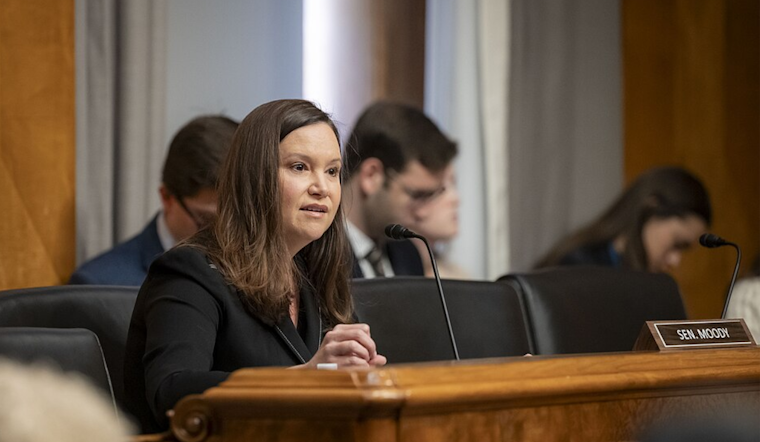
Orlando Democrats gathered downtown this week to accuse U.S. Sen. Ashley Moody of abandoning Floridians on healthcare, pointing to her vote for Medicaid cuts, her opposition to extending Affordable Care Act subsidies, and her financial stake in a major pharmaceutical company. Speakers described rising insurance premiums, fears about losing Medicaid coverage, and a call for the senator to treat constituents with more compassion.
The press conference, organized by Orlando Democrats, featured Orange County residents sharing personal accounts of navigating Florida's healthcare system under financial strain, according to Orlando Weekly. Tess O'Hara, an Orlando resident who has multiple sclerosis and relies on medication and specialized treatment, said Moody voted to kick millions of Floridians, including people with chronic illness, off Medicaid. O'Hara added that Floridians are struggling with high premiums and sacrificing necessities just to afford basic health care.
A Medicaid Vote With Sweeping Consequences
Moody voted for major Medicaid cuts under the One Big Beautiful Bill Act, the sweeping 2025 budget reconciliation law that, per the cited analysis in the Orlando Weekly report, will cut roughly $1 trillion in Medicaid funding nationally over the next decade. The law also introduced federal Medicaid work reporting requirements set to begin in 2027 and shortened redetermination periods for expansion enrollees from twelve months to six months, according to Healthinsurance.org.
Florida's healthcare stakes are unusually high. The state led the nation in Affordable Care Act marketplace enrollment for the 2026 plan year, with more than 4.53 million residents selecting coverage through HealthCare.gov, per the Centers for Medicare & Medicaid Services. Florida also remains one of ten states that has not expanded Medicaid under the ACA, leaving an estimated 800,000 to 1.1 million low-income residents in a coverage gap without access to either Medicaid or marketplace subsidies, according to KFF.
Premiums, Subsidies, and a Senator's Vote
Susan Windmiller, an Orange County Democrat and Medicare recipient, told the gathering she is experiencing health insurance premium increases and said Florida needs real Senate representation rather than a rubber stamp for special interests. Moody voted to end health insurance subsidies that had made Affordable Care Act plans more affordable for middle- and low-income earners, the Orlando Weekly report states. That vote came in December 2025, when Moody joined 47 other Senate Republicans in declining to take up a bill extending the enhanced ACA subsidies for three years, according to Florida Politics.
The same outlet reported that a Republican polling firm found 73 percent of registered Florida voters supported extending the federal tax credits and subsidies, suggesting the issue carries support well beyond Democratic voters. Windmiller urged Moody to emulate Dolly Parton's kindness, saying the senator should lead with kindness toward Floridians, seniors, and people needing health care — a reference tied to the death of the country music icon in Nashville at age 80, announced the day before the Orlando press conference.
Moody's Long Record on the Health Law
Moody's opposition to the Affordable Care Act predates her Senate tenure. As Florida Attorney General from 2019 to 2025, she kept the state as a plaintiff in the multi-state "California v. Texas" lawsuit seeking to overturn the entire law, a case the U.S. Supreme Court ultimately rejected in a 7-2 decision in June 2021, according to the Florida Policy Institute. Before that, Moody became the youngest judge in Florida when she was elected to Hillsborough County's Thirteenth Judicial Circuit in 2006 at age 31.
Gov. Ron DeSantis appointed Moody to the U.S. Senate at the end of January 2025 to fill the vacancy left when Marco Rubio resigned to become Secretary of State, a move Hoodline covered in this January 2025 report. Since taking office, Moody has also advocated for reauthorizing the Older Americans Act and secured nearly $500 million in FEMA funds for Florida recovery projects, according to Hoodline's earlier coverage.
Pharmaceutical Investments Draw Scrutiny
Speakers also raised Moody's financial holdings, noting she has investments in pharmaceutical companies, including a six-figure investment in Eli Lilly. Moody's office told CNN that the senator never approved or initiated a stock trade, and has said she has not traded stocks since April 2025. Her office also said a family investment partnership made investment decisions independently with a third-party financial adviser, according to the Orlando Weekly report.
Moody has introduced legislation aimed at restoring trust in Congress and addressing individual-stock trading by lawmakers. She also hosted U.S. Health and Human Services Secretary Robert Kennedy Jr. in Tampa, where the two discussed school nutrition. Moody's office did not provide a response to Wednesday's criticisms before the Orlando Weekly report published.
The November Matchup
Moody, a Republican, is running against Democratic Senate nominee Angie Nixon in the November 3 general election. Nixon, a former union organizer from Jacksonville who has served in the Florida House since 2020, upset establishment-backed candidate Alexander Vindman in the August 18 Democratic primary, according to the Wikipedia entry on the special election. Nixon has drawn national attention before: Hoodline reported in May that she was arrested at a Capitol sit-in after a five-hour protest outside Gov. DeSantis's office over housing costs and state leadership.
Nixon supports free, universal healthcare through Medicare for All and holding drug companies accountable to the American people, and has been endorsed by Sens. Bernie Sanders and Elizabeth Warren. She faces a steep structural climb: Florida has more than 1.5 million more registered Republicans than Democrats, and Democrats have not won a U.S. Senate race in the state since 2012. Independent and no-party-affiliation voters make up nearly a quarter of Florida's registered electorate, a bloc both campaigns will be courting as healthcare affordability becomes a defining issue heading into the fall.




.jpg)