

























































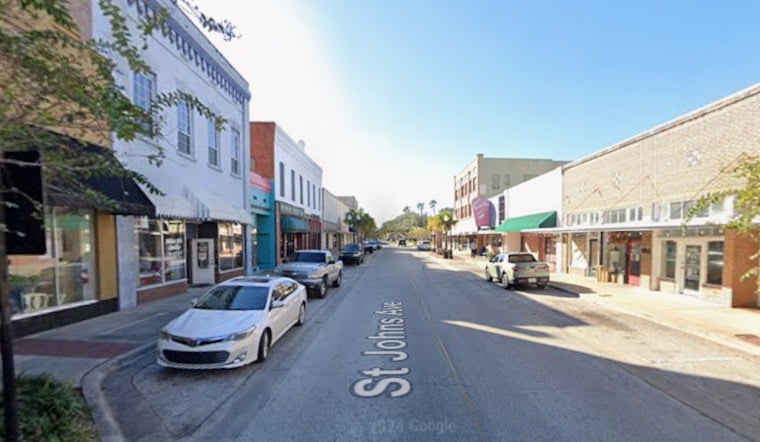
A man working on a rooftop in downtown Palatka passed out Thursday afternoon as heat indices across the region soared past 106 degrees, prompting firefighters and EMTs to scale the building on a fire truck ladder and carry him down to the ground. Rescue vehicles arrived at 305 St. Johns Ave. shortly before 2:40 p.m. after someone called 911, and crews lowered the unconscious patient to the ground at 3:22 p.m., roughly 40 minutes later.
The patient, described as a white man who appeared to be in his 30s to mid-40s, was wearing an oxygen mask as rescue workers brought him down, according to the Palatka Daily News. The Palatka Fire Department and Putnam County Fire Rescue both responded to the medical emergency, with rescue workers ascending the fire truck ladder to begin providing immediate care before lowering the patient using a gurney, backboard, harnesses and other equipment prepared at the scene. He was then transported to a hospital by ambulance, though his condition afterward was not known, and the cause of his medical emergency also remains unclear.
A co-worker on the roof told the outlet he saw the man passed out and reported that the roofing crew planned to stop working for the afternoon and return later once temperatures cooled. Rescue vehicles blocked traffic along St. Johns Avenue between Third and Fourth streets for the duration of the response, according to witnesses cited by the same report. The address sits at 305 St. Johns Ave., home to Miss D's Quilt Shop along Palatka's historic downtown commercial corridor, per Better Business Bureau records.
A Dangerously Hot Afternoon Across North Florida
The rescue unfolded during an active Heat Advisory that the National Weather Service in Jacksonville had in effect for Putnam County, including Palatka, from 11 a.m. to 8 p.m. Thursday, with peak heat index values forecast between 106°F and 110°F. The advisory was part of a broader pattern, as the Florida Division of Emergency Management had issued a statewide bulletin the same day warning that dangerous heat and humidity would persist across Florida for five days under building high pressure, placing much of North Florida under active advisories.
Conditions on the rooftop itself would have been even more extreme than the ambient forecast suggested. Research compiled by The Roofing Brief shows dark roofing surfaces absorb radiant solar energy and can run 50°F to 70°F hotter than the surrounding air, meaning rooftop work environments can exceed 140°F even on a 90-degree day. That kind of heat, re-radiating continuously off dark asphalt and membrane materials during peak afternoon hours, turns an already brutal day into an extreme microclimate for anyone working above ground level.
Roofing Ranks Among the Deadliest Trades in Extreme Heat
Federal heat safety guidance requires employers to provide mandatory 15-minute rest breaks every two hours and to closely monitor outdoor workers once the heat index crosses the 90°F high-heat trigger threshold, according to enforcement standards outlined by Safety By Design. Whether the roofing crew on St. Johns Avenue was following those acclimatization and break protocols has not been reported.
The stakes of that question are significant. A study published in the American Journal of Industrial Medicine, cited by the same Roofing Brief research, found roofers face a heat-related death risk index of 6.93 — nearly seven times higher than the average construction worker. Separately, federal data analyzed by the CDC shows construction workers make up roughly 6 percent of the U.S. workforce but accounted for 36 percent of all occupational heat-related deaths nationwide between 1992 and 2016.
The U.S. Bureau of Labor Statistics' Census of Fatal Occupational Injuries recorded a fatal injury rate of 51.8 deaths per 100,000 full-time roofing workers in 2023, making it one of the most hazardous trades in the country; falls remain the leading fatal hazard, though heat exhaustion can trigger the dizziness and loss of consciousness that lead to falls in the first place. Federal enforcement data compiled by Clemson University also found that 74% of workplace heat fatalities occur during a worker's first three days on a job, with 35% happening on the very first day, due to a lack of heat acclimatization.
Open Questions Remain
It is not yet known whether the Palatka worker's collapse was heat-related, and his condition following hospitalization has not been disclosed. Federal OSHA regulations require employers to formally report any work-related inpatient hospitalization to the agency within 24 hours of learning about it, but whether such a report was filed in this case is unknown.





