

























































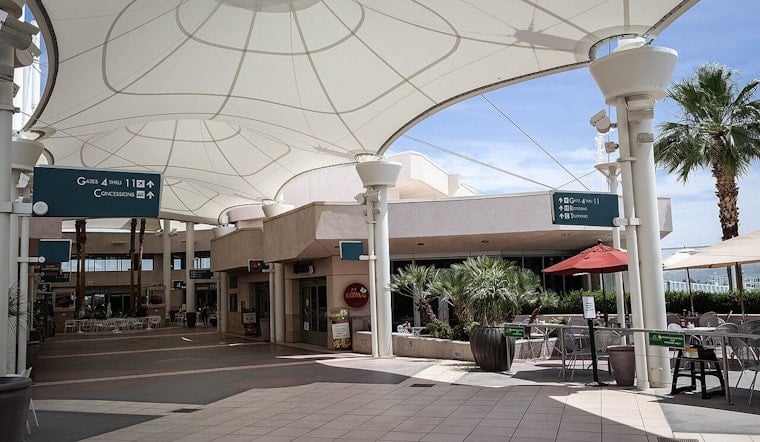
Palm Springs International Airport is bracing for a busy fall and winter travel season, with several seasonal nonstop routes set to return in the coming weeks and a major electric vehicle charging upgrade underway in Lot B. The airport has welcomed more than 2 million passengers so far this year, and officials are moving to keep that momentum going as cooler months approach.
Among the headline additions is Alaska Airlines’ seasonal nonstop service to Santa Rosa, which resumes September 10, as reported by KESQ. The route will operate five days a week on 76-seat Embraer 175 aircraft through April 25, 2027.
Santa Rosa isn't the only route making a comeback. Seasonal nonstop flights are also returning to Austin, Houston, Boise, and Minneapolis, giving Coachella Valley travelers a wider menu of direct connections as the desert's high season ramps up.
New EV Chargers Join Escalator Upgrades
On the infrastructure side, the airport is installing 80 new electric vehicle charging ports in parking Lot B, a project completed in partnership with Southern California Edison. According to EVinfo.net, the buildout — comprising 39 dual-port pedestals and two single-port pedestals — creates the third-largest airport EV charging array in Southern California, trailing only LAX and San Diego. The $400,000 project was funded entirely through airport revenues rather than local tax dollars, the outlet reported.
The airport is also replacing the Bono Concourse escalators, part of a broader push to modernize passenger amenities even as long-term construction looms. Together, the projects reflect the airport’s broader modernization effort.
A Record Year, Then a Slight Cooldown
These upgrades follow a record-breaking 2025 for the airport, which served an all-time high of 3.31 million travelers — a 2.4% increase over 2024 — and reached its busiest month ever in March 2025 with about 500,000 passengers.
Passenger traffic at the airport has also been discussed in recent reporting.
Notably, PSP still handled about 3,800 fewer commercial flights in 2025 than in pre-pandemic years, according to Patch. Airlines have offset that gap by shifting to larger, quieter, more fuel-efficient mainline aircraft that carry more travelers per flight.
A $2.2 Billion Plan for the Long Haul
The near-term upgrades are early pieces of a much bigger picture. In January 2025, the Palm Springs City Council approved a 20-year, $2.2 billion Airport Master Plan aimed at nearly doubling annual passenger capacity to 6.4 million by 2042, according to CalMatters. The plan calls for expanding terminal gates from 18 to 32 — a significant jump from the original central terminal, which was built to handle roughly 1.5 million passengers annually.
That growth is tied to the Coachella Valley's tourism economy, which CalMatters estimates generates around $9 billion annually across hotel occupancy, conventions, dining, and short-term rentals. The outlet also noted that Palm Springs' resident population grew 5% between 2021 and 2024, adding to local demand for air travel.
Any expansion will have to work around the terminal’s architectural legacy. The terminal’s architecture is to be preserved, and it is listed in the National Register of Historic Places.
The master plan also includes construction of a Federal Inspection Station to handle U.S. Customs and Border Protection clearance on-site, which would let PSP pursue new international routes beyond its current Canadian service. CalMatters reported that nonstop flights between Canada and Palm Springs currently rely on pre-clearance facilities located at the Canadian airports of origin, since PSP lacks that on-site clearance capability today.
Airport Leadership and Recent Growth
The airport’s recent record year was announced while Harry Barrett Jr. was executive director.
The airport’s push for smoother, more modern travel comes as seasonal flights and infrastructure upgrades roll out this fall. Officials appear focused on positioning the airport for steady growth without losing the mid-century character that has long set it apart.




