

























































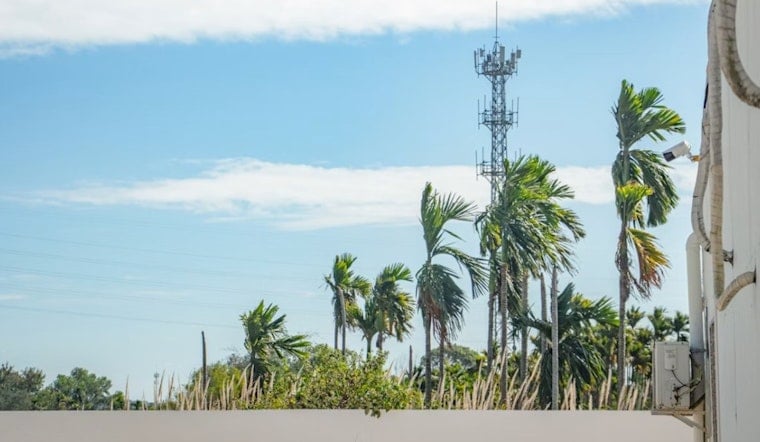
A cell tower disguised as a palm tree is going up in the middle of a Papaikou neighborhood, and the families living beside it say they had no idea it was coming until construction crews showed up earlier this year. The roughly 60-foot Verizon structure is planned on Olson Trust land squeezed between the Papaikou post office, Pat & Co. and a nearby household, and neighbors are now exploring legal options to stop it even as county officials say the project is on solid legal footing.
Patrick Ferreira, whose family has lived on its Papaikou property for three generations, is among those leading the opposition, according to the Honolulu Star-Advertiser. Ferreira said the community was never notified by the Olson Trust, Verizon or Hawaii County before the project moved forward, per the same report. He also noted that canceling the Verizon contract would cost money, a financial reality that has shaped how far the Olson Trust says it can go to fight the plan it now leases to the carrier.
Why the Standard 600-Foot Buffer Doesn't Apply Here
The timing is central to the dispute. The Olson Trust signed its contract with Verizon in 2018, and the Hawaii County Planning Department approved the tower plans in December 2024, before the county's new setback rule existed. Hawaii County didn't pass its 600-foot setback requirement, keeping new towers away from homes and schools, until June 2025, when the County Council unanimously approved Bill 24, according to the same reporting citing the planning director. Because Verizon's approvals predate that law, the planning department has determined the Papaikou project is exempt from the setback entirely.
That same 2025 ordinance also did away with mandatory contested-case public hearings for tower permits, handing approval authority directly to the Planning Director instead, according to reporting from Citizen Portal. That change, paired with the wind survivability certification requirements the county added for structural safety, explains why the planning department was not required to notify nearby residents or hold a hearing before signing off on the Papaikou build, per the planning director. The county issued the building permit for construction in June 2026, months after the underlying tower plans had already cleared review.
Residents Petition and Push for Alternatives
Papaikou resident Margaret Johnson has circulated petitions opposing the tower that have collected nearly 200 signatures, though she supports the idea of a cell tower somewhere else in the area. The Olson Trust has received a letter signed by a dozen community members laying out concerns about the project, and Sammie Stanbro Olson, a nonvoting member of the Olson Trust advisory board, said the community should have been informed about the project much sooner. The Olson Trust has urged Verizon to communicate directly with residents, but has said it cannot stop the project outright without breaching its contract with the carrier, according to attorney Paul Alston.
Community members have also worked with Hamakua council member Heather Kimball to identify alternative sites for the tower, and Kimball met directly with a Verizon representative to discuss those options. Verizon, however, said the community-proposed alternative location was not technically feasible, according to the Star-Advertiser's reporting. The carrier has said the project complies with local, state and federal laws, permitting requirements and safety guidelines, and that the tower will improve public safety services and community connectivity in the area.
Federal Law Limits What Neighbors Can Fight Over
Part of what makes this fight so difficult is baked into federal law. Under Section 332(c)(7)(B)(iv) of the Telecommunications Act of 1996, state and local governments are barred from denying wireless facility applications based on environmental or health concerns tied to radio frequency emissions, so long as the facility meets FCC regulations, according to legal analysis published on Note. That preemption is a major reason county planning officials and even the Olson Trust itself cannot legally block the tower over the property values, community character and health worries that residents have raised.
Federal case law adds another layer of protection for carriers. Wireless companies can challenge local permit denials in court if they can show a rejection would create a significant gap in coverage and that their proposed facility is the least intrusive feasible option, according to analysis from Baker Donelson. That legal backdrop underscores why Verizon rejected the community's alternative site as technically infeasible rather than negotiating further, and why the carrier currently has legal authority to proceed with the project in its current form.
A Trust Better Known for Scholarships Than Controversy
The Olson Trust has not typically been a lightning rod on Hawaii Island. Founded by the late Edmund C. Olson, who died in 2024 at age 93 after building a major self-storage company and amassing more than 15,000 acres across the state, the trust runs its headquarters out of the historic Onomea Sugar Plantation building in Papaikou, according to Ke Ola Magazine. Before the tower dispute, the trust was known largely for land conservation and agricultural stewardship, including a $200,000 scholarship program it endowed at the University of Hawaii at Hilo in September 2023, as reported by PBS Hawaiʻi. It remains one of the 20 largest private landholders in the state, and the tower site sits on land zoned commercial, where a telecommunications tower is a permitted use.
Hawaii County's setback rule stands out statewide. Oahu's telecommunications zoning only requires freestanding antenna towers to sit back from property lines a distance equal to one-fifth of the tower's height, according to Aloha State Daily. Community testifiers had originally pushed for an even larger 1,200-foot buffer before the County Council settled on the 600-foot standard, the outlet reported, making Hawaii County's rule among the most restrictive in the state even as it comes too late to help the Papaikou site.
A Neighborhood Already Stretched Thin
The construction site along Old Mamalahoa Highway now sits behind black construction fences, directly adjacent to a local auto repair shop and within steps of roughly five single-family homes, according to EMFRadar. The tight footprint is part of why residents describe the tower's proximity as impossible to ignore in daily life. Papaikou is also home to Prince Jonah Kūhiō Kalanianaʻole Elementary and Intermediate School, which hosted 130 displaced Hilo students during Haʻaheo Elementary's three-year campus expansion that wrapped up earlier this month, adding another layer of concern for families focused on children in the surrounding area.
Verizon currently leads local wireless coverage in Papaikou, with FCC and industry data showing the carrier at 96.56 percent coverage and average download speeds of 9.1 Mbps, ahead of AT&T at 94.07 percent and T-Mobile at 91.31 percent, according to network data compiled by US Mobile. Even so, residents have expressed mixed opinions about how good local signal actually is, and that disagreement has done little to settle the broader question of whether the tower belongs where it's being built. For now, Ferreira and other community members are exploring legal action to try to stop the project, though it remains unresolved whether they can find administrative or procedural grounds to challenge a permit that both the county and Verizon maintain was lawfully approved.




