

























































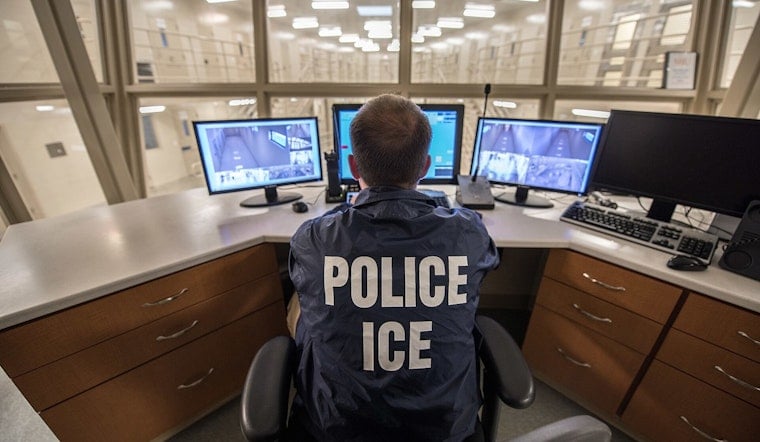
A federal appeals court based in Philadelphia has ruled that the Trump administration's practice of jailing undocumented immigrants without bond hearings, even those who have lived in the country for years while pursuing legal status, violates the Constitution and federal immigration law. The 2-1 decision from the U.S. Court of Appeals for the 3rd Circuit, issued Friday, orders bond hearings or release for two long-term U.S. residents and adds Pennsylvania, New Jersey and Delaware to the growing list of regions where the policy has been struck down.
The mandatory detention policy has been a central strategy in the administration's mass deportation campaign, and immigration arrests have surged across the region since President Trump returned to office in January 2025, according to WHYY. U.S. Immigration and Customs Enforcement enacted the no-bond directive in July 2025, marking what the outlet describes as a drastic shift in decades of government practice.
How the Government Stretched a Border Law
At the heart of the dispute is a statutory sleight of hand. Federal law contains two separate detention frameworks: 8 U.S.C. § 1225(b)(2)(A), which mandates detention without bond for “applicants for admission” encountered at the border, and 8 U.S.C. § 1226(a), which guarantees noncitizens arrested inside the U.S. interior the right to an individualized bond hearing before an immigration judge, according to legal analysis from Dvoinik Law. ICE argued that the border-detention statute also applies to noncitizens who have lived in the country's interior for years, the same claim WHYY's reporting says the 3rd Circuit panel rejected in its 2-1 ruling. The dispute directly affects nearly all undocumented immigrants living in the region, per the outlet.
Immigration attorneys responded by filing waves of habeas corpus petitions in federal courts challenging their clients' confinement, WHYY reports. Prior to Friday's appellate ruling, federal district judges across Pennsylvania and New Jersey had already been routinely granting those petitions, including in Eastern District of Pennsylvania cases such as Buele Morocho v. Jamison, ordering immediate release or bond hearings for immigrants ICE had detained without bond, according to court records from the Eastern District of Pennsylvania. Those district judges repeatedly noted that the Board of Immigration Appeals' decision in Matter of Yajure Hurtado, which had sought to expand mandatory detention, was non-binding under recent Supreme Court administrative law precedent.
A Circuit Split Eight Courts Deep
The Philadelphia court's ruling means the 3rd Circuit has joined seven other federal appeals courts in rejecting the mandatory detention policy, per WHYY's reporting. As of August 2026, eight circuits in total, the 1st, 2nd, 3rd, 6th, 7th, 9th, 10th and 11th, have rejected the administration's interior no-bond approach, while only the 5th and 8th Circuits have upheld or permitted it, according to an immigration law firm's circuit tracker. That split traces back to the Supreme Court's 2024 Loper Bright decision ending Chevron deference, which freed federal courts to independently scrutinize the executive branch's interpretation of the detention statute.
Hoodline previously covered a Trump-appointed judge's rebuke of the same policy, after the 9th Circuit ruled 2-1 in Rodriguez Vazquez v. Bostock on July 30 that interior immigrants cannot be subjected to mandatory detention under the border statute, with Judge Aaron Bress authoring that majority opinion. Weeks earlier, a unanimous 10th Circuit panel reached the identical conclusion in Santillan Quiroz v. Mullin, ruling that mandatory detention is limited strictly to border encounters and affirming bond hearing rights across six Western states. That panel warned that treating millions of interior residents as unbailable border entrants creates severe due process concerns, a point Hoodline detailed in its earlier report on the 10th Circuit's ruling.
Advocates Call the Policy Cruel; DOJ Stays Silent
Vanessa Stine of the American Civil Liberties Union of Pennsylvania said in a statement, cited by WHYY, that immigration detention was “a cruel and unnecessary practice” even before the administration's expanded detention campaign. Stine added that denying bond hearings to detained individuals conflicts with both the statute and the Constitution's due-process guarantee. The Justice Department did not immediately respond to a request for comment, per the outlet's reporting.
Federal judges across the country have ruled that immigration detainees' claims overwhelmingly favored them, WHYY notes, even as thousands of habeas corpus petitions have flooded district courts nationwide since the July 2025 directive took effect. Civil rights advocates have separately reported that 18 immigrants died in ICE custody during just the first four months of 2026, bringing total detention deaths under the administration to 49, a toll Hoodline detailed in an earlier report on detention conditions. ICE's own financial estimates put the average daily cost of detaining an adult noncitizen at $164.65, with facility bed costs facing a 5% inflationary increase as the agency expands capacity, according to the American Immigration Lawyers Association.
Next Stop: The Supreme Court
Both the Justice Department and the ACLU have now asked the U.S. Supreme Court to take up the mandatory detention question in its next term, WHYY reports. Newsweek, describing the same push, notes that government petitions in cases like Lopez-Campos v. Raycraft specifically ask the High Court to decide whether long-resident immigrants can be subjected to mandatory border detention rules, a request detailed in Newsweek's coverage of the circuit split. With eight circuits against the policy and two in favor, the geographic disparity now determines whether a detained immigrant gets a bond hearing or stays locked up, depending entirely on where they were arrested.
Until the Supreme Court acts, the current patchwork remains in force. Undocumented immigrants, including those pursuing legal status through official channels, remain the primary people targeted by the policy in the circuits that have not yet ruled against it, per WHYY's reporting.


.jpg)