

























































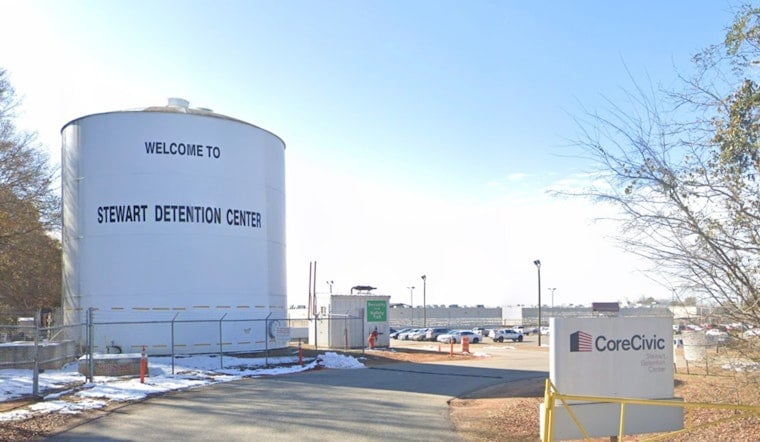
An Iranian woman held at Stewart Detention Center in Lumpkin, Georgia is fighting off deportation orders that would send her not to Iran, the country she fled, but to the Central African Republic, a nation she has never set foot in and knows no one from. Immigration and Customs Enforcement is seeking to remove her there even though she converted to Christianity in 2024 and says returning to Iran would put her life at risk because of the Iranian government's powerful security apparatus and the threat of retaliation against her family.
The case, first detailed in an ICE document shared with the Atlanta Journal-Constitution, shows the woman entered the United States in 2024 after briefly crossing the southern border. She was later detained by ICE and denied relief from removal in June 2025, according to ICE records cited in the AJC's reporting. Her attorney says she fears that being sent back to Iran would endanger her life, but instead of home, the government has set its sights on Bangui — a city she says she knows nothing about, telling the AJC she is scared because she does not know anyone there or speak the language.
She filed a federal lawsuit in Georgia on July 13, 2025, challenging the removal decision, and remains in immigration detention while she pursues legal avenues to stop it. Per the Department of Justice, an order from an Iranian judge issued in December 2025 could also block her deportation, according to the AJC's account of DOJ's position. The AJC's reporting, by immigration reporter Lautaro Grinspan, notes the Department of Justice has said a separate order allows ICE to arrange her deportation to a third country regardless.
A Widening Third-Country Deportation Pipeline
Her case is not isolated. The Trump administration has expanded its mass deportation policy to include sending thousands of immigrants without legal status to countries that are not their homelands, and the U.S. has struck deportation agreements with the Central African Republic along with Uganda, South Sudan, Sierra Leone, Ghana, the Democratic Republic of the Congo, and Cameroon, per the AJC's reporting. The Central African Republic has already received flights carrying deportees in June and July of 2025, and last year the administration also deported more than 100 Venezuelan nationals to El Salvador.
Third-country deportations emerged as a national flashpoint in March 2025, and the scale has only grown since. According to Human Rights First, the federal government forcibly transferred more than 23,000 individuals to 26 third countries between January 20, 2025, and August 15, 2026, under newly expanded agreements — part of a broader push that saw the U.S. enter third-country transfer arrangements with more than 35 nations during that span. The U.S. government has spent millions of dollars on these agreements, including an estimated $85 million in grants for individual migrant flights and $49 million for stabilization assistance, according to a U.N.-affiliated agency estimate cited by the AJC.
On June 12, 2026, U.S. authorities deported a group of 17 or 18 noncitizens — including nationals from Iran, Afghanistan, Iraq, Turkey, and Armenia — to Bangui, despite almost all of them having court-ordered protection against return to their home countries, according to Amnesty International. Human rights organizations have said the transfers violate non-refoulement principles under international law. Once those deportees arrived, they faced two weeks of mandatory detention, lacked access to essential medications, and some were hospitalized for malaria, according to reporting compiled by the Third Country Deportation Watch project citing USCRI, which also found deportees reported ongoing police harassment and were left without family or linguistic support in a country under heavy armed group influence.
A Legal Mechanism Built On Contradiction
The legal footing for these transfers rests on a Supreme Court precedent. Under 8 U.S.C. § 1231(b)(3), a grant of withholding of removal bars the U.S. from deporting someone to their country of origin, but the Supreme Court's 2021 ruling in Johnson v. Guzman Chavez affirmed that DHS retains statutory authority to send that same person to any third country willing to accept them, according to case documents referenced by Justia. Withholding of removal requires applicants to prove a greater than 50 percent likelihood of persecution, a bar the Iranian woman's legal team says she has cleared with respect to Iran specifically.```<`br>U.S. authorities themselves deem the Central African Republic unsafe for travel. The State Department's Level 4 Do Not Travel advisory, issued in January 2025, warns citizens to avoid the country entirely, noting that U.S. personnel stationed in Bangui are restricted to armored vehicles under strict curfews and that federal officials have limited ability to provide emergency services amid violent crime, armed conflict, and kidnapping. The AJC's reporting notes the country has rampant violence including homicide, terrorism, robbery, larceny, and kidnapping — the same conditions the U.S. government cites in warning its own citizens away.
A Massachusetts federal judge issued a temporary restraining order in the case D.V.D. v. DHS in March 2025, ruling that immigration authorities cannot deport noncitizens to a third country without providing advance written notice and a meaningful opportunity to claim fear of persecution or torture, according to the Center for Gender & Refugee Studies. That litigation followed internal ICE directives ordering a review of non-detained dockets for third-country removal, and the legal fight remains active in federal court even as DHS continues to assert its authority to carry out the transfers.
Scrutiny Mounts At Stewart Detention Center
The Iranian woman's detention adds to mounting pressure on Stewart Detention Center itself, Georgia's largest immigration lockup. Located in Lumpkin, the facility is operated by private prison company CoreCivic and holds an official capacity of roughly 1,750 beds, with revenue sharing from the site accounting for over half of Stewart County's annual municipal budget, according to the Global Detention Project. Hoodline has previously reported on allegations of medical neglect there, including the case of a detainee who died after a leukemia diagnosis and weeks in ICE custody, and a Cary woman's claim that neglect left her father paralyzed after a stroke.
U.S. Senator Raphael Warnock conducted an oversight visit to Stewart on Tuesday, demanding answers from ICE officials over rising 911 emergency calls, severe medical neglect, and multiple detainee deaths occurring inside or shortly after release from the facility, according to a statement from his office. Stewart has seen 15 reported detainee deaths since it opened in 2006. Nationally, advocates with Asian Americans Advancing Justice-Atlanta reported that 18 immigrants died in ICE custody during the first four months of 2026 alone, pushing the total number of detention deaths under the current administration to 49.
The facility's custody practices have also drawn judicial pushback. The 11th U.S. Circuit Court of Appeals ruled 2-1 in May that DHS's mandatory no-bond policy for interior immigration arrests was overly broad, a decision Georgia court curbs ICE no-bond rule gave detained immigrants in Georgia, Florida, and Alabama greater ability to request bond hearings. For now, the Iranian woman remains in detention while she continues pursuing every legal avenue available to stop her removal to a country she has never known.





